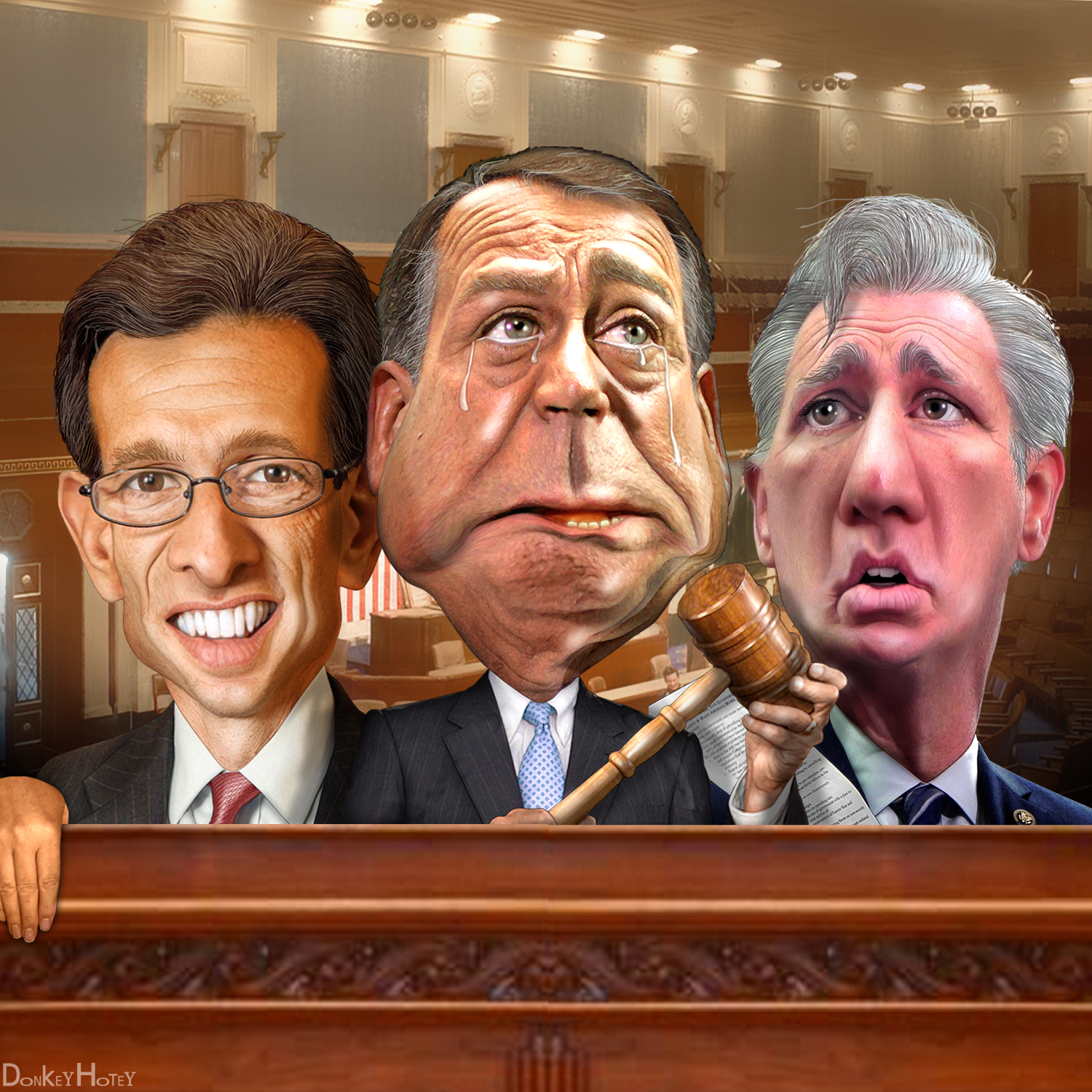
Boehner in the Middle?

White House Press Secretary Jay Carney just argued that, if the House Republicans won’t allow a default, why would they not give a longer extension of the debt ceiling, instead postponing another round of brinksmanship in 6 weeks, which—the argument goes—will merely lead to another extension, with arguably deleterious impact on the economy and financial markets.

I wanted to quickly point out that this appeal to subgame perfection—the game theoretic notion that equilibrium behavior should be based on credible threats—is intuitive, and arguably spot on…in a two player bargaining situation.  But, this is a bargaining game between (to simplify) Obama and the House Republican Conference.

Arguably, tea party members can’t—for signaling reasons similar to those described in this post—vote for along-term extension of the debt ceiling.  According to such an argument, this might be “the best that Boehner can get.”  However, there’s another story that is more interesting.  Suppose that Boehner and Obama each wish to achieve real reform, but both realize that any changes to the Affordable Care Act are a “no go.”  (That is, suppose they wish to reach “a grand bargain” on entitlements and taxes.)

Suppose they need time—like, more than 7 days—to work this out.  In order to get such a bargain approved without requiring Democratic support, Boehner has a problem without the debt ceiling as a “nuclear weapon in his back pocket.”  In particular, Boehner can use the very real (in legal terms) threat of default to bring his conference into the fold on a vote bundling the grand bargain with a debt ceiling extension.  Indeed, such a story would be a “win-win” for the GOP and Obama, who could presumably use the next couple of weeks to both take some credit for the bargaing and, arguably follow some strategy like the one I describe in this post.

The point is that the threat of breaching the debt ceiling can be useful to both Boehner and Obama in terms of keeping the rank-and-file in line on a substantive vote.  Finally, note that, to the degree that some reelection-minded members actually don’t want to default or keep the government shut down, they would also prefer a short-term extension in this case, so as to simultaneously provide electoral cover for real reform.

With that simultaneously hopeful and cynical note, I leave you with this.

Why a Clean CR is A No Boehner

Before getting into today’s post, I wanted to point out this excellent post about the discharge petition by Sarah Binder.  I was both embarrassed and relieved when I read it, because it predates and more eloquently states what I did about the practical difficulties with using the discharge petition.  Sarah knows her stuff so, as I explained to my daughter last night, I was sorry to have not read it before posting, but proud to have been thinking the same way.  (Sarah also describes the observed historical difficulty of this procedure in this post.) Credit paid where it is due, I’ll now turn away from the procedures for a second and focus on the floor.

Specifically, I was to consider the math behind the problem that Speaker John Boehner faces.  For simplicity, let’s presume Boehner that would like to move past the shutdown and would be perfectly happy with a “clean CR” that extends appropriations at the (sequestered) levels.[1] For a little over a week at least, Democrats have supported a “clean CR.” Recently, Boehner and Majority Leader Cantor have responded that such a measure would not pass the House.  Democrats have challenged them to try it, noting (somewhat disingenuously, as I’ll get to below) that, if Boehner and Cantor are right, then there’s no harm in trying. Right?


Wrong, for at least three reasons. First, many reasonably argue (e.g., David Karol) that the majority party collectively prefers to appear united, a presumption that is given some credit by the much ballyhooed “Hastert Rule.”[2]

The second reason is the one I will focus on first: uncertainty.  This explanation applies to why Boehner didn’t allow a vote on a clean CR prior to the shutdown.  In a nutshell, many members of both parties face a highly uncertain electorate in the following sense.  A vote on a clean CR represents trading-off two “goods” or, put another, choosing the lesser of two evils.  For the stereotypical “moderate” Republican, these are[3]

  1. Responsibly funding the government, or
  2. Modifying the Affordable Care Act.

A public “yea” vote on a clean CR—particularly given the presumption that the ultimate vote will be close—is a costly and visible signal that the member thinks (1) is more important than (2).  This public signal is, of course, a coarse one.  There is no nuance in a clean CR.  So, in order for a reelection-minded member to see a vote on a clean CR as desirable, he or she must know ex ante what vote he or she would like to cast.  I’ll simply assert that few members of the House are very certain about this—this is why whip counts like this one and this one are occupying our attention right now.

The third explanation for why a vote on a clean CR would be “bad for Boehner” applies only after he has taken the public stance that a clean CR would not pass.[5]  While many have argued that Boehner is in a pickle because bringing up a clean CR might lead to a revolt within the GOP and possible his removal as Speaker. I understand this argument, but I don’t think it’s nearly as potent as some others do, mostly because a replacement for Boehner must secure a majority of votes in the House.[6]  Rather, consider the following simplistic story: presume that Boehner wants to be seen as an effective leader with control of his caucus.  Accordingly, he doesn’t want to expose his members to pointless and electorally difficult-to-explain votes.  This is what distinguishes this from the multiple times the House has voted on the pointless measures to repeal the Affordable Care Act—these votes were not difficult for most, if not all, GOP members to explain to their base constituents.

So, what would Boehner gain from allowing a vote on a clean CR?  Well, if the clean CR passes, Boehner and Cantor look disingenuous, inept, and/or out-of-touch with their copartisans.  If the clean CR fails, then Boehner has exposed his members to a difficult-to-explain and pointless vote.  (And, to be even more common-sense about this, he would have let the Democrats (appear to) dictate the agenda of the House.)

Once you add into the mix the residual uncertainty about the debt ceiling, I think it’s a “no brainer” that Boehner and the GOP membership in the House stand a lot to lose in both perception and electoral terms from allowing a vote on a clean CR.  This logic further amplifies the point I made in my previous post about the importance of the Democrats finding something to “lose” in pursuit of an end to this mess.

With that, I leave you with this.

______________________

[1] Remember the sequester…the fiscal cliff?  We were all older then…we’re much younger now.

[2] It is not infrequently brought up, but note that my explanation is arguably more consistent with the history of Boehner’s leadership, because he has violated the Hastert rule on several high-profile votes.

[3] For a stereotypical Democrat, these are

  1. Responsibly funding the government, or
  2. Fighting to undo the effects of the sequester.

[4] Or a “sincere delegate” seeking to faithfully represent some notion of his or her constituents’ interests.  I know, I know…but it’s possible.

[5] Arguably, it also applied with a slightly more circuitous reasoning as soon as the House passed the first “CR with strings” a couple of weeks ago.  But, I’ll leave that for another day.  Perhaps sadly, I expect I’ll have a chance to write about this in about 9 days, if Treasury Secretary Lew’s estimates are right.

[6] Unlike the Majority Leader position and other caucus/conference leadership position, the Speakership isn’t controlled by the majority party.  Accordingly, the Democrats can protect Boehner simply by voting “against his removal,” (they need not vote for Boehner), presuming that some GOP members would stand with Boehner.

Why The House Can’t Discharge Its Duties

[Edit 10/5/13. Note: When I wrote this, I had not yet read this piece in the Washington Post, which refers to this bill. This doesn’t change the basic math of the post and, indeed, makes its points arguably even more tangible.]

A few people (fewer than I would have expected) have mentioned the possibility of the discharge petition as way to circumvent the House leadership in pursuit of a “clean CR.”  I will briefly describe this procedure and why it wouldn’t work, even procedurally, for the current dilemma.  (For those interested in more details, see my 2007 article “The House Discharge Procedure and Majoritarian Politics,” the ungated version of which is here.)

Essentially every bill considered by the House of Representatives is first considered by one or more standing committees.  While committees are generally thought of as places where bills might be more closely considered and amendments proposed for eventual consideration by the floor, they also represent opportunities for “gatekeeping,” or negative agenda control, insofar as the committee(s) in question can delay or potentially block floor consideration (and, hence, passage) of the bills referred to them. The discharge petition is a tool that allows a majority of the House to remove (“discharge”) the committee from its responsibility for/ownership of a bill.

The basics of a discharge petition are as follows:[1]

  1. A bill is referred to a committee.
  2. The committee does not report the bill to the floor within 30 days.
  3. A member starts a discharge petition to remove the committee from consideration of the bill.
  4. The petition is signed by a majority of the House (218 members).
  5. The petition is called up when it is privileged (2nd and 4th Mondays of the month)
  6. The motion to discharge is approved by majority vote.
  7. The bill is then considered under the standing rules (open rule)
  8. The bill (possibly as amended) must then receive a majority vote to pass.

This is quite a hill to climb, for many reasons.  For the purpose of this post, I simply want to point out that, as far as I can tell, no “clean CR” has been referred to a committee in the House.[2]  Thus, a member would need to introduce such a CR and have it referred to a committee, and then wait 38 days at least (November 11, 2013). That assumes the member can get 218 signatures.[3]

More to the point, even if a clean CR has been sitting in some committee for 30 days or more, the earliest that such a CR could practically be brought up is October 12th 14th (the second Monday of October).  Given that the GOP has shown unity on procedural maneuvers (such as the previous question on a special rule) during this SHUTDOWN SHOWDOWN, I have a hard time imagining that even this would work.  After all, in 1993, the discharge petition was successfully used…to make signatures on discharge petitions public.[4]  Thus, every GOP member who signed it would be “out in the open” for potentially several days or weeks.

So, in a nutshell, the discharge petition is a potential route to circumventing the leadership, but it definitely ain’t an easy one.  But, you know, should we really be surprised?

With that, I leave you with this.

________________________________

[1] I dispense here with some variations on the route to discharge, including special rules and multiple referrals.  There are some interesting differences for special rules, but discharge of a special rule for consideration of a bill can take no less (and, generally, more) time than a “straight discharge.” The virtue of discharging a special rule is that this route to discharge allows one to discharge a committee and then consider the bill under a “closed rule,” protecting it from amendment.  This is arguably irrelevant in this case, since the Senate has already passed a clean CR, and this would arguably be the object of the discharge.

[2] The closest thing I could find currently in committee in the House is H.J.Res. 62, which is a CR that permanently defunds the Affordable Care Act.  Using this measure to achieve a clean CR would require the use of the special rule route to discharge, mentioned in note [1].  The time problem remains even if this route were used.

[3] …And that the Speaker has not read my article about a subterfuge that would at least theoretically circumvent the whole thing. Really, it’s quite cool.  You know, if you’re into stuff like that. It also can probably be pulled at most one time, after which the rules would be changed.

[4] To see the four currently pending discharge petitions, click here and scroll to the bottom.

Winning At All Costs Will Make Winning Costlier (Than It Needs To Be)

So, the shutdown continues.  Indeed, it seems to me that the collective conscience has accepted that the shutdown will continue until mid-October, when we can get a “two-for-one” CR-Debt Ceiling deal.  Kind of makes sense, in a sad way.

Anyway, the topic of today’s post is the uncomfortable position of Speaker John Boehner, who may very well want a clean CR. Or, more to the point, he might have truly wanted such an outcome before the shutdown.  There is at least a partial narrative to the effect that a clean CR would not pass.  The storyline is, as I alluded to in the previous post, is one of “ends against the middle,” in which liberal Dems want a “clean plus” CR that restores funding to the pre-sequestration levels[1] vote with tea-party GOP members who prefer people eating the goo out of each other’s heads to anything that might be seen as conferring legitimacy on collective governance.[2]

So, how to resolve this?

Well, I definitely don’t know for sure.  But I think the problem right now—to the degree that one thinks that the proper and properly lexicographic priority is to open the government—is entirely due to the Democrats’ stance on the CR.

Let’s be quick about this.  There is no discussion of what one might call a “CR minus,” which would (for example) fund the government at (say) 95% of the last FY’s levels.[3]

So, what Boehner needs here is a way out while saving face.  That’s basically what he is pleading for with respect to the debt ceiling. To me, Boehner is basically (and reasonably) saying “I’ll get the votes however I can, including from Dems…but I need to look like I got something out of this.”  It is important to note that, in politics, hypothetical wins and losses can count as much (if not more than) observed ones.

From a game-theoretic perspective, Boehner’s leadership struggle (as well as the reelection struggles of his more moderate copartisans) is based on the suspicion that he is not a sufficiently “true conservative.”  In signaling game terminology, Boehner needs some meaningful (“costly”) way to differentiate (“separate”) himself from Obama.

A side note: this argument can be related directly to the normal practice (at least in the US) of the winner of an election deferring his or her victory speech until the loser gives his or her concession speech, often preceded by a publicly announced “phone call” from the loser to the victor congratulating him or her on the victory and “a contest well fought.”

Here’s the deal: Obama (and arguably Pelosi) each have the opportunity to go VERY public and demand the moon.  Overplay the hand—demand not only a clean CR, but—-I dunno—a tax increase on the rich.  Let every Democrat who wishes to do so go public and disown this position as too extreme.  Then, have Obama/Pelosi sit down with Boehner and Cantor at the local Applebee’s, and come out with Pelosi and Obama mad as hell.  They need to say that Boehner won’t budge, won’t give into the strengths of their positions.  Maybe get Howard Dean to come up and give a “HEEEE-YAAHHH” for full effect.

Then Boehner takes the stage and says, look, this isn’t the thing we as good conservatives wanted here, but I think it’s time for us to come together and get to the real business of this nation.[4]  He turns and welcomes Reid, McConnell, and a few other Democrats and Republicans to the stage.  The Rules Committee brings the clean CR passed by the Senate to the floor with a closed rule, Boehner walks out smelling like roses with a solid 330-100 or so vote, and *POOF* the tea party is arguably neutered.

It has been said that the real value of the right to appeal in judicial systems is as a way for losers to “save face.” I really believe this.  Almost every collective decision has at least two components: the policy impact of the actual choice, and the reputational impacts on those who argued for and against the choice during the deliberations.  Incentivizing “fair dealing” sometimes requires the (policy) winners to “take a hit” on the reputational front.[5]

It would be sad and truly ironic if the Democrats take the “evidence” (at least strong folk belief) that the GOP overplayed its hand in 1995-96 so closely to heart that they end up overplaying their own hands in this one.

With that, I leave you with this.

______________

[1] Sorry to bring it up again, but remember sequestration?  Man, those were crazy times.  Like when we opened the fire exit for those dudes bringing burgers back from Hardees and almost didn’t get to walk in graduation!  Except, now it’s like, they got cold hot dogs from 7-11 and we ate them while watching Full House reruns.

[2] Too strong?  Oh, I don’t think so.

[3] The piecemeal approach being pursued by Boehner is an intriguing one, but I’ll leave that for later.  For now, I’ll simply say that such a strategy smacks of “politics meets the need to be seen as active meets the desire of Members of Congress to have their trash picked up.”  Or, more simply, “panic politics.”

[4] Which is, of course, Reality TV.

[5] Note that, in classical two-party electoral competition, “taking a hit” and “declining to pounce on an opportunity to win” are equivalent.

SHUTDOWN: The Inherent Tension Between Responsive & Responsible Governing

The US federal government is currently “closed” because the Democratic and Republican parties cannot agree to what seems to be a Pareto optimal (i.e., unanimously preferred) policy (namely, the government being “open”).

I will dispense with current events and turn immediately to the question of “why?”  This shutdown is arguably different than the most recent (1995-96) one.  In the previous shutdown, a Republican controlled Congress attached policy prescriptions to measures keeping the government open (known as continuing resolutions, or “CRs”).

That sounds similar to this situation…but remember, in 1995 the GOP had not controlled both chambers of Congress for FORTY YEARS.  (Interestingly, Bill Clinton was arguably slightly more popular (in terms of job approval margin) when he faced the shutdown than Barack Obama is now.)  So, in a sense, the stance they took could be argued to be “a new one” with respect to the status quo policies.

Now, of course, the GOP’s focus is on a policy that has most definitely been debated and redebated repeatedly over the past 3 years: health care.

So, why the impasse?  Well, in game theory, there’s a classic result (really, family of results) known as the “folk theorem.”  This result states that cooperative (Pareto optimal) outcomes can be sustained, even in spite of players’ short-run incentives to shirk/defect/fight, so long as the players expect the game to “continue for long enough.”[1]

The basic (very loose) intuition behind the folk theorem is that, if two players are facing each other in the same game repeatedly (i.e., “for long enough”), “defecting/selfish play” by one player can lead to “defecting/selfish play” by the other in future periods/iterations of the game.  Thus, this specter of punishment of today’s poor behavior deters such behavior in pursuit of higher sustained cooperative payoffs in future iterations of the game. The political salience of this possibility in the present conflagration is brought out by this article. In a nutshell, Speaker Boehner arguably might worry that effecting a compromise will lead to his ouster as Speaker of the House. But this leads to the question of why members of either party would risk overturning normal order and replacing a Speaker for enabling a seemingly obvious, common-sense, and efficient (if stop-gap) compromise.

A key feature of today’s electoral environment—especially for members representing “tea party” (i.e., very conservative) and “tree hugger” (i.e., very liberal) districts—is a high level of uncertainty—not about the general election, but the primary election.  In particular, the internal politics of both parties, combined with both demographic (immigration/aging) and technological (facebook/cell phones/twitter) changes has arguably made things like microtargeting possible and highly potent in terms of mounting a “challenge from the extremes” in primary elections—especially in ideologically homogeneous districts.

In some ways, such changes are “good”: to the degree that voters’ wishes should be respected, these changes potentially reduce the stagnation attributed historically to regularities such as the “incumbency advantage.”

On the other hand, such changes arguably increase the incentive for (reelection-seeking) members to “dig their heels in” as a bulwark against potential challengers from the extreme of their in the upcoming election.  To think about this concretely for a second, note that both Democrats and Republicans have been against a “clean CR” (one that would simply extend funding at the present (sequestered) levels.[2]

I will not delve into the details of this opposition too much, but simply consider this vote and this vote—in both, the extreme liberals and conservatives of the House essentially voted “in protest” of what was about to happen.  This “(ideological) ends against the (ideological) middle” type of conflict is rare in Congress.  That’s because, from a simple “yea/nay vote on a bill” perspective, it doesn’t really make sense: one of the “ends” should be happy about the (either left or right) direction embodied in the bill in question.

But here—the conflict is not about the policy, it’s about the appearance of supporting the policy as opposed to a hypothetical counterfactual.  The liberals against a clean CR (at least early on) wanted to make it clear that they favored expanding funding back to the pre-sequestration levels.  The conservatives against a clean CR wanted to make it clear that they were against Obama the Affordable Care Act.

So, in this situation, as in all good social science: there’s a pro, a con, and a lot of gray.[3]

On the one hand, members are arguably very attentive to their constituents. YAY!

On the other hand, members are unsure about how constituents will interpret their actions. BOO!

The gray area comes about because, it is not clear to me that the voters are actually clear on what THEY want either.  The Affordable Care Act polls very badly.  I doubt that it will do so in five years. But, to be fair, this is a democracy.  The question, then, is do we want Congress to make long-lived policy choices based on what “we want them to do now,” or on what “we, looking back in 20 years, will want them to have done now”?

That’s paternalism, of course, though arguably in a slightly subtle guise.  But, if you say you’ve never worried about your short-term impulses and tried to constrain yourself, then I say, you should. When you “worry about short-term behavior,” this is equivalent to worrying about the impact of revisiting/second-guessing “normal” decisions on a regular basis.

The problem in this situation, then, is that we are (at least in certain districts, and arguably everywhere but to different extents) an electorate that allows itself to constantly reconsider “what has my representative done for me lately?”  Keeping your representative “responsive” can provide strong incentives to pander and/or “act tough/sincere/ideologically pure.”

_______________________

Notes.

[1] Folk theorems rely on something known as “the discount parameter,” which indicates how much one values “rewards received tomorrow” relative to “rewards today.”  In other words, a higher discount factor means one is more patient. The interpretation of the discount parameter in practice is a bit ambiguous, but one positive determinant of its value in this context is the likelihood that the player in question will be involved in the interaction in question (i.e., policymaking) again in the future.  Thus, higher certainty of reelection for any GOP member of the House implies that this member’s discount parameter should be higher, ceteris paribus.

[2] Remember the sequester?  Remember the fiscal cliff?  Ahh, we were so innocent. Turns out that was just a “fiscal step.”

[3] In much good social science, there’s also a con man.

Putting the “Come At Me, Bro” in “Comity” or, Boehner is a Painer to McConnell

So, as you might very well have read (and probably predicted): the House has attempted to present President Obama with the facile Faustian bargain of averting government shutdown by agreeing to repeal the Affordability Care Act (ACA, or “Obamacare”).

I have ideas about how this is even more absolutely ridiculous (from a strategic perspective) for the House GOP than it might appear.  But those are even less interesting than what I am going to write about.  (And to be clear, GOP leaders—including the Chair of the Appropriations Committee, Harold Rogers (R-Ky)—are publicly clear about the fact that this is a ridiculous gambit.)

Quickly, because we all have fantasy football lineups to pore over for hours prior to leaving them just as they were (i.e., FFB Fiduciary Diligence), let me ask—has anyone asked Mitch McConnell, the Senate Minority Leader, how much he is hating his life right now?  (I presume that McConnell is in favor of removing the ACA defunding language, though it seems like he might not yet have said as much. The linked blog also sketches out a neat (and obvious upon reflection) trick that I hadn’t thought about Reid using to strip the language.)

In addition to the fact that the House GOP’s tactic will not win any extra votes (and probably lose a few), McConnell has to choose exactly how he wants to “plate” a simmering pile of turd in the Senate.  There are two basic scenarios, depending on whether the Senate takes up the House’s version of the continuing resolution (CR).  The two are actually the same, except in terms of labeling. And while labeling can/does matter in politics, I will get to the point.

Reid wants to present to the Senate for a final vote a version of the CR that is free of the ACA-defunding language.  Regardless of how Reid tries to get there (either through a new CR, a pre-cloture amendment to the existing CR, or—as the above link highlights—securing cloture prior to offering such an amendment), a determined coalition of 41 Senators can stymie his efforts.  The GOP currently holds 46 seats so, without McConnell’s cloakroom help, Reid would need (at least) 6 Republicans to visibly cross lines and support Reid (cloture votes must be recorded).

Presuming that this won’t happen (or that McConnell would prefer that it not happen for other reasons), McConnell must somehow get his Senators to not filibuster the new version of the CR.  Ugh.

Note that Boehner has many more tools at his disposal—let’s call them “the Rules Committee and their precious panoply of procedural ploys”—to save face while sending a relatively clean CR to the Senate so as to keep the government from shutting down.

Also, note that—as far as I can tell—this is all still separate from the debt ceiling showdown.  With that, I leave you with this.

The Politics of Going Public

The Syrian crisis and the debt ceiling/government funding crisis have one thing in common in my mind.

Narrative.

In each situation, President Obama has a chance to “look Presidential” by being decisive. To be short about it, “Presidents order military strikes based on moral/strategic prerogative” and “Presidents tell Congress that the business of governing goes on.”

But what’s different about this situation?

I and others have thought and discussed the two crises ad nauseam.  But their interaction is the point of this post.  While I discussed this earlier, I will take a different, ahem, take in this post.

Syria comes first: Obama might or might not have personal beliefs about what is best to do there but let’s accept as plausible that “doing nothing” requires no explanation: the default of “don’t put Americans in harm’s way” is a safe and understandable (even when wrong) option. To do something requires explanation (especially after Iraq).  There are some layers there, given the various subtle differentiations between “airstrikes” and “boots on the ground,” but the point remains: if Obama wants to do more than a one-off strike on Syria, he needs to explain to America (read: insure himself in Congress) why this is a good idea.

Now we turn to the coming budget showdown: Obama will have no choice but to face a choice here.  Let’s stipulate that Congress ain’t going to hand him a sequester-free continuing resolution (longhand in today’s world for “federal budget”). So, he will face meaningful calls for veto threats, stonewalling, and general resistance to whatever Congress sends to his desk. And, of course, if Congress sends him nothing, then he is forced to face the question of how to avoid/deal with default.

Ugh.  I mean, $400K is a lot of sugar, but that job SOUNDS LIKE IT SUCKS RIGHT ABOUT NOW.

All that said, and while I have already said/implied that I think committing troops/materiel to Syria would put the GOP in a tough spot while also saying that he may very well (and understandably) not know what to do, I want to point out that Obama lingering on the sidelines on Syria, as morally slippery as that may be, might be the right strategic call.  While he dithers and is lampooned by Putin, Gates, and Panetta, Obama is reserving the flexibility to “go public” with a fuller narrative.  When and if the debt/funding crisis comes to his doorstep, Obama arguably has the ability to distract/dissimulate/refocus the public on “the big (Presidential) moments” as he sees fit.  This won’t work with certainty, of course, there are always Benghazis/Wacos/Katrinas to wreck a hard-working President’s day.  But, I’ll just point out that there’s one thing more Presidential than stepping in front of the camera and making the hard call and, as usual, it is referenced in Kenny Rogers’s “The Gambler.”

Real leaders know when to hold their Presidential opportunities until they are at their most ripe as Presidential moments.  From a strategic perspective, Obama has one distinct and enduring advantage over Congress: he not only gets to decide, but he also can—within reason—decide when and in front of whom to decide.

With that, I leave you with this.

Damn, He Asked US About Damascus or, ‘CJT Meets WMD’

Why did Obama seek Congressional authorization for military intervention in Syria?

There are a number of theories, ranging from the facile to the subtle (and probably including the subtly facile).  The “best” explanation, from my perspective at least, is that President Obama is signaling something about his ability to prosecute a potential conflict (for example, consider this spin of a classic argument, provided by Roseanne McManus).[1]

But here’s a slightly different take, removing foreign relations from the equation.  (In particular, a problem with the signaling argument is that I find it hard to believe that foreign powers actually believe that Congress would hamper active and ongoing military operations, particularly those that are at east potentially trying to secure chemical weapons in the middle of a strife-torn nation that neighbors Israel.)

The basics of the story is that Obama might simply not know what to do. When I say this, I say it knowing that I have no idea what he should do, either.  This is in contrast to my beliefs prior to the 1990 Gulf War (I thought it was a good idea), Afghanistan (I thought it was a good idea), and Iraq (I thought it was a bad idea).

If Obama wants an honest opinion about what to do there, who should he turn to?  Well, in some sense, he should turn to “the voters,” as the real dilemma, it seems, is intervention is seen as right by the citizens.  (This isn’t cynical: this is “classically” democratic in the sense of saying that, collectively, “we” should do what we collectively think is right.)

So, to get a true opinion about this, who would Obama turn to?  Well, he could turn to voters directly, but I will lay this to the side for practical reasons. Instead, he might turn to the directly elected representatives of the people: Congress.

There is a well-known result in political science known as the Condorcet Jury Theorem (CJT), which says (in part) that a majority vote over two alternatives about which everybody has similar (but only imperfectly known) preferences will tend to result in a better choice than if we simply had one person choose on his or her own.[2]

So, the logic of the CJT suggests that, if the consideration is simply “Strike Syria” or “Don’t Strike Syria,” `polling’ Congress will result in a better outcome for President Obama (and all of us) if we also presume (reasonably to me) that the citizens of the US share the same preferences–though we might have different beliefs right now—over the outcomes in Syria.[3]

So far, so good.  But what of the more subtle question: the CJT depends upon the individuals voting sincerely over the two alternatives.  That is, for Obama’s tact to result in “information aggregation” within Congress would require that members of Congress actually do something like poll their constituents, put in the effort to come up with an informed estimate of whether these constituents prefer intervention or not, and then vote this information sincerely.[4] Note that, to the degree that citizens care about the outcome, they might hold their members accountable for this (high-profile) vote if and when those members seek reelection.  Thus, let’s just suppose that a member, if forced to vote on the issue, would rather vote in line with the majority of his or her constituents.

So, why would Congress do this?  After all, some have claimed that Obama is/was looking for a fall guy.  Why not just demur?

Well, on the one hand, the sad reality is that people are and will continue to die in Syria.  Regardless of how, if Congress does nothing AND Obama also demurs, then the blood is arguably then (at least partly) on Congress’s hands.  Hawks in Congress missed a chance to assert our massive and massively expensive military might, Doves missed a chance to vote against war, and the many moderates on this issue in both parties are sitting there looking even more ineffective.

Secondly, Obama’s gambit has set this up as a de facto “Constitutional Moment.” If Congress doesn’t act at all, the presumption that Presidents do and should have great flexibility with respect to unilateral military action will presumably only be bolstered. For similar reasons, Congress can’t/shouldn’t say “do whatever” or “well, you’re going to decide what you decide anyway.”  Thus, unless Congress wants to simply vote “no,” which then results in a high profile and public acceptance of the “blood on the hands” problem above or a de facto Presidential override (thus bolstering the Presidential autonomy dimension), they must “own” this moment.  While this might bias members towards a “yes” vote, this classic article (gated) by my colleague Randy Calvert suggests that this bias—in favor of the President’s stated opinion—actually makes it more likely for a collective decision of  “no” to be persuasive.[5]

So, where are we?  Well, I’ll simply quote President Obama:

Yet, while I believe I have the authority to carry out this military action without specific congressional authorization, I know that the country will be stronger if we take this course, and our actions will be even more effective. We should have this debate, because the issues are too big for business as usual. 

With that, I leave you with this.

____________________

Notes:

[1] Also, in terms of domestic/institutional/public law signaling, Eric Posner provides an excellent take on the real institutional impact of President Obama’s request for Congressional authorization.

[2] There’s a lot of technical details concerning when the theorem actually holds, but I leave those to the side: I mean, hey, this is just a blog post.

[3] I am leaving aside the distinctions between pure majority rule (as in the classical CJT) and the details of Article I, Section 7 of the Constitution.  These distinctions are relatively unimportant, particularly given the fact that Obama is not actually bound by the decision of Congress, so it doesn’t even need to duly pass anything to achieve the goals supposed in this post.

[4] I am also leaving aside the question of coarsening of citizen-level information through the binary vote choices of the 535 members of Congress. For example, if each member votes in line with a delegate model and simply votes the majority support of his or constituents, then a majority of Congress might support intervention with as few as 25% of voters actually supporting it (or vice-versa), but this is both unlikely and beyond the scope of this post.

[5] If I’m blogging, I’m self-promoting, so let’s keep it going.  I have an article (published and gated here; ungated working paper version here) that considers how this type of situation might similarly bias the information that Obama is getting from his advisers.  Similarly, Sean Gailmard and I have an article (published and gated here; ungated working paper version here) that examines how and why the quality of the information presented to Obama in situations such as these might be slanted/altered through bureaucratic procedures and their circumvention.

No War Left Behind?

When President Obama requested Congressional authorization for military intervention in Syria, he not only “scored one for the Constitution,” he also—not coincidentally—scored one for his party.

First of all, he provided an opportunity for the GOP to lay bare the division within their ranks: on this dimension, there are effectively “I hate Obama, so I vote `no'” and “We need to be an effective superpower and project our rightly garnered might wherever the executive sees fit” camps.

Second, and more provocatively, he also drummed up a prologue to the forthcoming budget fight(s) between him and Congress.  In short, the GOP can either say “no” to intervention in Syria (and hence have the blood of whatever comes from that tragic crisis at least putatively on its collective hands), or the GOP can authorize something that it then must try—if it plays hardball with budgetary/debt ceiling recalcitrance—to explain why it won’t fund.  I have a hard time seeing either one being palatable to the GOP, much less in tandem.

The sad part of this, of course, is that it centers on the lives and dreams of people far away, who get no vote in how it could ever be settled.  Nonetheless, these are the times we live in: work for what you think is right, and pray that the chips fall on the side you support.

With that, I leave you with this.

A Whip Applied Twice Is Half A Whip

Politico is reporting that Pelosi has sent a fifth letter urging House Democrats to support authorization for military intervention in Syria:

“Pelosi, who says she won’t whip Syria vote, sends fifth letter in a week to colleagues…”

The tweet suggests—to me at least—that the repeated (public) calls to support authorization for military intervention in Syria amounts to whipping, even if not in name.  I write briefly to suggest that this is exactly the wrong inference to be drawn.

To cut to the chase, the notion of a whip in legislative politics is that of party pressure: of exercise of a command-and-control mechanism from party leadership on party rank-and-file: to “get in line,” as it were, on a given matter.

What is special about whipping is that it is not good old-fashioned lobbying: it is supposedly more impressive and effective precisely because it works.  We might disagree about why, but whipping is different than simple lobbying because it is based on partisan-caucus membership, as opposed to “good old fashioned pressure/persuasion.”

This picture is, in classically mysterious terms, enforced/sustained only by the use of it being quite nonobvious.  Parents among us will understand the importance of this feature when you think about expressions like “oh, when Dad used to get that look in his eye…,” “I did it because I knew Mom liked it done that way,” or—most fittingly—“oh, you never heard Mom/Dad say it twice.

Here, “the parent,” Nancy Pelosi, has said it publicly five times.  At some level, people might say—well, clearly she wants to have the effect of whipping the vote while saying she isn’t.  Really?  To believe this is to equate whipping the vote with getting the votes.  That’s like saying Peyton Manning didn’t care if he threw 7 TDs or had Ronnie Hillman run 3 TDs in, 2 TDs come from Danny Trevathan interceptions (okay, maybe too soon), and have the NFL grant him 14 legacy points.

NO.  PEYTON. CARES.

Almost every leader cares not only about outcome, but also about the perception of how that outcome was achieved.  (See: why did Saddam Hussein—quite nonuniquely—hold elections that he was sure to win?)

If Pelosi was going to whip this, there’s no fifth letter.  Hell, there’s no first letter.  She’d simply remark in an off-the-cuff way, “the President will receive the support his request deserves from the House Democratic Caucus,” and that would be it.

Some have said—quite plausibly—that Pelosi can’t whip the vote even if she wanted to.  Maybe.  In fact, I think that’s probably right.  But, as my previous post elucidated, it’s not clear she wants to.  And, at this point in her career, I don’t think she has much to work for except her legacy and/or what she thinks is right.  Is intervention in Syria right?  I definitely don’t know.  But I do know that, in all likelihood, she wasn’t just randomly choosing whether and when to write public letters to her colleagues over the past couple of days.  She’s the freaking Minority Leader in the House.  This ain’t her first rodeo.

Of course, there’s a good story—in addition to, and not contradictory to, mine—about why she might not whip her caucus than “she doesn’t have the juice.”  In a nutshell: this story is called, “Hey Johnny B., how you like this upside-down version of Article I, Section 7?”

And with that, I leave you with this.