
Hey, long time no see. While we’ve been apart, there’s arisen a bit of a dustup in my little corner of the world about the Data Access and Research Transparency (DA-RT) initiative. In a nutshell, DA-RT represents a movement to continued discussion, implementation, and fine-tuning of standards regarding how social science research is produced and shared amongst scholars and the broader community.
In (quite belated) response, this petition dated November 3rd, 2015, requests a delay in the implementation of “DA-RT until more widespread consultation can be accomplished at, for instance, the regional meetings this year, and the organized section meetings and panels and workshops at the 2016 annual meeting.”
With the background set, a disclosure/explanation is in order: I am a coeditor of the Journal of Theoretical Politics, and hence a co-signatory on the DA-RT Journal Editors’ Transparency Statement (JETS). That’s basically why I’m writing this, particularly once one reads the petition twice and realizes that, its length and detail notwithstanding, it is entirely unclear to whom the petition is directed (other than “colleagues”).
In practical terms, is this a petition to
- Journal editors?
- Journal publishers?
- Journals’ editorial boards?
- Journal reviewers?
- The governing bodies of the various political science associations?
- Political scientists in general?
In the spirit of this blog and my own view of the world, I’ll be clear:
the absence of a clearly named target of the petition is absolutely and definitively telling: this is not a serious (or at least well thought-out) plea. Full. stop.
Delay, delay, delay. Without impugning any of the signers of the petition, it is clear to me that the petition is classic and barely disguised foot-dragging. This petition, as drafted, will do nothing to further serious dialogue about the issues at hand. Rather, it draws a (sadly, frequently and unnecessarily drawn) line in the sand between quantitative and qualitative analyses in the social sciences.
Transparency is hard for everybody. The petition states that “Achieving transparency in analytic procedures may be relatively straightforward for quantitative methods executed via software code.” Sure, it might be. But it need not be. Difficulties with implementing transparency are qualitatively common to all forms of analysis: formal, quantitative, and qualitative. Formal analysis can depend on methods, proofs, or arguments that are obscure or opaque even to many scholars. Along the same lines, both quantitative and qualitative methods can be difficult to convey in a parsimonious fashion. Finally, both quantitative and qualitative analyses can bring up questions about how to preserve anonymity of subjects, maintain incentives for the collection of new data (“embargoing”), etc.
Let’s keep talking…at, you know, some place and some time. Each of the above issues is difficult to deal with, of course. But rather than acknowledging this (clear) reality and putting something productive forward, the petition instead suggests that “we” should delay implementation
“until more widespread consultation can be accomplished at, for instance, the regional meetings this year, and the organized section meetings and panels and workshops at the 2016 annual meeting. Postponing the date of implementation will allow a discipline-wide consideration of the principles of data access and research transparency and how they should be put into practice.”
To understand why this is foot-dragging, note first this “Response by the DA-RT organizers to Discussions and Debates at the 2015 APSA Meeting” (henceforth “the Response”). Seriously, if you’re already here in this post, you should take the time to read it. It’s not that long, but it’s got a lot of information.
Finished reading it? Good. Let’s move on to what I think is the money shot of the Response, and it’s adroitly situated right in the opening:
At the 2015 Annual Meeting of the American Political Science Association in San Francisco, DA-RT and JETS were a central topic at several meetings. There were multiple workshops, roundtables, and ad hoc discussions. In addition, transparency was debated at several of the organized section business meetings. As a result, conversations about openness took place on almost every day of the Annual Meeting. As facilitators of a now five-year long dialogue on openness, we were of course delighted that the topic received such a wide airing. (Emphasis added and doubled.)
All that said, the petition asks for more discussions: “discussions” that are neither organized nor even clearly described. Just a vague call for “let’s talk some more at some of those meetings that we’ll all be at in the next year or so.”
But, wait…to stop piling on and return to the facts as stipulated by both the Response and the petition itself: such discussions have been going on for the past 5 years.
Yes, it’s tough. But the sky isn’t falling. Look, both sides of the debate are filled by smart and well-meaning scholars. Is the topic at hand—implementing the right kind(s) of transparency in research—a hard task? Yes. …And all involved acknowledge that, even if only because denying it would be ridiculous.
Any Good Transparency Standard Requires and Relies Upon Context. Why is this a hard task? Because there’s no perfect answer. Transparency is a beguiling concept, especially to scholars. To beguile implies at least a strong possibility of deception (which is ironic) and the allure of transparency fits this bill, precisely because “transparency” is like obscenity: you know it when you see it, because when you see it, you can account for the context. If a statue of a nude person is made of marble, it’s totally okay: not obscene. If you withhold data because the IRB (or contract, law) requires you to do so, or because revealing it would put people in harm’s way, that’s okay: still transparent. Just tell the editor(s) and reviewers (and, by extension) readers why. This is a collaborative enterprise, this search for knowledge and betterment. In the end, we’re in this together.
Look, This Ain’t A Democracy. Finally, and I think most importantly, note that editors can and do impose policies about topics like this. Simply put, the petition is silly because journals and their editors do (and should) have discretion: that’s why we don’t have one big “JOURNAL OF RESEARCH” that everybody publishes in.
More specifically, and as the Response states,
It is important to note that JETS does not create new powers for journal editors. Instead, it asks them to clarify or articulate decisions they are already making or attempting to manage. Journal editors have had, and will continue to have, broad discretion to choose what they will and will not publish and their basis for doing so. (Emphasis added…twice.)
This isn’t about quantitative versus qualitative. The petition draws a false, and all too commonly drawn, line in the sand. The Response—and clear thinking—makes clear that neither the issue of transparency nor reproducibility differentially impinges on scholars due to the nature of their data or their method. Data is data, method is method. Sure, the implementation details of how best to achieve transparency will vary from one study to another—but this is based on the subject, not the nature of the data or method. A method is something that can be done…you know…methodically. That doesn’t require numbers. Write down your method. Share your data to degree that is legally and ethically possible. Stop being fearful. If none of that works, ask the editor for an exception. If all of those steps fail…publish it somewhere else. You can be like John Fogerty, Trent Reznor, or Prince.
This petition is cynical. In the end, there’s no fire in that barn: somebody else is just blowing a lot of smoke from behind it. The petition is a manipulative force both playing upon and probably driven by fear. Hopefully either the Response or maybe even even this post makes clear that this fear is unwarranted.
In the end, “haters gonna hate,” and, as a corollary, “editors gonna reject.”
Neither the DA-RT initiative, nor the petition, will change either of those truisms.
With that, I leave you with this.

 .
.
 .
.
 ,
, is the number of people in group g in city C and $latex Pop^C$ is the total population of city C. Higher levels of CDI reflect more even populations across the different groups.[2]
 denote the number of people in group g in neighborhood n, and let
  denote the total population in neighborhood n. Then city C’s
  .
.
 ,
, and
and  . The result of one run is pictured below.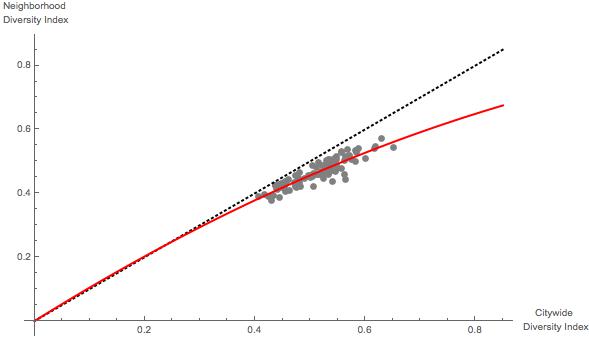
 . Thus, this measure is problematic to use when comparing cities that have measured “groups” in different ways.
 .
.