I’ve been reading several papers lately that examine the effects of various government policies on various social and economic outcomes. Increasingly, I find myself wondering what these studies actually conclude with “null” results. (By the way, I am sure that this issue has been raised before, but I’ve been thinking a lot about it lately, and I figured that’s what a blog is for.)
A (justifiably) standard approach in these literatures is as follows:
1. Describe why the outcome variable, y, is important, how it is measured, acknowledge weaknesses in the data, etc.
2. Describe the vector (list) of K independent variables, X, acknowledge they are imperfect, describe why they are still arguably useful, and perhaps link these with a theory explaining why they might affect y.
3. Apply a statistical model to generate estimates of the effect of the various variables in X on y.
For a lot of very good reasons, the standard approach in thinking about (or “modeling”) the effect of X on y is as based on some equation that essentially boils down to the following:

so that 


Then, typically, if the researcher is unable to reject the hypothesis that the estimated value of 


In many respects, this is perfectly reasonable: this approach is a classical way to model/uncover the relationship between the outcome variable and independent variables. And, particularly in modern social science, it is broadly and well-understood as a means to conceptualize/present results. So, I’m not saying we shouldn’t do this. That said, I am saying that we should think about the political relationship between the outcome and independent variables.
Now, for the sake of argument, suppose that 


The first order condition for maximization of 


We have reached this conclusion without presuming anything about the true relationship between 
Put another way, if we find in observed, real-world data that the effect of
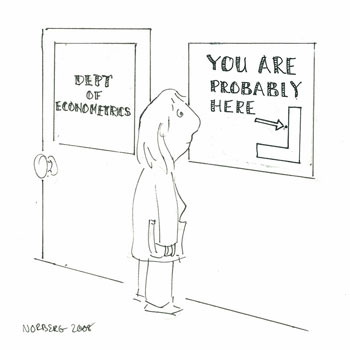
With that, I leave you with this.