This blog has been operating under the subtitle “Three Implies Chaos” since 2012. Long-time readers know the phrase pulls multiple duty: Li and Yorke’s period-three theorem from chaotic dynamics, Arrow’s theorem on preference aggregation, the Gibbard-Satterthwaite theorem on strategic manipulation, and the McKelvey-Schofield chaos theorem on multidimensional voting. Each of these results says, in its own register, that once three or more elements enter a system the system stops behaving the way the system was supposed to behave. Of the four, only McKelvey-Schofield has never had its own post here. Today we fix that.
It is arguably the most spectacular of the four (Ed.: I dunno, Li-Yorke is pretty freaking spectacular, too), and the most relevant to the kind of political analysis MOP keeps trying to do. So: overdue.
The Easy Case
In one dimension, things behave. Each voter has an ideal point on a line — left to right on whatever issue is at stake — and prefers policies closer to her ideal to policies further from it. Sort the voters by ideal point and take the median. Black’s median voter theorem (1948) says that the median voter’s ideal point is a Condorcet winner: in any pairwise majority comparison between the median and any other policy, the median wins.
The reason this works is the same reason elementary calculus works on the real line. “Left of \(x\)” and “right of \(x\)” partition the voters cleanly into two groups. There is exactly one direction of dispute, and the pushing stops at the median. The dimensionality of the policy space and the dimensionality of the voters’ arrangement are both equal to one, and one-dimensional spaces have an order. Order does a lot of work in mathematics; we tend not to notice it until it stops being there.
It Stops Being There Fast
Add a dimension. Three voters with ideal points at the vertices of a triangle in \(\mathbb{R}^2\). Each voter’s preferences are described by Euclidean distance from her ideal point — closer is better, indifference contours are circles. Pairwise majority rule: between two policies \(x\) and \(y\), each voter votes for whichever is closer to her ideal point, and the policy with two of three votes wins.
Pick any policy \(x\). The set of policies that voter \(i\) strictly prefers to \(x\) is an open disk centered at voter \(i\)’s ideal point with radius equal to the distance from that ideal point to \(x\). Three voters give three such disks. The set of policies that beats \(x\) in a majority vote — the winset of \(x\) — is the set of points lying inside at least two of the three.
For almost any \(x\) you pick, that winset is non-empty. The two-disk overlaps fail only on the line segments connecting voters’ ideal points pairwise — a measure-zero condition in \(\mathbb{R}^2\). So almost any \(x\) loses to some other policy under majority rule. Call that policy \(y\). By the same argument, \(y\) loses to some other policy \(z\). And \(z\) to some \(w\). The chain does not terminate.
Plott’s Condition
The chain terminates only at a point that no other policy can beat. Charles Plott (1967) gave the necessary and sufficient condition for such a point to exist: the voters’ ideal points must be arranged with radial symmetry around it, paired such that each pair lies on opposite sides at equal distance. With three voters, this collapses to the requirement that the voters be collinear and the median voter sit between the other two — which is to say, the requirement that we have not actually moved into two dimensions yet. (Side note: I was Charlie’s RA in the first year of my PhD program at Caltech!)
This is a measure-zero condition. Move any one voter’s ideal point by an arbitrarily small amount and it fails. The set of voter configurations for which a Condorcet winner exists has Lebesgue measure zero in the space of configurations. Empty cores are not the exception. They are the rule, and the exceptions are the negligible vanishing edge of a generic situation in which no policy beats every other policy under majority rule.
Anywhere From Anywhere
Now the punchline. Richard McKelvey (1976, 1979) and Norman Schofield (1978, 1983) asked the natural follow-up question. The cycling proceeds indefinitely, fine. But how far does it take you?
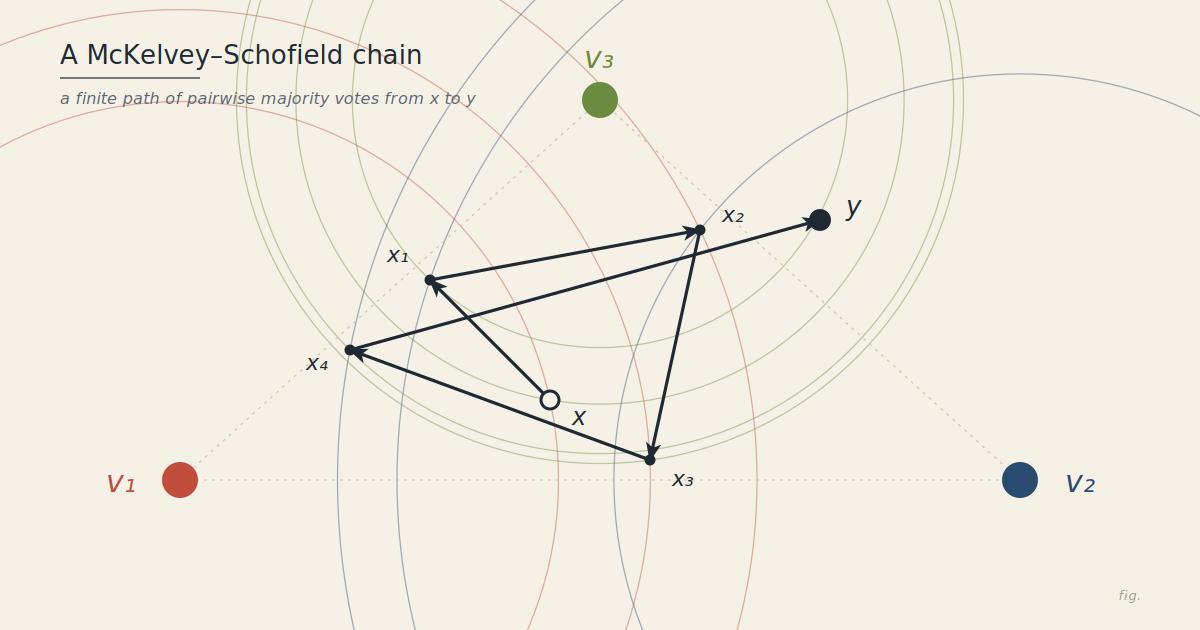
Their answer, the result that names this blog, is the following. In any policy space of dimension at least two, with three or more voters and no Condorcet winner, the top cycle set — the set of points reachable from any given starting point through a finite sequence of pairwise majority votes — is the entire policy space.
Translation: pick any starting policy and any target policy. There exists a finite sequence of policies, each beating the previous by majority rule, that begins at the starting policy and ends at the target. The agenda-setter who controls the order of pairwise comparisons can drive the outcome to any point in the policy space. Anywhere, from anywhere, in finitely many steps.
The construction is explicit. The argument exploits the fact that the winset of every non-special point extends in directions you can chain together; a clever sequence of intermediate proposals navigates from any \(x\) to any \(y\) through a series of pairwise majority wins. The proof is one of the more visceral demonstrations in formal theory. You can essentially watch the policy bus turn corners through the policy space, two voters at a time, and arrive at the destination of the agenda-setter’s choosing.
What This Means
What is “the policy a majority prefers” in a multidimensional space? Generically, the question has no answer. Every policy is preferred by some majority to some other policy, and there is no policy that is preferred by some majority to every other policy. The collective preference relation is intransitive over the entire space. There is no “what the majority wants.” There are only sequences of pairwise comparisons, and the agenda-setter chooses which comparisons happen.
This is the most uncomfortable conclusion in formal political theory, and it is mathematically airtight.
Real legislatures are not unconstrained pairwise voting processes. They have committee jurisdictions limiting which proposals reach the floor, germaneness rules limiting which amendments can be offered, single-subject requirements preventing log-rolls across unrelated issues, closed rules, suspended rules, the Byrd Rule, the budget reconciliation process, calendar Wednesdays, and a thousand other procedural devices that collectively constrain the space of feasible motions. These rules do not look like much, individually. They are denounced periodically as bureaucratic obstacles to the popular will.
The McKelvey-Schofield theorem says: this is exactly backwards. There is no popular will to be obstructed. The procedural rules are what produce the appearance of stable popular will in the first place. Strip the procedural apparatus and the will of the majority does not stand revealed; the will of the majority dissolves into a vector field with no fixed points and a finite path to anywhere from anywhere. The institutional structure is the thing producing democratic outcomes. The substance follows the structure, not the other way around.
This is the formal version of an argument we have made repeatedly through other channels: the rules are doing the work, the rules are usually invisible to the people benefiting from them, and the rules deserve the kind of attention we usually reserve for substantive policy. Chesterton’s Fence is at its sharpest here. The constraints do not look like they are doing anything until you remove them, at which point the path-dependence of the process they were containing becomes radically visible — and at that point the agenda-setter, whoever they happen to be, is suddenly in a position to take the policy bus to a destination that the constraints had been quietly preventing. The constraints were not blocking the destination from being reached. They were producing the conditions under which the question of where to go was a question with a determinate answer.
That, ultimately, is what three implies. Not that democracy is a fraud. Rather, any democratic system’s outputs are an artifact of structure, and the structure deserves the kind of attention we usually reserve for the substance.1
With that, I leave you with this.
1 Richard McKelvey proved the original cycling result in 1976 at Carnegie Mellon, and the global trajectory result in 1979 at Caltech. He died in 2002. Norman Schofield gave the general genericity form of the result and was, for many years, one of formal political theory’s most generous and incisive voices. Norman was a mentor and colleague to both Maggie and me at Washington University, and it was Norman, in a bar in Barcelona, who suggested that Maggie and I write our first book, Social Choice and Legitimacy: The Possibilities of Impossibility, which we dedicated in part to McKelvey. Norman died in 2018. Three implies chaos is, more than anyone else’s, the theorem of these two men. That this blog has spent fourteen years quietly orbiting their result without ever giving it a post of its own is a fact I should probably take up with myself at some point.
I love the REM reference!
Thanks!!