Now, I’ll Show You Mine: Why Obama Budged A Bit on the Budget

President Obama proposed his 2014 budget this week.  A huge document, it contains a number of interesting policy proposals.  One that is attracting a lot of attention concerns the “chained CPI.” In a nutshell, this change will reduce the rate of growth in social security payments over the next decade.  Overall, the proposal arguably represents a compromise with Congressional Republicans.  Perhaps understandably (although this is a classic chicken-egg situation), some Congressional Democrats and liberal interest groups are outraged. Did Obama overreach?  Has he sold out his party? To both questions, I argue “no,” and I also assert that, while Obama may be a pragmatist, this proposal isn’t a fair-minded compromise with the GOP.  It’s far more aggressive than that and positioned for the 2014 elections.

From a strategic standpoint, Obama is in an interesting situation.  He’s a lame duck president with a receding mandate and an approaching midterm election.  I think he has policy/legacy motivations to drive him to do more in his second term than most (all?) two-term presidents.  Accomplishing this would be greatly assisted by the Democrats doing well in the 2014 midterm elections.  (And, of course, he might want such a thing either on partisan or personal grounds, too.)

Going into 2014, the Democrats are in a tough situation in the Senate and a long-shot in the House. So how does Obama’s proposal affect this?  Not much in the grand sense, of course, because budget proposals are “inside baseball” for the most part and it seems unlikely (to me at least) that the public will buy into the narrative that “Obama is attacking Seniors.”

However, Obama’s proposal puts the House GOP in a bind and, by extension, potentially presents Senators of both parties with a challenge.  On the one hand, the House GOP can not simply “sign off” on Obama’s budget: for one, it raises taxes and, two, it’s Obama’s budget.  In taking a stand against his budget, though, the House GOP must come up with a reason.  While Boehner can try to claim that the proposal is incremental and doesn’t go far enough with respect to entitlement reform, this approach forces the GOP to come up with an even more aggressive plan or keep pushing the Ryan plan. Given the public’s lack of support for cutting social security, and the fact that Social Security is technically “off budget” and therefore of little value in reducing the budget deficit in the short term, it’s not clear to me what the GOP can counter with in terms of spending.  (And, of course, I wrote about this last year: there’s almost no way to balance the budget without new revenues or dramatically shrinking the defense budget.)

One way to view this is that Obama has “caved” to GOP demands and that this is another example of Obama not realizing that Congressional Republicans can not be dealt with.  Somewhat ironically, Obama’s very public and tangible concessions (even if “incremental”) are arguably the strongest positive bargaining move he has made in recent years. The key words here, and the “math of politics” of this post, are public and tangible.  By going public with a specific proposal, Obama is framing the next stage of the budget process. He is putting the spotlight on the Republicans and thereby calling their bluff that they have a politically feasible budget plan. (It’s a dual version of the logic I sketched out during Boehner’s stratagem during the fiscal cliff showdown.)

It is important to note that Obama’s budget was two months late.  He waited until after sequestration hit, after the House and Senate each passed their own budget resolutions.  In a colloquial sense, this forces the House GOP to respond to his proposal, as opposed to the Senate’s.

By going public (as opposed to privately bargaining with Boehner), Obama imposes “audience costs” on both himself and the House GOP.  For Obama, he would face a potentially huge cost if his budget was approved and sent to his desk for his signature.  (This isn’t going to happen, but a partial version could.) For the House GOP, of course, it now has the public’s attention on their budget priorities again.  That hasn’t worked out so well in the past.

By being tangible (i.e., by including the specific, headline garnering proposal regarding Social Security), Obama has arguably placed himself as the compromiser.  More importantly, Obama’s proposal presents Congressional Democrats with a useful foil and “clear indicator” of the importance of the 2014 elections.  Key here from Obama’s perspective is that he’s a lame duck president: if he has policy goals, he can be less concerned with maintaining his short-term popularity.  He can also turn to his partisan base and say (truthfully, in my opinion): “if you want Democratic priorities to win, you need to give me—and you—a Democratic House.  More importantly, perhaps, you better be darned sure the Democrats hold onto the Senate.”

With that, I think of the President of the Senate, and leave you with this.

Inequality: Smaller GINIs Can Fit in Smaller Bottles

I have been thinking a lot lately about this very interesting post by Kristina Lerman.  The post is excellent: succinct and well-written, data-centric, and relevant beyond the data’s idiosyncratic qualities.  In a nutshell, Lerman’s central question is whether the rate of information production is outstripping the rate at which we (choose to or can) consume and digest it.

Of course, information overload is clearly an important problem for scholars and practitioners alike (and, accordingly, not one with any obvious and easy answer). But upon reflection, I am still wondering whether it is a problem at all.  Given my second-mover advantage, I will cherry-pick one of the arguments in the post.

In a section titled “Rising Inequality,” Lerman uses the Gini coefficient of citations to physics papers as a measure of scholarly inequality.  Since the Gini coefficient has grown over the past 6 decades, Lerman concludes that “a shrinking fraction of papers is getting all the citations.”  This is undoubtedly true once one slightly rewords it as “a shrinking fraction of the papers made available is getting all the citations.”  This is an important qualifier, in my opinion, and the central point of this post.

Any notion of inequality is inherently relative. As I read it, Lerman’s argument is that the increase in information production has potentially caused us to use cues or heuristics to manage the decision of what information we as scholars consume.  Lerman argues that this is bad because the Gini coefficient has increased along with the rate of publication, indicating that the cues and heuristics we are employing is narrowing our attention to a smaller set of articles and creating a “rich get richer” dynamic in terms of citations and scholarly focus.

However, is this conclusion warranted by the data?  I am not so sure: the Gini coefficient, like any measure of inequality, is potentially sensitive in counterintuitive ways to the set of things being compared to one another.

The nature of Gini coefficients. Lerman’s argument that higher Gini coefficients are bad is very sensible if one thinks that the “pie” of citations is fixed in size and/or that the low citation articles are somehow “unjustly” receiving fewer citations.  At least in my opinion, neither of these suppositions is reasonable in this context.  There’s a number of ways to skin this cat, but I think this is the easiest.  Suppose, for the sake of argument, that the number of citations an article will receive is independent of the number of articles uploaded (or, accepted into an APS journal).  Then, suppose that only those articles that will receive m citations are uploaded.  As the costs of uploading/writing/publishing decrease, m would presumably decrease as well.  With this in hand, the key question is:

Holding the latent population of articles fixed, how does the Gini coefficient of the uploaded articles change as m increases?

Note that decreasing m increases the number of articles uploaded.  To me, at least, Lerman’s implicit argument is that decreasing m “should” decrease inequality (i.e., decrease the Gini coefficient).

This isn’t necessarily the case.  I ran a simulation to demonstrate this with a very large set of “pseudo-data.”  Specifically, I generated 100,000 observations from a Pareto(k=1,\alpha=1.35) distribution.  This pseudo-data yielded a Gini coefficient of \approx 0.59.  Then I truncated the distribution at various values of m\in \{1,2,\ldots,25\} and computed the ratio of the Gini coefficient of the resulting truncated data set and the Gini coefficient of the full data set. If decreasing m “should” decrease inequality, then this ratio should be increasing in m.
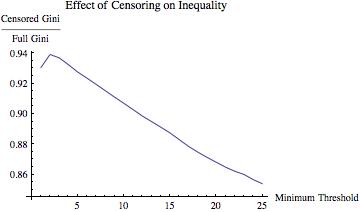
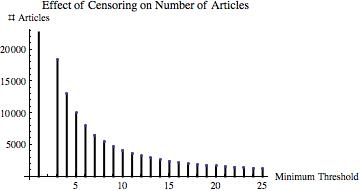
The results are displayed below

CitationGiniRatio CitationSurvivors

The simulated data demonstrate that increasing the selectivity of the upload/publication process can actually decrease inequality among the (changing set of) uploaded/published papers.  In other words, increasing the rate of uploading/publication of articles can increase inequality without reference to information overload or any changes in citation behavior

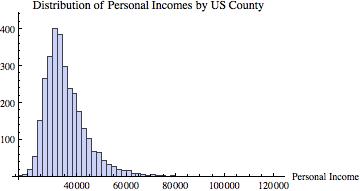
Out of curiosity, I went out and got some real data. For simplicity, I downloaded the per capita personal incomes of each US county for 2011 (available here).  This data looks like this:

PersonalIncomeHistogram

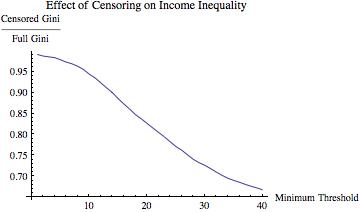
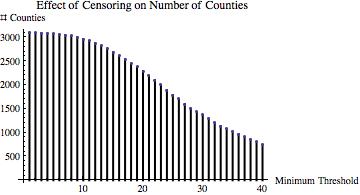
I then did an analogous analysis, varying the income threshold from $20,500 to $40,000, computing the ratio of the Gini of the truncated data to the Gini of the overall data set at each increment of $500.  The results of this are below.PersonalIncomeGiniRatioPersonalIncomeSurvivors

Again, as one gets more “elite” with respect to the inclusion of a county in terms of income into the calculation of the Gini coefficient, estimated inequality decreases.

Now, it is probably very simple to find examples in which the opposite conclusion holds.  But that’s not the point: I am not arguing that Lerman is wrong.  Rather, I am making a point about inequality measurement in general.  In line with my earlier point about Simpson’s paradox and education policy, comparing relative performance between different sets-even nested ones-is tricky.*

Also, as an aside before concluding, it occurred to me that the data used by Lerman seems to vary from point to point.  While the data demonstrating the rapid increase in production rate over the past two decades is from arxiv.org (and, further, note this graph, which is a more “apples-to-apples” comparison), the data on which the Gini coefficients are calculated are papers “published in the journals of the American Physical Society.”  These are two very different outlets, of course: arxiv.org is not peer-reviewed, while the journals of the American Physical Society are.

While I do not have the data that Lerman is working from in her post, the difference between the two data sources might be important due to changes in the number & nature of publication outlets over the time period.

Specifically, consider either or both of the following two possibilities:

  1. Presumably, there are publication outlets other than the APS journals.  If this is the case, even if the APS journals have published a fixed and constant number of papers per year, changing publication patterns could be far more important in determining the Gini coefficient of citations to articles published APS journals than the overall article production rate.
  2. After doing some poking around, I came across this candidate as the likely source of Lerman’s data for the Gini coefficient calculations.  I may be wrong, of course, but if this is the data used, it considers only intra-APS journal citations.  If this is the case, then one is not really looking at inequality of attention/citations broadly—just inequality within APS articles.  The sorting critique from the above point applies here, too.

Conclusion: Comparisons of Inequality Are Not Always Comparable. Again, I really like Lerman’s post: this is a hard and important question.  My point is only that measuring inequality, a classic aggregation/social choice problem, is inherently tricky.

With that, I leave you with this.

____________________________

* As another aside, it occurs to me that these issues are intimately related to some common misunderstandings of Ken Arrow’s independence of irrelevant alternatives axiom from social choice.  But I will leave that for another post.

Inside Baseball: Uncommon Knowledge

Note: This is the first of what might be an irregular “column” of sorts, “Inside Baseball,” focusing on the minutiae of my research, as opposed to current events. 


The heart of game theory is “what would everyone else think if I do what I am about to do differently?”

This is slightly different than the standard “introduction to game theory” approach, where the focus is often on the related question, “what would everyone else do if I do what I am about to do differently?”  But while the difference is slight, it is fundamental.  Game theory is about beliefs, or more appropriately, about consistency of beliefs.

This point bedevils empirical applications (or, more crudely, “tests”) of game theory for at least two reasons.  First, we rarely, if ever, can measure beliefs in anything approximating a direct fashion.  There is a core concept in game theory that is amenable to this test, known as rationalizability, and—unsurprisingly to me as a game theorist—people frequently refute the claim that all actions are rationalizable.  But let’s leave that point to the side.

The second point is more important, to me at least.  At the heart of game theory is the idea that not only are beliefs consistent with one’s own actions (that’s rationalizability, in a nutshell) and consistent with others’ actions (that’s Nash equilibrium, very loosely), they are are consistent with each other.  That is, in any reasonable game theoretic notion of equilibrium, every person not only acts in accordance with his beliefs about what others will do, he or she also understands (“believes”) correctly what everyone else in the game believes, understands that the other players believe correctly about what the player in question believes, including that the player believes correctly about what the other players’ believe about what the player in question believes about their beliefs, and so forth….

This uncommon notion is an instance of what is referred to as common knowledge in game theory.

Well, this uncommon notion is simultaneously elegant and unambiguously empirically false.  For example, it flies in the face of the reality that Florida Gulf Coast University made it to the Sweet 16.

But more seriously, this point is exactly the point of game theory. Game theory is a theoretical enterprise and accordingly requires a priori constraints for the purpose of being meaningful.  And, since this constraint is theoretically elegant and epistemologically appealing, one must always keep in mind that game theory is an inherently philosophical endeavor.  While one can (and should) certainly employ the trappings of game theory for empirically-minded endeavors, the goal of equilibrium analysis is inherently normative or prescriptive.  In other words, game theory models ask “what can (in theory) be achieved in a world in which individuals are intimately involved with the interaction at hand?”

A key (and illuminating) point in this regard is the beginning point of this post: what can happen in equilibrium is, in most interesting settings (i.e., “games”), dependent on what each individual believes about what will happen—or, more fundamentally, what other involved individuals will believe—if he or she acts differently.

When you take this point seriously, you must realize that “testing” game theory models is an inherently ambiguous enterprise.  Suppose the model “works.”  Did it work for the “game theoretically correct” reasons?  Suppose the model doesn’t work.  Why did it fail?

These are important questions, and any answer to either one has no bearing on the “validity” of game theory. Rather, the fact that one could ask either of these questions, the context within which these questions is accordingly posed, is to the credit of game theory.  In a nutshell, every time equilibrium predictions fail, an empirical angel gets his or her wings thanks to game theoretic reasoning.

With that, I leave you with this.

The Slow Burn of Coburn or, “Get The Hell Off My Lawn!”

So, dispensing with technicalities, the efforts to curtail NSF funding of political science research have apparently succeeded, at least for now.

I think this is a good opportunity to post something that has bothered me over the past few years.  In a nutshell, I am unsure that the “Coburn amendment” is a bad thing for political science.  I will set aside considerations of the direct and indirect benefits of NSF funding, as well as potential crowding out effects such funding might induce in private and corporate donors.  Rather, I want to focus on the virtues of being left alone.

I post here semi-regularly about the substance of my research.  I apply mathematical social scientific models to politics, particularly to political institutions.  I teach courses to undergraduate and graduate students, and I spend a lot of time conducting original research and evaluating the research of colleagues around the world.  I love my job, and I honestly believe that it matters.  This blog is a small instance of why I believe this: I get things wrong, perhaps most of the time, but what I do allows/forces me to think about why and how things work the way they do.  While one can and definitely should think about things in different ways, the attacks on political science are simply nihilistic.

I have made the argument at various points and maybe it’s wrongheaded, but the question of whether an act/profession/interest is relevant or useful in and of itself is typically either ill-posed or easily answered with “no.”  Political science, like every other academic discipline, involves rigorous application of technique to create, assemble, and understand a body of knowledge.  I sleep (very) well at night knowing that what we do as a discipline informs, alters, and shapes the way I think about a broad range of incredibly “relevant” political events and broader phenomena.  Perhaps most importantly, what we do not only allows me to understand these things—it enables me to both be and recognize when I am wrong in simultaneously informative and informing ways.

So, while the jury’s still out about both the long-term prospects and effects of the Coburn amendment, I can definitely say this: I look forward to not talking about it anymore.  I’m tired of being confronted by the loaded question (“Have You Stopped Defending Your Junk Science and Charlatanism Yet?”), especially because my responses are sometimes witty and always unprintable.

But more positively, I am a consequentialist and take a glass half-full approach by recognizing that the die is cast for now and, as a field, we have more fundamental and important work to get back to.  So, ironically, thank you Tom Coburn: may your amendment most ironically refocus us on our science.

Oh, and I leave you with this.

_____________________

* It’s public record, but in the interest of full disclosure, I have some skin in the game.

Consensual Resolution?

Just a quick post. Yesterday, the Senate voted to invoke cloture (63-35) on the Mikulski-Shelby substitute to (i.e., the Senate version of) the continuing resolution, HR 933. In a nutshell, this obviates threats to delay this funding bill, which I have discussed previously (here and here).

I bring this up because it bolsters the case I made in the previous post that the Senate might be operating in a fairly consensual/bipartisan manner.  While McConnell (and 1 Democrat, Jon Tester (D-MT)) voted against cloture, 10 Republican Senators putatively “crossed over” to vote in favor of cloture.  The motivations for these votes are beyond the scope of this post and, regardless of their nature, I think it is worth noting that, yesterday at least, the Senate agreed to get to what has to be gotten to.

With that, I leave you with this.

Quid Pro Status Quo: A Tale of Two Tails

In my previous post, I discussed the Senate’s consideration of a continuing resolution (or CR) that includes some provisions relevant to gun control.  In so doing, I mentioned a form of unanimous consent agreement, or UCA, (like this one) that the Senate has been using for consideration of measures that would presumably otherwise fail to obtain cloture.

Leaving aside the finer points of cloture, the key aspect of this UCA is that it guarantees a vote on the amendment in question but requires 60 votes (a three-fifths majority, like cloture) for passage.  Upon reflection, two of the first four amendments to the CR to receive consideration are particularly illustrative of the parties’ collective strategies of position-taking when compared side by side.

The first amendment considered by the Senate was offered by Ted Cruz (R-TX).  It was actually an amendment to an amendment in the nature of a substitute (i.e., a complete replacement for the CR) offered by Sens. Mikulski (D-MD) and Shelby (R-AL), the chair and ranking minority member, respectively, of the Senate Appropriations Committee.*

The second amendment I wish to compare it with is the one, mentioned in the previous post, offered by Sen. Harkin (D-IA), which was also an amendment to the Mikulski-Shelby substitute.  It proposed to increase spending on a slew of Democratic priorities, including

special education, childcare subsidies, The Ryan White AIDS Drug Assistance Program, suicide prevention, aid for first-in-their-family college students, food safety, lead poisoning screening for kids in this country, diabetes prevention, and worker safety.

In addition, as I pointed out in the earlier post, this amendment essentially proposed returning to the substance of the Labor-Health and Human Services appropriations bill except for any additional spending on Obamacare.

Thus,

  1. a vote for Cruz’s amendment was a vote against Obamacare (or, perhaps, “big government”), and
  2. a vote for Harkin’s amendment was a vote for traditional Democratic priorities.

Note the order of the votes—Reid essentially allowed Republican incumbents to take clear positions against Obamacare—prior to at least a handful of these Senators voting for the CR next week.  Then McConnell and Reid (essentially) agreed to a UCA under which Democrats would get a chance to cast themselves as pro-Democratic priorities sans
Obamacare.  This quid pro status quo did not threaten the CR, because Cruz’s amendment did not have majority support (hence, no need for a UCA, assuming no Democrat filibustered, which they didn’t) and Harkin’s amendment would not receive 60 votes (but it did receive majority support, hence the need for the UCA to obviate a Republican filibuster).

Thus, this sequence arguably represents a classic, cooperative logroll between the parties (really, between the incumbents of the parties).  Policy was not put at risk, but both parties’ incumbents got to take at least one good position-taking roll call vote.  A larger take on this trade-off—a classic “question” in political science—was recently offered by Greg Koger, Hans Noel, and—well—Greg Koger.  Well worth the read.

I won’t weigh in on the larger question at this time (though I have offered a take on it in published research (ungated version)).  Instead, it is important to note that sometimes the parties work together by agreeing to stand apart.  (Also, I have already talked about part of this dynamic with the fiscal cliff, though from a different angle.)

With that, I leave you with this.

___________________

* If my reading is true, Sec. 110 (Cong. Rec. S1613)  and Sec. 514 (Cong. Rec. S1619) contain the provisions (3 in Sec. 110 and 1 in Sec. 514). The fact that the Senate is using an amendent in the nature of a substitute to the House version of the CR means that—at least from a practical-cum-technological standpoint—it is even harder to find “the Senate’s version” of the CR.  This approach also greatly expands the “voting tree” for consideration of the CR.

Showdown at Uzi Gulch: Putting the Glock in the Spiel

The Senate is considering a continuing resolution (CR) that both extends funding operations of the federal government through the rest of the fiscal year (Sept. 30, 2013) and also makes permanent several provisions that stymie enforcement of gun control laws. While the reality is that the provisions in the Senate bill do not represent a significant change in the day-to-day enforcement of gun control, making the provisions permanent represents a significant step “backward” in light of the Newtown school massacre and the 57% of Americans who favor renewing the ban on assault weapons and the 52% who favor “stricter gun control laws.”

So, what’s the strategy here?  First, it is important to remember that the CR is a very potent vehicle: Obama could veto it, as Clinton did in 1995, causing the federal government to “shut down” during his struggles with the GOP-controlled 104th Congress.  However, given (1) the fiscal cliff debate & currently ongoing sequester and (2) the fact that the Democrats hold a majority of seats in the Senate, the analogy between the two situations is not a perfect one.  Simply put, it is not clear that Obama would win the “public approval game” following a veto as Clinton did.

But the more important point is that Senate Democrats are facing a very “tough map” in the upcoming 2014 midterm elections. In particular, at least 7 Democratic seats are up for election in closely divided states where support for tougher gun control is probably not a winning electoral gambit, ceteris paribus: Alaska, Arkansas, Iowa (open seat), Louisiana, Montana, North Carolina, and South Dakota.  So including these provisions might actually be a gift to Obama in some ways.  Democrats so electorally disposed can reaffirm their anti-gun control bona fides by voting for this CR and Republicans can more easily explain their vote to fund the government as a pro-gun rights vote. More interestingly, however, are two strategic possibilities that might come up as this story unfolds over the next week.

  1. A Senator’s anti-gun control bona fides would arguably be even better established by voting for an amendment that would strip the anti-gun control provisions.
  2. Similarly, a Senator’s pro-gun control bona fides could be similarly established by voting for an amendment in line with an even-more-anti-gun control provision rumored to be supported by some in the House.

These possibilities highlight an awesome implication of the Senate’s supermajority (“60 vote”) requirement for cloture.  Specifically, Reid and McConnell can broker an agreement (known as a unanimous consent agreement, or UCA) under which a pro-gun control amendment and an anti-gun control amendment are each considered and debated for a fixed amount of time and then voted upon, with each amendment requiring 60 votes to be approved. This agreement would allow Senators to vote for and/or against gun control measures while posing no real threat to the underlying CR, which is needed prior to March 27th.

Note that this type of UCA is not just some theoretical creature—it has already been used during the consideration of this bill.  And, furthermore, in line with the yarn I am spinning, the amendment in question* (sponsored by the retiring Senator Harkin from Iowa) failed with a majority of votes on a party line vote.  Thus, even though everyone presumably knew this amendment would fail under the terms of the UCA, it was nonetheless duly considered and the subject of a roll call vote. Finally, the starting point of my fantastic tale of legislative chicanery is that THAT VOTE IS THE POINT.  By agreeing to push the supermajority requirement back from ending debate to actual passage, Senators can go “on the record” about a majority-favored policy change with a vote that changes nothing.

We’ll see what Reid and McConnell do, but note that the consideration of Harkin’s amendment is telling in many respects, particularly given the huge number of amendments that have already been submitted to the CR and the queue of gun control bills now awaiting consideration, each of which could be considered under this type of UCA as well, of course.

With that, I leave you with this.

____________________________________________________________________

* For the curious, Harkin’s amendment was complicated, but Harkin’s summary of it from the floor (Congressional Record, p. S1742) included these interests:

special education, childcare subsidies, The Ryan White AIDS Drug Assistance Program, suicide prevention, aid for first-in-their-family college students, food safety, lead poisoning screening for kids in this country, diabetes prevention, and worker safety.

What is really interesting to me about this amendment was that it was essentially the substance of the Labor-Health and Human Services appropriations bill that had been negotiated between the chambers a few months ago minus appropriations for the Affordable Care Act (“Obamacare”), a point that Harkin clearly and repeatedly expressed in his comments on the amendment.

Harkin’s amendment thus allowed Democrats to vote in favor of some clear Democratic “issues” without making them vote in favor of Obamacare. I’ll leave that for another day, but note that Ted Cruz’s amendment the CR to defund Obamacare entirely was rejected on a similar party-line vote.  And, furthermore, note that the absence of Senator Joe Manchin (D-WV (!!)) for this vote and the hubbub surrounding his non-vote on this amendent underscores the electoral dynamic at play on these types of votes.

Gresham’s Law in the Senate: How Filibuster Reform Begot Rand Paul’s Filibuster

Bad money drives out good. – Gresham’s Law

Gresham’s law was coined (hahaha!) back when it was apparently okay to call things laws based on a hunch.  Nonetheless, it has a solid theoretical foundation.  To understand it, just consider how you would pay for things if gold and lead were both made legal tender at the same price per pound (hint: you wouldn’t be smart to pay gold for anything).

I bring up Gresham’s law because today’s filibuster by Rand Paul—still ongoing as I write of this—highlights a similar phenomenon that has emerged recently in the Senate.  During the first two months of the 113th Congress, there have already been filibusters of presidential nominations (2 cabinet-level (Hagel & Brennan), one judicial (Halligan), and this phenomenon is directly, and presumably ironically, tied to the filibuster reforms agreed to in January.

In a nutshell, these reforms eliminated or limited the ability to filibuster some (arguably redundant) procedural steps, sped up cloture, and created a few explicitly bipartisan maneuvers that can be used to thwart holds on legislation (thus making it easier for the Majority and Minority Leaders to work together so as to actually begin debate on a bill).

The details of these changes are beyond the scope of tonight’s post.  The point/analogy I want to make can be summarized in two steps.

  1. Filibusters are often about a Senator or group of Senators seeking attention, where “attention” can take many forms: the opportunity to offer amendments, policy or patronage concessions from the President, etc. Accordingly, and particularly if the attention is rather parochial or not on the legislative agenda (as in the case of stonewalling by the White House in the face of requests for clarification about when the President can have drones kill people on American soil), it is often either strategically optimal or logically necessary to filibuster something that is unrelated to the content of the attention that the Senator(s) seek.

  2. The rules changes adopted in January explicitly exempt Cabinet-level and judicial nominations.  Without belaboring the point, the clear goal of the filibuster reform package was to increase the individual cost of filibustering, but it did not do so uniformly.  In other words, while the individual costs of filibustering other matters have increased following the reforms, the cost of filibustering Cabinet-level and judicial nominations is still the same..

Combining these two points: the “currency” of a Senator seeking attention is fundamentally that most precious of all commodities: time. Even in the Senate, where a day is often not a day, an hour is an hour is an hour.  However, the filibuster reforms made some, but not all hours of Senate time more expensive than others for a Senator upset about drone strikes and White House stonewalling.  Tonight, Rand Paul is simply using the cheap coin rather than the expensive one: quite fitting for one who is presumably dubious of bimetallism.

And, speaking of “bad coin,” I leave you with this.

I Study Political Science. You’re Welcome.

There is a simmering debate about the science of politics.  For example, here’s a recent uninformed and deliciously uninformative anger-fueled argument that political science does not “serve the public”—a notion that any good political scientist knows is the warm bed of those too lazy to consider the vacuity of the notion of “serving the public.”

That said, social science is, without a doubt, decidedly unimportant to the everyday, snapshot welfare of the average American.  Similarly, basic research in medicine, nuclear test monitoring, TSA screening at airports, and even your usual dental and automotive checkups have incredibly infinitesimal positive impacts—clearly outweighed by the direct cost of any one visit—on your life.  STOP BRUSHING YOUR TEETH.  IT WON’T MATTER….today, at least.

That said, you’re reading this—so you’re not average.  (lost? bored? –ed.)

The reality of the matter is that politics is about many things.  That said, the requisite consideration is whether politics, as a discipline, contains anything that is both not subsumed by another field and is also important.  The answer to that query is undoubtedly “yes.”  Specifically, the study of politics concerns the study of institutions.  And, to be clear and slightly pugnacious, I mean the study of real institutions. To further the pugnaciousness, I mean both the theory and empirics of real institutions.

In a nutshell, there are many regularities of decision-making that can not be understood without thinking in detail about the rules that people have to follow.  The world is replete with rules.  And, continuing the business of bringing/inviting the fight, I mean formal rules.

To understand why and where power resides where it resides in any system, the very first place to look is the rules.  For example, did you know that the Speaker of the House has the power to announce the result of a voice vote without appeal? Or that the Speaker of the House has the absolute power to expedite business through a somewhat arcane but incredibly potent and important route known as “suspension of the rules”?

(Edit: In recognition of the thoughtful (off-line) comments of my friend Brian Sala, I should clarify my ambiguous description of the Speaker of the House’s power with respect to suspension of the rules. This is a formal motion to pass a bill “as is” without amendment and with limited (40 minutes, equally divided) debate. It requires a two-thirds supermajority. It also is in order only on certain days, and at the pleasure of the Speaker. This is an absolute power (essentially of recognition) and allows the Speaker to deny attempts to circumvent normal order. Given that suspension is very commonly used, this gives the Speaker a subtle form of a carrot to reward members. The Speaker’s power, of course, is conditioned on the supermajority requirement. (That, of course, is not by accident.)  Sorry for any confusion!)

What about the intimate and not so intimate details of recess appointments?  When does the President have power?  When has Congress given this power to the President?  Why would they do so?  Should courts care?  Should voters care?

The easy (and accordingly unsatisfying) answer to these broad questions is, “well, it depends…”

Political science is uniquely responsible for telling you what it depends on, how it depends on it, and—if we’re lucky—how you might change things to make these dependencies work in your favor.

So, unless you think that neither Obamacare nor the Keystone XL project are important, the business of institutional details “matter.”  Then, moving to the redundancy worry—maybe political science is merely a secondary backwater of those who might be able to  teach but surely can’t “do”—the reality is that no other social science (not to mention any other discipline) is concerned with the details that matter and how they matter.

Sure, economics and law worry about related issues, but institutional political science is focused on the mechanics of how things work and how they could work.  Law worries a lot in very important ways about how things work, but the reality is that their focus is appropriately focused on the way things “are,” and (more subtly) focused on things that matter to clients (broadly construed).  Clients—be they litigants or lobbyists—are important.  But they are not the same as voters.  Indeed, theoretically motivated empirical studies in political science confirm that they are potentially very different.

To be quick about it, economics is concerned with broad and systematic models of social/economic/political interaction.  There are very many productive and meaningful overlaps between the two fields.  (Indeed, I have a PhD in economics.)  That said, the two fields are distinct for a reason.

(For example, and first and foremost to someone like me, the idea of a “representative voter” is equivalent to assuming away all of politics.  Those of you who know me know that I like to refer to the theorems of Arrow and Gibbard-Satterthwaite theorem (too) frequently. Both show, for related but distinct reasons, that it is difficult if not impossible to sustain the presumption that one can utilize the notion of a “social will.”)

Economics is incredibly useful when it comes to “large numbers” analysis.  But to be honest and utilize the safety of my own blog, there is nothing particularly “economic” about the game theoretic analysis of general institutions.  In particular, mechanism design makes it clear that, in the abstract environment of institutional design, much should be possible—approximation or outright achievement of “first best” (unambiguously efficient) outcomes should be possible.

The difficulty of these results is that they neglect the practical and, appropriately, political realities that hinder (for example) credible commitments in the design of institutions.  For example, governance would be (theoretically) quite easy—and deliciously simultaneously democratic and authoritarian in good measure—if one could simply compensate the “chief executive” based on the measured realization of “social welfare” at regular time intervals during his or her tenure with some sort of fungible numeraire good.

Yes…this is exactly how ZERO countries (that I know of) are governed.  Hell, it’s not even how public corporations are governed.  The recent debate about responsibility, oversight, and transparency in (say) financial corporations is predicated precisely on the difficulty of (for example) measuring “social/shareholder welfare” in a meaningful and credible (i.e., relatively non-manipulable) fashion.

This is not to say that economists/lawyers/etc. do not worry about many of the same issues.  Unlike those who like to throw stones, I don’t need to attack others.  I have too many interesting and—again it’s my blog—important research questions to dive into to waste my time trying to avoid my own glass walls.

In that spirit, I leave you with no silly link this time.  Instead, I prefer to point out that, whenever someone says that rules (for example) are just a bunch of minutiae, you should respond, “you know, the definition of “minutiae” is endogenous.”  Or, combining an old adage and old saw among politicos, “minutiae is defined by those about to screw you.”

Immigration Reform: You do it…So I Don’t Have To…Really.

The US Senate is currently considering immigration reform, with a bipartisan group of Senators working toward a compromise on one of the higher profile post-election issues. At the same time, the Obama Administration has been preparing its own plan, which was leaked by USA Today.  President Obama called on Congress to address the issue in his State of the Union address, and reaction was generally positive from both sides of the aisle.

The strategic situation here is a classic, but nonetheless interesting one.  Immigration reform is seen as necessary by both parties.  The devil is in the details.  President Obama’s gambit here is to present both Democrats and Republicans in Congress with a “way out.”  For example, he is speaking in generalities about reform, encouraging the notion that there is a bipartisan consensus on the broad strokes of reform, and stating that he will sign a bill if given one by Congress. These strategies allow Obama to not take a position and also allow/require Congress to construct a policy that can cover enough members’ interests to secure passage.  It is notable in this regard that reform is “starting” in the Senate—this highlights the cross-cutting nature of immigration reform.  On the one hand, it is always tough to get 60 votes.  Starting the process in the Senate suggests that securing the votes is seen as “doable” by some, if not all, Senators.

At the same time, members of the Obama Administration are making clear that that the President will present his own legislation if Congress does not act quickly.  In addition, House Democrats are publicly claiming that President Obama can act unilaterally in meaningful ways. For example, Rep. Joseph Crowley (D-NY) is quoted as saying that, with respect to immigration reform, Obama is “not just beating the drum … he’s actually the drum major.”

Obama may or may not have the stomach to make (further) significant unilateral moves on immigration.  But making the argument that he does increases the bargaining power of Democrats in Congress.  In particular, if Obama does proceed unilaterally on immigration, the pretense of bipartisanship is much less valuable to him.  Accordingly, Republican members of Congress who seek a say in the details of reforms must envision a tough road securing those details in a unilateral Obama-led administrative/prosecutorial immigration reform push.

In a nutshell, then, Obama’s language can be read as “I don’t have any reason to not yield on many possible specific points/details of this reform.  I also don’t have any reason to fight for them.  You put in the effort, you get the discretion.”  This gambit is possible precisely because of the cross-cutting nature of immigration reform: many of the details are themselves not partisan “per se.”  This gambit is valuable to Obama for exactly the same reason: any reforms he implements through unilateral action can–unlike statutory reform–be undone with the stroke of a pen by his successor.  That, regardless of your party, isn’t real reform at all.

With that, I leave you with this.