
Can a Game Know Its Own Rules?

Hi again! The question I’m about to pose is one that, I’m reliably informed, clears rooms at cocktail parties.1 But I think it sits at the foundation of why institutions are so hard to reform — and why the people who try to reform them so often end up making things worse. That’s for next time, though. Today, I want to talk about games.

Taking Your Ball and Going Home

Here’s a scene everyone recognizes. Two kids are playing a game — basketball, say. One of them is losing. So he picks up the ball, says “this is stupid,” and goes home (note: he never says, “I forfeit the game,” maybe he was in a hurry?) Anyway, pragmatically at least, “uhh, game over.” Sounds like a lot of (mostly less fun) games I have played in life. (I won’t tell you which character I was playing, but I will admit/confess that I have played both “roles,” so to speak. I’m a “double threat,” I suppose. Is that a compliment to myself?)

Now: what just happened, strategically? Within the rules of basketball, there is no explicit provision for this exact situation. Instead, the “rules of basketball” understandably tell you “what happens” when you shoot (depending on whether it “goes through the hoop,” for example), when you foul, when the clock runs out. They do not tell you what happens when a player picks up the ball and leaves the court, never to return. This action is, formally speaking, outside the game. Your first instinct might be: “Well, obviously — he loses. He quit.” And that’s a perfectly reasonable/”practically accurate” interpretation. But notice that “he quit, and therefore he loses” is your (and, yes, most of society’s) inference, not the rules’ literal interpretation.

To make this less ethereal, suppose instead the kid says, “I’m so sorry — my parents are here, I have to leave!” Should that kid lose because of his parents’ timing/schedules? (And, in spite of my inclinations, no, “don’t be a stickler right now.” Yes, that’s about to get “ironic AF”.)

The rules of basketball define how you score and how the clock works; they don’t contain a general provision for “a player decided to leave and never come back.” You’re filling the gap with common sense — and common sense, as we’ll see, is doing a lot of heavy lifting that the formal rules cannot. Let me push on this with a darker example, because I think it reveals something important.

The Penalty Ceiling

Suppose, in the course of an NBA game, you want to prevent an opponent from scoring. You could commit a blocking foul. You could commit a hard foul — a flagrant foul, in the NBA’s terminology.2 The NBA distinguishes two levels: a Flagrant 1 (“unnecessary contact”) gets you two free throws and possession for the other team, while a Flagrant 2 (“unnecessary and excessive contact”) adds an ejection. That’s where the ladder ends. There is no Flagrant 3. So: what if, instead of committing a hard foul, you grab the opposing player and strangle him? Within the formal rules of basketball, the in-game consequence is… [flips through pages speedily….] well, it’s identical to a Flagrant 2 foul. Ejection. Two free throws. Possession. The rules literally cannot distinguish, in terms of game outcomes, between a very hard basketball play and attempted murder. Everything above the Flagrant 2 ceiling looks the same to the game. Criminal law handles the strangulation, of course — but that’s an external enforcement system, a different “game” entirely. Within the four corners of basketball’s rules, the marginal in-game cost of escalating from a hard flagrant to actual assault is zero.3

Now, you might (yes, quite reasonably) think: “Fine, but no one actually strangles an opponent during a basketball game. The criminal law deters that.” True. But the fact that you need to invoke an entirely separate system of rules (here: “the rules of the legal system”) to handle actions that are physically possible within the game is essentially precisely the point. From a logical perspective, the rules of the “game of basketball” themselves have a ceiling,4 and above that ceiling, deterrence vanishes.

This matters beyond basketball. Consider: why have police unions historically resisted making the penalty for assaulting an officer as severe as the penalty for killing one? It’s not squeamishness. It’s strategy. If assaulting a cop carries ten years and killing a cop carries life, then a suspect who has already committed the assault faces an enormous marginal cost for escalating further. The gradient protects the officer. But if both carry life? The marginal cost of escalation drops to zero. A suspect who has already crossed the assault threshold faces no additional deterrence against killing. The punishment structure only deters escalation when there’s room to escalate into.

The general principle: any finite penalty schedule creates a flat region at the top where marginal deterrence fails. And raising the ceiling doesn’t solve the problem — it just moves the flat region higher. You haven’t eliminated the zone where deterrence vanishes; you’ve simply changed where (i.e., “conditional on what action?”) the deterrence “has its bite.”

And there’s a second problem with “if you do X, you lose” — one that is, if anything, even more fundamental. Everything I’ve said so far implicitly assumes a two-player game. In a (zero-sum)5 two-player game, “you lose” means “your opponent wins,” and since you have exactly one opponent, this is unambiguously bad for you. The fix might fail for other reasons, but at least it’s a punishment. Add a third player and even this breaks down. “You lose” no longer determines who wins — it just removes you from contention. And the question of which remaining player benefits from your removal is now a strategic variable. If you prefer Player C to Player B, and your continued participation is helping B more than C, then losing is not a punishment — it’s a gift to your preferred outcome. “If you break this rule, you lose” becomes, in effect, “if you break this rule, you get to kingmake.”6 The penalty has been tranformed from a deterrent into a strategic instrument, and, having assigned a definite/predictable outcome to the violation in question, the rules have no way to prevent (or, somewhat ironically, deter) this type of behavior. They did exactly what they were supposed to do. The problem is that what they were supposed to do “isn’t enough” — or more appropriately, they are not incentive compatible within the game itself.

This is not that exotic, of course. In sports, it’s called tanking: a team deliberately loses late-season games to secure a more favorable draft pick or dodge a stronger playoff opponent. In elections, it’s strategic withdrawal: a candidate drops out not because they can’t win, but to determine who among the remaining candidates does. In legislatures, it’s the entire logic of strategic voting and logrolling.

Simple and universal point: whenever “a game” has three or more players, even the declarative “you lose” outcome is no longer necessarily the worst possible outcome. How you lose, and when you lose, and who benefits from your loss are all strategic variables that the rules have handed you.7 The penalty, intended to close the game, has opened it. (Readers of this blog will note the family resemblance to a certain famous theorem about what happens when you have three or more alternatives: it sort of rhymes with “Mia Farrow.” We’ll come back to this.) I want to convince you that this problem is not trivial at all. In fact, I think it’s a deep problem, one that connects to some of the most important results in mathematics, and political economy.

The Chessboard, Overturned

Consider chess. Chess is, compared to basketball in the driveway, a remarkably well-specified game. The rules define every legal move, every legal position, and every terminal outcome (checkmate, stalemate, draw by repetition, and so on). Chess even has a formal provision for one action that might seem “outside” the game: resignation. If you tip over your king, the game ends and your opponent wins. Clean, elegant, formally complete. But now imagine a player who, upon finding herself in a losing position, sweeps all the pieces off the board and onto the floor. What happened? Not a resignation — she didn’t tip her king. Not a checkmate. Not a draw. The rules of chess, so carefully specified, have nothing to say about this. And here’s what’s interesting: it’s not obvious what they should say. The most natural response — the one most people jump to — is: “Well, obviously she loses. Flipping the board is just resignation with theatrics. We can infer that she wanted to concede and was simply… efficient about it.” And in a single game of chess, maybe that resolution works well enough. But notice what it’s doing: it’s interpreting a physical action (scattering pieces) as a strategic action (resignation) by reasoning about the player’s intent. The rules of chess say nothing about intent. We’re filling the gap with inference — and inference, as we’re about to see, opens its own can of worms.

The Game Within the Game

Here’s where it gets interesting (Ed: …Finally?). Suppose our chess player isn’t playing a single game. She’s playing a best-of-seven match. She’s down a game, and the current game — game 3 — is going badly. She has two options within the formal rules: play on to the bitter end, or resign. But these two options are strategically different in the context of the match, even though they produce the same outcome in game 3 (she loses). Playing to the bitter end reveals information — about her style, her preparation, her responses to specific positions — that her opponent can exploit in games 4 through 7. Resigning early conceals that information. Accordingly, the timing and manner of her concession is itself a strategic variable, one that the rules of chess (which govern individual games) don’t acknowledge at all. The match is a game; each game within the match is a game; and the two levels interact in ways that neither level’s rules fully capture. Now: is it “legitimate” for a player to play badly — or concede early — in game 3 in order to improve her chances in game 4, 5, 6, and/or 7? While I play chess, I’m not serious at it (Ed: you mean you’re not that good at it?) That said, I suspect that most chess players would say this offends the spirit of competition (to understand why, ask yourself, “does anybody think being described as tanking something is a compliment?) But the rules of a best-of-seven match, as typically specified, say nothing about it. We’re back in the gap between what the rules formally cover and what is physically (and strategically) possible.

What Poker Understands

This is a good moment to note that at least one common game does understand the problem we’re circling around — or at least one important dimension of it. In standard Texas Hold’em, when all of your opponents fold, you win the pot. You may then show your cards to the table, but you are explicitly not required to. This is a rule about information, and it is one of the rare cases where a game’s designers grasped that the strategic management of private information is itself part of the game. Whether you show a bluff, show a strong hand, or show nothing at all is a decision with consequences for future hands — and the rules protect your right to make that decision. Most rule systems are not nearly this sophisticated. They either ignore the information dimension entirely (chess doesn’t care (or, more accurately, is realistic about the fact that it “can’t measure”what you were “thinking” about doing) or — and this is the case that will matter most for us — they try to compel disclosure, and immediately discover that compelled disclosure is extraordinarily hard to enforce.

Belichick’s Injury Reports (and Other Mendacities)

Which brings us to the NFL, and to a man who made a career out of finding the gaps between what rules say and what rules mean. The NFL requires teams to publicly disclose player injuries before each game. The purpose is transparent: betting markets, opposing teams, and fans should have access to the same basic information about who’s healthy and who isn’t. The rule was designed to “level the playing field” — to prevent teams from gaining a strategic advantage by concealing private information about their own roster. This is, on its face, a reasonable rule. It is also exactly the kind of rule that is most vulnerable to manipulation, because it attempts to regulate something — private information — that the regulator cannot directly observe. The NFL can see what a team reports. It cannot easily verify whether the report is accurate. And so Bill Belichick, with characteristic precision, listed half his roster as “questionable” every single week. Technically compliant. Informationally useless. The rule required disclosure; Belichick disclosed — in a way that conveyed nothing. The spirit of the rule was defeated by the letter of the rule, and the letter couldn’t be tightened without creating new problems. (What does “accurate” mean? Must a team disclose a player’s private medical details? Who adjudicates disagreements about severity?) Notice the irony: the injury disclosure rule was created specifically to prevent teams from “gaming the game” with private information. But the rule itself became the game that got gamed. This isn’t a bug in the NFL’s rule-writing process. I think it’s a theorem — and we’re about to see it again.

Belichick’s Safety

Let me give you a second Belichick example, because one might be an anecdote but two starts to look like a pattern (and, yes, I am both a proud Tarheel and Steelers fan, so I am not “unbiased” with respect to Billy B). In a 2003 NFL game, Belichick’s New England Patriots were leading the Denver Broncos late in the game. Facing a 4th down deep in their own territory, the conventional play would be to punt. But Belichick did something that, at the time, struck many observers as bizarre: he had his punter intentionally run out of the back of the end zone, conceding a safety — two points for Denver. Why? Because a safety, unlike a punt, is followed by a free kick from the 20-yard line, which typically travels farther and is harder to return than a punt from deep in your own end zone. Belichick wasn’t breaking any rules. He was following them. But he was exploiting a feature of the rule mapping — the relationship between safeties and free kicks — that the rules’ designers almost certainly never intended as a strategic option. The rules said: “if a safety occurs, the following happens.” They assigned an outcome to the event. And that assigned outcome, in the right circumstances, made deliberately causing the event profitable. This is not a curiosity. This is a theorem.

Gibbard-Satterthwaite, in Football Pads

The Gibbard-Satterthwaite theorem, one of the foundational results in social choice theory, tells us (informally) that any sufficiently rich system of rules that isn’t dictatorial — that is, any system where more than one person’s actions matter — is manipulable. There exists some situation in which some agent can achieve a better outcome by acting contrary to the system’s intended purpose. Both of Belichick’s exploits are Gibbard-Satterthwaite in football pads. The NFL’s rules are “sufficiently rich” (they cover a complex, multi-agent strategic environment) and non-dictatorial (both teams’ actions matter). So the theorem guarantees that there exist situations where a team can benefit by doing something the rules didn’t envision as a strategic choice. The intentional safety was always there, latent in the rule book, from the moment the safety/free kick provision was written. The meaningless injury report was always available, from the moment the disclosure rule was written. It just took decades — and a coach who modeled the game differently than the rule designers — to find them. And notice the computational point: these exploits were hard to find. Not hard in the sense of requiring genius (though Belichick is a genuinely brilliant strategic mind), but hard in the sense that the space of possible rule interactions is vast, and most people never think to search it. The manipulability is guaranteed by theorem; the discovery of any particular manipulation is a search problem of potentially enormous complexity.

The Trilemma

Now let’s go back to our ball-taker and our chessboard-flipper and think about what a game designer could do about these “outside” actions. I think there are exactly three options, and none of them is satisfactory. 

Option 1: Leave the action outside the game. The rules simply don’t address it. This is the status quo for chessboard-flipping. The game is formally incomplete: there exist feasible actions with no assigned outcome. This might seem acceptable — we handle these situations with social norms, tournament rules, or just the general understanding that you’re not supposed to do that. But “not supposed to” is doing an enormous amount of work here, and it’s not part of the formal game. We’ll come back to this. 

Option 2: Assign the action a bad outcome. “If you flip the board, you lose.” This is the most natural response, and it’s what most rule systems try to do — define penalties for rule-breaking. But here’s the problem: the moment you assign an outcome to an action, you’ve brought that action into the game. It’s now part of the strategy space. And once it’s part of the strategy space, it interacts with everything else. Belichick’s safety is exactly this: the rules assigned an outcome to the “bad” event of a safety, and that assigned outcome, in interaction with the rest of the rules, made the event strategically attractive. The injury report is a subtler version: the rules assigned a requirement (disclose) with a penalty (fines, draft picks) for noncompliance — and in doing so created a new strategic question (how to comply in form while defecting in substance) that didn’t exist before the rule did.

Worse, any newly incorporated action can be used as a threat. “Trade with me or I flip the board” is now a meaningful strategic statement, because “flip the board” has a formally defined consequence. You’ve just enriched the game in ways you may not have intended. And recall the multiplayer problem from earlier: even the seemingly nuclear option — “if you do this, you lose” — is only a deterrent when the game has exactly two players. The moment there are three or more, “you lose” becomes a strategic instrument rather than a punishment, because the violator gets to influence who among the remaining players benefits. This is not a minor caveat. Most real-world “games” — legislatures, markets, regulatory environments, organizations — have many players. In these settings, Option 2 doesn’t just fail because penalties create new strategic possibilities. It fails because the maximum penalty — total defeat — is itself a strategic resource. The penalty schedule cannot be made severe enough to deter a player who would rather kingmake than compete. There is, quite literally, no “bad enough” outcome to assign, because the badness of the outcome for the violator is not the relevant quantity — the relevant quantity is the differential effect of the violation on the remaining players, and the rules cannot control this without controlling the entire game, which is the problem we started with.

This, I think, is where the blog’s namesake result makes its quiet entrance (Ed: I just knew you were into “branding”). The two-player case is well-behaved: there’s one opponent, preferences are opposed, and penalties can work (modulo the ceiling problem). Add a third player — or a third alternative — and the structure changes qualitatively. Stability dissolves. Manipulation becomes ubiquitous. Three implies chaos

Option 3: Define an external enforcement mechanism. “There’s a referee, and the referee handles situations the rules don’t cover.” This works — until you realize that the referee’s judgment is itself a rule system. What are the rules governing the referee? Can a player “go outside” the referee’s rules? If so, you need a meta-referee. And meta-meta-referee. You’ve begun an infinite regress — or, if you prefer, you’ve acknowledged that the game is embedded in a larger game, which is embedded in a larger game, and somewhere the buck has to stop at a system that is, itself, formally incomplete.

Why This Matters (or: Gödel Was Here)

If the “trilemma” above reminds you of something, it should (Ed: Oh goodness, is this another “truels post“?). Gödel’s incompleteness theorems tell us, roughly, that any formal system rich enough to express basic arithmetic cannot be both consistent and complete. There will always be true statements that the system cannot prove from within.

The analogy to games is, ahem, more than an analogy (is there a word for “X is analogous to X,” beyond “tautological” (Ed: Not that tautologies have ever stopped you before). A “self-enforcing” rule is one where breaking that rule is never incentive-compatible, given the other rules of the game. This is another way of understanding “internal consistency,” for those of you playing at home.

To verify that a rule is self-enforcing, you need to check it against all other rules and all possible strategies — which is itself a statement within the system. And for any sufficiently rich game, the system cannot verify all such statements from within. There will always be some actions, some contingencies, some interactions that the rules cannot “reach” without expanding the system — at which point you’ve created a new system with new gaps. A game, in other words, cannot fully know its own rules. It cannot certify, from within, that all of its rules are self-enforcing. There will always be a kid who can pick up his ball and go home, and the game — qua game — has nothing to say about it.

A more tangible way of understanding this: any interesting game must have some rule X that the other rules of the game that define “winning the game” must sometimes give you an incentive to break “rule X.”

I now dub that the Billy B Rule and it expands far beyond American Football, Chapel Hill, and indeed time and space itself! (Ed: Seriously? ….Oh, what the hell, if they’re still reading, let’s go for it, I guess.)

The Impossibility Migrates

I want to close (Ed: What? Oh, I thought you were just getting started.) by suggesting that what we’ve identified is not merely a curiosity about games. It’s a conservation law. The trilemma says that the “gap” in a rule system — the space between what the rules formally cover and what strategic agents can actually do — cannot be eliminated. It can only be relocated.

You can leave it as incompleteness (Option 1), and accept that some actions have no formal consequence.

You can try to close it by assigning penalties (Option 2), and discover that the gap reappears as manipulation — new strategic possibilities created by the very rules you wrote to prevent the old ones.

Or, you can hand it off to an external enforcer (Option 3), and watch the gap reappear one level up.

In any event, the problem is conserved; it just changes form. This pattern — call it the migration of impossibility — shows up far beyond sports and parlor games.

The “Hook”: Consider algorithmic fairness. There’s a well-known result (due to Kleinberg, Mullainathan, and Raghavan, and independently to Chouldechova) showing that two natural fairness criteria — error-rate balance and predictive parity — are generally incompatible when different groups have different base rates of the behavior the algorithm is trying to predict. This is, in its structure, an impossibility theorem of the same species as the ones we’ve been discussing: you can’t have everything you want, simultaneously, within the system.

Now, in some recent work that Maggie Penn and I have been doing, we noticed something. The classical impossibility results hold behavior fixed — they assume that people’s base rates of compliance (or recidivism, or default, or whatever the algorithm is classifying) are just facts about the world, not choices that respond to incentives.

But of course they are choices that respond to incentives, and in particular they respond to the stakes of classification — the severity of the fine, the length of the sentence, the terms of the loan. Once you recognize that base rates are endogenous — that they’re equilibrium objects shaped by the algorithm and its consequences — an escape route from the impossibility opens up. You can simultaneously achieve error-rate balance and predictive parity by adjusting the stakes of classification to induce equal base rates across groups.

Cool, …problem solved, right?

Not quite. Here comes the conservation law. The statistical impossibility disappears, but it migrates: achieving both fairness criteria requires that identical classification decisions carry different consequences for different groups. You’ve moved the inequality from the distribution of algorithmic outcomes to the severity of consequences attached to those outcomes. The impossibility doesn’t vanish. It changes address. And it gets worse — in a way that connects directly to the penalty-ceiling problem. In some cases, equalizing base rates under equal stakes requires penalizing compliance — effectively setting negative incentives that suppress the behavior the system is supposed to encourage.

That’s the fairness equivalent of flattening the penalty gradient between assault and murder. You’ve “equalized” the treatment, but you’ve destroyed the incentive structure that was generating the behavior you wanted. The gap migrates, again, from one form of unfairness to another.

I think this is a general feature of any system that tries to regulate strategic behavior. The gap between what the rules intend and what agents can do is not a deficiency of any particular set of rules. It is a structural property of the relationship between rules and the strategic agents who inhabit them. Fix it here, and it appears there. Close this loophole, and you open that one. The impossibility is conserved.

A Provocation for Next Time

So if the impossibility always migrates — if every fix to a rule system creates new gaps somewhere else — then what does this mean for the biggest, most complicated “games” we play? What does it mean for institutions, bureaucracies, governments? It means, I’ll argue, that every well-functioning institution is riddled with informal patches — norms, workarounds, conventions, and practices that exist precisely to handle the cases the formal rules can’t reach.

These patches are the institution’s solution to the migration problem: every time a gap was discovered, someone — a bureaucrat, a judge, a middle manager — found a way to cover it, and that patch became part of the operating system. The institution looks messy from the outside because it is messy. It has to be. The formal rules can’t do the job alone, and the patches are where the real work happens. And it means that anyone who looks at those patches and sees only waste, inefficiency, or evidence of a “deep state” is making a very specific error: they’re assuming the game is complete, when we just showed it can’t be.

They’re treating the messiness as a bug, when it is — often, not always, but far more often than reformers tend to appreciate — a feature. There’s also, I think, a deeper thread here about information — about the fact that rules governing who knows what, and who must disclose what to whom, are a particularly fragile species of rule. Poker understands this; the NFL tried and largely failed; and some of our most important legal infrastructure (think §6103) exists precisely at this fault line. But all of that is for next time. (Ed: Oh, you’ll be back…like in 2016? Sheesh.)

For Now, I Leave You with This

In the 1983 film WarGames, a military supercomputer called the WOPR is tasked with simulating global thermonuclear war. It plays every possible scenario — every first strike, every retaliation, every escalation — searching for one that ends in victory. It finds none. After cycling through the entire game tree, it arrives at a conclusion: “A strange game. The only winning move is not to play.” (Ed: I could make a joke about your blog, but I think you already see it, dammit.)

The WOPR, in other words, did what the trilemma says can’t be done: it verified, from within the game, that the game has no self-enforcing solution. It searched the space, hit every penalty ceiling, found every flat region at the top, discovered that every “winning” move triggers a retaliation that migrates the problem somewhere worse — and concluded that the game is, in our terms, formally incomplete.

There is no outcome the rules can assign to “global thermonuclear war” that makes initiating it incentive-incompatible (Ed: Thank goodness, …right?), because the penalty structure maxes out at “everybody dies,” and at that ceiling, the marginal cost of escalation is zero. Of course, the WOPR had an advantage we don’t: it could search the entire game tree. For the rest of us — playing games whose rules we can’t fully verify, in institutions whose patches we can’t fully see, against opponents whose strategies we can’t fully anticipate — the only honest starting point is to admit that the game is bigger than its rules. With that, I leave with one (dated, but memorable, and timeless) question: “Shall we play a game?”

  1. He didn’t inform me of this, but my friend and coauthor Tom Clark essentially encouraged me to write this up some months ago. ↩︎
  2. Note the “subtle shift” here: I moved from “basketball” to “basketball as governed by” (or, to quote James Scott’s awesome work: “made legible by” a specific institution that, ahem, “provides basketball to the public for their enjoyment and remuneration.” ↩︎
  3. And here’s an additional wrinkle: the NBA’s rules say that no team may be reduced below five players. If a player fouls out (six personal fouls), but there are no eligible substitutes, that player stays in the game and is charged with a personal foul, a team foul, and a technical foul for each subsequent infraction. So ejections are actually the only mechanism that can force a team below five — which means our strangler has, in addition to getting himself tossed, potentially inflicted a roster-count penalty on his own team. But note: this is the same roster-count penalty he’d have inflicted with a garden-variety Flagrant 2 for an overly aggressive screen. The punishment doesn’t scale with the severity of the act. (And even the “stay in the game with a technical” rule is itself manipulable. If your player just picked up his sixth foul with 30 seconds left in a close game, is the team better off keeping him on the court — where every subsequent foul triggers another technical free throw for the opponent — or just… letting him leave and playing 4-on-5? The rule was designed to protect teams from being shorthanded. But in the right circumstances, the “protection” costs more than the problem it solves. We’ll see this pattern again.) ↩︎
  4. Speaking of “ceilings,” I am tempted to ask what Naismith would have thought of physical “ceilings” in laying out the initial rules of basketball. Don’t know if he was a physicist or even that “sophisticatedly rational” to think about it, but I would suppose that he would have eventually agreed that “having a ceiling over the game” where you throw a ball up high to avoid defenders’ hands would “only complicate” the eventual performance (and adjudication) of his new game. This makes think of both XFL and Arena Football: both are fun, partly because they borrowed some of the elements of an “already legible sport” (i.e., American Football) and “slightly modified” the nature of the constraints in that sport…) ↩︎
  5. For simplicity, let’s just think about “games” where there can be no more than one winner. That a lot looser than “zero-sum”in a formal sense, but with two players, it’s basically without loss of interesting generality (and, yes, I am an American, and I do (in my heart) think “ties are boring.” But that’s maybe why, or because, I find faculty meetings generally unsatisfying. There’s a lot in there, I know.) ↩︎
  6. I think the idea that “kingmaking” is a recognized verb should make all of us think more about the nature of language in both analytical and sociological terms. ↩︎
  7. I say “the rules” have “handed you” this to differentiate it from very real, “expressive” feelings of guilt or failure from being labeled “a loser.” Just ask our president DJT. The only thing he hates more than rules is being (or, it seems, being associated with) “a loser.” ↩︎
One Thing Leads to Another: “Delaying“ DA-RT Standards to Discuss Better DA-RT Standards Will Be Ironic

In response to the concerns raised by colleagues (principally and initially in this petition, but see also Chris Blattman’s take and other responses from both sides), I wanted to clarify why I think that delaying implementation of the Journal Editors’ Transparency Statement (JETS) is a poorly thought out goal, one that will differentially disadvantage some scholars, particularly younger, less well-known scholars.

These Standards Are Already Being Implemented. To begin, and reiterate one of the arguments I made here a few days ago, journal editors already have the unilateral discretion to impose the kinds of policies that JETS is calling upon editors to implement. To wit, editors are already implementing policies along these lines. For example, see the submission/replication guidelines of the American Journal of Political Science, American Political Science Review, and the Journal of Politics, to name only three. These three vary in details, but they are consistent with JETS as they stand right now.

It’s Happening Anyway, Let’s Stay In Front of It.  The point is that the JETS implementation is already under way and, indeed, was underway prior to the drafting of JETS. The DA-RT initiative is simply providing a public good: a forum for exactly the conversations that the petition signers seek. (The individuals who have contributed time to the public good that is DA-RT, and their contributions, are described here.)

The Clarifying Quality of Deadlines. The “implementation of JETS” scheduled for January 2016 is best viewed as a moment of public recognition that we as a discipline need to continue the conversations. Editorial policies are not written in stone, after all. Thus I strongly believe that delaying the implementation of JETS will do nothing other than further muddy the waters for scholars. JETS is about recognizing and shepherding the movement towards more coherent and uniform procedures to increase the transparency of social science research. Delaying it will place scholars, particularly junior and less well-known scholars, at a disadvantage. This is because implementation of the JETS will give all scholars firmer ground to stand on when seeking clarification of the details of a journal’s replication and transparency requirements.

Clear Policies Level the Playing Field and Make Editors (more) Accountable. Furthermore, scholars will be able to publicly compare and contrast these procedures, allowing more judicious selection of research design, early preparation of justifications for requests for exemptions, and finally, a counterpoint for an editorial decision that is inconsistent with the standards of peer outlets. That is, if journal X decides that one’s research is sufficiently transparent and then journal Y decides otherwise, the transparency of those journals’ standards—which JETS aims to ensure are publicly available—will ensure that the journals’ standards are fair game for comparison and debate. This is the type of conversation sought by many of the petition signers I have spoken with. Implementation of JETS will push this conversation forward, whereas delay will simply retain the status quo of an incoherent bundle of idiosyncratic policies.

Will The Sun Rise on January 15, 2016? It is important to keep in mind that the implementation of the JETS statement will in most cases result in no new policy: journal editors have been setting and fine-tuning standards like these for decades. Rather, implementing JETS binds editors—like myself—more closely to the sought-after conversations about how best to achieve transparency in the various subfields and with respect to the various methodologies of our discipline.

In other words, implementation of JETS will empower scholars to demand more transparency and accountability from the editors of the 27 journals that have signed the statement.

With that, I leave you with this.

How Two People’s Rights Can Do Both People Wrong: Vaccines & (Anti-)Social Choice Theory

Vaccination, both in terms of its social good and the role of government in securing that social good while respecting individual liberty, has been a hot topic lately.  In fact, it’s gone viral. (HAHAHAHA.  Sorry.)  In this short post, I link the debate about vaccination, liberty, and social welfare, with the work of Amartya Sen, a preeminent social choice theorist who won the 1998 Nobel Memorial Prize in Economic Sciences.

The Vaccination Paradox. Suppose that—due to there only being one dose of the measles vaccine available—two families, A and B, each with a single child, a and b, are confronted with choosing which child (if any) to vaccinate against measles.  The choices are “a: vaccinate child a,” “b: vaccinate child b,” “n: vaccinate neither child.”

Family would prefer that child b get vaccinated because child a has a compromised immune system, but would prefer that child a get vaccinated rather than neither child gets vaccinated.  In other words, Family A‘s preference over the three outcomes is:

b > a > n.

Due to personal beliefs, Family B is opposed to vaccination for anyone, but due to child a‘s situation, prefers that child b get vaccinated rather than child a.  Thus, Family B’s preference over the three outcomes is:

n > b > a.

Now, suppose that a government agency is tasked with choosing whether to vaccinate a child and, if so, which one.  Furthermore, suppose that the government agency is required to respect the families’ wishes with respect to their own children.  That is, if either family prefers having nobody vaccinated to having their own child vaccinated, then their child is not vaccinated (i.e., the government agency is required to grant an “opt-out” exemption to each family).

What would the result be?  The opt-out exemption requirement implies that Family A is decisive with respect to a versus n, so that n will not occur: child a will be vaccinated if child b is not.  Similarly, Family B is decisive with respect to b versus n, so that b will not occur: child b will not be vaccinated. Accordingly, because the government agency can not choose n, and it can not choose b, it must choose a.  Because the government agency is required to respect individual rights to opt-out, child a will receive the vaccine.

Okay.  But, wait… the government agency has (implicitly) ranked the three possible vaccination choices as

a >> n >> b,

so that in spite of both families agreeing that they prefer that child b be vaccinated rather than child a:

b > a,

The government agency—because it is respecting individual rights—must vaccinate child a instead of child b.

This is an example of the Liberal Paradox (or Sen’s Paradox), which states that no policymaking system can simultaneously

  1. be committed to individual rights and
  2. guarantee Pareto efficiency.

This paradox is at the heart of a surprising number of political/social conundrums. One basic reason it emerges is that individual rights are in a sense absolute and not conditioned on the preferences of others.  That is, if Families A and B could somehow write a binding contract and Family B knew/believed Family A‘s preferences, then Family B would agree to sign away their right to decline the vaccination for child b.

I’ll leave this here, but my limited take-away point is this: individual rights are important, but even in situation in which their definition seems straightforward, there’s no free lunch here: individual rights invariably come into conflict with social welfare.  That’s not saying that individual rights should be sacrificed, of course.  But it is saying that preserving individual rights does not always maximize social welfare.

LegerdeBoehner, or “The Rules Rule.”


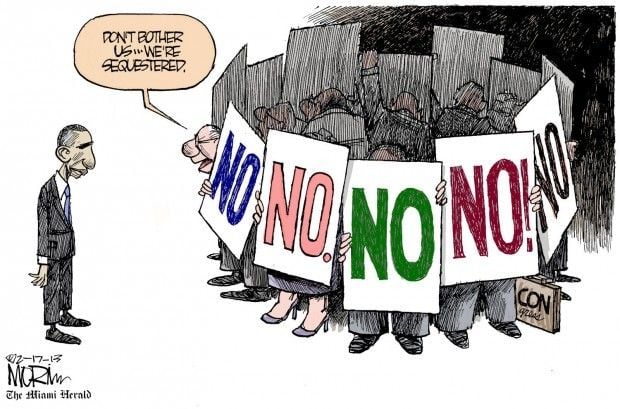
In a little noticed procedural move on October 1st, the House of Representatives “entered in to the stage of disagreement” with the Senate with respect to H.J.Res. 59, the “clean” continuing resolution (CR) that, as currently amended by the Senate, would reopen the government at the sequestered levels.[1]

Specifically, H.Res. 368 does two things.  The first is a tripartite bit of normal business in the “navette” system used by Congress to resolve differences between the two chambers’ versions of a bill,[2] stating that the House

      “(1) takes from the Speaker’s table the joint resolution … (2) insists on its amendment, and (3) requests a conference with the Senate thereon.”

What this means, in short, is that the House collectively asserts that it is “done considering” the Senate’s version of the CR, and requests that the two have a “sit down” to work out the details of a compromise.  This is pretty normal.

The “trickery,” which I absolutely love, is the second part, which states

      Any motion pursuant to clause 4 of rule XXII relating to House Joint Resolution 59 may be offered only by the Majority Leader or his designee.

What this little sentence does is further make discharge of a clean CR even harder.  I didn’t think about this charmingly arcane and surprisingly potent possibility when I wrote on discharge as a strategy to get a clean CR last week. (I haven’t seen anyone bring it up until this weekend, when the Democrats hit upon it.)  Under the standing rules of the House,

When the stage of disagreement has been reached on a bill or resolution with House or Senate amendments, a motion to dispose of any amendment shall be privileged.

What this means is that, conditional on the first part of H.Res. 368, under which H.J.Res. 59 reaches “the stage of disagreement,” any member of the House could at any time move that the House “recede and concur” with the Senate’s amendment, thereby approving the clean CR.

To be clear, this isn’t “undemocratic,” per se: H.Res. 368 was approved 228-199 (Roll Call 505)—an example of majority rule being used to make the rules arguably less “majoritarian.”[3]  Now let’s consider the MathOfPolitics of this move.

As I have argued before, in a variety of ways, the bargaining situation between the Democrats and Republicans in both chambers and President Obama is a decidedly “multi-player” situation and, importantly, one that the House GOP (and probably some of the House Democrats, too) would like to resolve in a nuanced manner.  In particular, voting “yea or nay” on the clean CR is a blunt and high-profile signal to members’ constituents about the members’ relative priorities.  To the degree that the House GOP leadership and/or rank-and-file wanted to negotiate something other than a clean CR (or even just wait for a combined “CR and debt ceiling deal,” this logic implies that they need to avoid the possibility of facing a “clean vote” on a clean CR.  To attempt to get a conference with the Senate,[4] the House had to enter into the stage of disagreement.  But this step also would hand a gun to the minority: they could at any time force exactly the vote the majority did not want.

So, putting the two components of the rule together—thereby meaning that the House could affirmatively “act upon the Senate’s CR” only by agreeing to hand this agenda power to Majority Leader Cantor—represents a classic example of a “credible logroll.” Note that the rule change limits the preexisting agenda powers of all members, not just those in the minority party. The Republican majority, in order to negotiate as a somewhat unified body, agreed to “bind their hands” from the potential temptation to “just agree to a clean CR.”

This type of procedural commitment strengthens the ability of Boehner and Cantor to “speak for” the House in the ensuing negotiations.  If the motion to recede and concur with the clean CR had been available to any member, as usual, then the Senate and/or President Obama could attempt to simply build a floor majority, without any special need to focus on/pay attention to the position of the House Leadership.  In a sense, the House signed away a limited, but durable, “power of attorney” to Boehner and Cantor on the CR negotiations.

With that, I leave you with this.

______________

[1] Remember, the sequester? HAHAHAHA.  Well, the Senate Democrats do.  Note the link between this position and my recent post on how appearing to lose may help one win.

[2] It’s tripartite because each of the three parts could in theory be debated and voted upon separately, but this is rarely if ever done in the House.  (They were accomplished here, as is pretty common, through a single vote on a “special rule” from the Rules Committee.) In the Senate, the analogue of this three-step process is one of the minority party’s secret weapons against the “nuclear options.”  But I will leave this to the side….for now?

[3] Hey, it’s my blog, so I’ll remind you that I’ve written and published (i.e., something more than a blog post) on this question.

[4] This might seem like a waste of time given hindsight, but I’ll simply point out that this step was necessary for the House to make it seem like the Senate was the roadblock to reopening the government (because the Senate did not agree to the conference).  Public opinion since October 1 seems to indicate this strategy failed to impress.

SHUTDOWN: The Inherent Tension Between Responsive & Responsible Governing

The US federal government is currently “closed” because the Democratic and Republican parties cannot agree to what seems to be a Pareto optimal (i.e., unanimously preferred) policy (namely, the government being “open”).

I will dispense with current events and turn immediately to the question of “why?”  This shutdown is arguably different than the most recent (1995-96) one.  In the previous shutdown, a Republican controlled Congress attached policy prescriptions to measures keeping the government open (known as continuing resolutions, or “CRs”).

That sounds similar to this situation…but remember, in 1995 the GOP had not controlled both chambers of Congress for FORTY YEARS.  (Interestingly, Bill Clinton was arguably slightly more popular (in terms of job approval margin) when he faced the shutdown than Barack Obama is now.)  So, in a sense, the stance they took could be argued to be “a new one” with respect to the status quo policies.

Now, of course, the GOP’s focus is on a policy that has most definitely been debated and redebated repeatedly over the past 3 years: health care.

So, why the impasse?  Well, in game theory, there’s a classic result (really, family of results) known as the “folk theorem.”  This result states that cooperative (Pareto optimal) outcomes can be sustained, even in spite of players’ short-run incentives to shirk/defect/fight, so long as the players expect the game to “continue for long enough.”[1]

The basic (very loose) intuition behind the folk theorem is that, if two players are facing each other in the same game repeatedly (i.e., “for long enough”), “defecting/selfish play” by one player can lead to “defecting/selfish play” by the other in future periods/iterations of the game.  Thus, this specter of punishment of today’s poor behavior deters such behavior in pursuit of higher sustained cooperative payoffs in future iterations of the game. The political salience of this possibility in the present conflagration is brought out by this article. In a nutshell, Speaker Boehner arguably might worry that effecting a compromise will lead to his ouster as Speaker of the House. But this leads to the question of why members of either party would risk overturning normal order and replacing a Speaker for enabling a seemingly obvious, common-sense, and efficient (if stop-gap) compromise.

A key feature of today’s electoral environment—especially for members representing “tea party” (i.e., very conservative) and “tree hugger” (i.e., very liberal) districts—is a high level of uncertainty—not about the general election, but the primary election.  In particular, the internal politics of both parties, combined with both demographic (immigration/aging) and technological (facebook/cell phones/twitter) changes has arguably made things like microtargeting possible and highly potent in terms of mounting a “challenge from the extremes” in primary elections—especially in ideologically homogeneous districts.

In some ways, such changes are “good”: to the degree that voters’ wishes should be respected, these changes potentially reduce the stagnation attributed historically to regularities such as the “incumbency advantage.”

On the other hand, such changes arguably increase the incentive for (reelection-seeking) members to “dig their heels in” as a bulwark against potential challengers from the extreme of their in the upcoming election.  To think about this concretely for a second, note that both Democrats and Republicans have been against a “clean CR” (one that would simply extend funding at the present (sequestered) levels.[2]

I will not delve into the details of this opposition too much, but simply consider this vote and this vote—in both, the extreme liberals and conservatives of the House essentially voted “in protest” of what was about to happen.  This “(ideological) ends against the (ideological) middle” type of conflict is rare in Congress.  That’s because, from a simple “yea/nay vote on a bill” perspective, it doesn’t really make sense: one of the “ends” should be happy about the (either left or right) direction embodied in the bill in question.

But here—the conflict is not about the policy, it’s about the appearance of supporting the policy as opposed to a hypothetical counterfactual.  The liberals against a clean CR (at least early on) wanted to make it clear that they favored expanding funding back to the pre-sequestration levels.  The conservatives against a clean CR wanted to make it clear that they were against Obama the Affordable Care Act.

So, in this situation, as in all good social science: there’s a pro, a con, and a lot of gray.[3]

On the one hand, members are arguably very attentive to their constituents. YAY!

On the other hand, members are unsure about how constituents will interpret their actions. BOO!

The gray area comes about because, it is not clear to me that the voters are actually clear on what THEY want either.  The Affordable Care Act polls very badly.  I doubt that it will do so in five years. But, to be fair, this is a democracy.  The question, then, is do we want Congress to make long-lived policy choices based on what “we want them to do now,” or on what “we, looking back in 20 years, will want them to have done now”?

That’s paternalism, of course, though arguably in a slightly subtle guise.  But, if you say you’ve never worried about your short-term impulses and tried to constrain yourself, then I say, you should. When you “worry about short-term behavior,” this is equivalent to worrying about the impact of revisiting/second-guessing “normal” decisions on a regular basis.

The problem in this situation, then, is that we are (at least in certain districts, and arguably everywhere but to different extents) an electorate that allows itself to constantly reconsider “what has my representative done for me lately?”  Keeping your representative “responsive” can provide strong incentives to pander and/or “act tough/sincere/ideologically pure.”

_______________________

Notes.

[1] Folk theorems rely on something known as “the discount parameter,” which indicates how much one values “rewards received tomorrow” relative to “rewards today.”  In other words, a higher discount factor means one is more patient. The interpretation of the discount parameter in practice is a bit ambiguous, but one positive determinant of its value in this context is the likelihood that the player in question will be involved in the interaction in question (i.e., policymaking) again in the future.  Thus, higher certainty of reelection for any GOP member of the House implies that this member’s discount parameter should be higher, ceteris paribus.

[2] Remember the sequester?  Remember the fiscal cliff?  Ahh, we were so innocent. Turns out that was just a “fiscal step.”

[3] In much good social science, there’s also a con man.

A Byrd in the Hand, or the 3 R’s of the Senate: Reid, Rules, & Retribution

Forceful confrontation to a threat to filibuster is undoubtedly the antidote to the malady.
–Sen. Robert Byrd (D, WV)

Filibuster reform in the US Senate has once again begun to attract attention.  In a nutshell, Majority Leader Harry Reid (D, NV) is—ahem—upset that—in his opinion, at least—Republican Senators are unreasonably holding up executive branch nominations out of either animus towards the Obama Administration, hostility to the missions of the government agencies in question, or both.  As a result, Reid is contemplating “the nuclear option,” in which the Democrats and Vice President Joe Biden, as President of the Senate, would use the essentially majoritarian character of the Senate’s rules to clarify that the Senate is—particularly when a majority is ticked off—an essentially majoritarian body in which 51 votes wins.

Senate Republicans, who hold a minority of seats, are understandably upset about the possibility of “the bomb being dropped” and are threatening retribution if Reid goes nuclear.  I will not describe the procedural details of the nuclear option, which are easily found for those who, like me, enjoy parliamentary skullduggery. Instead, I will focus on the “mathofpolitics” of Reid’s situation.

Let’s set up the problem in a succinct fashion.  Going nuclear, Reid and the Senate Democrats can at least ensure an up or down on nominees.  While it isn’t clear (feel encouraged to clarify this for/update me in the comments or “offline/online” by emailing me)  exactly how “big” of a nuclear bomb Reid will/can drop in the sense of whether it would guarantee votes on all executive nominations, including judicial, or just those to executive agencies (or some other subset), I’ll keep it simple and just presume it’ll apply to all nominations, but not legislation.

Presumably, being able to get a timely up or down vote on nominations will be good for Reid and the Democrats right now, because President Obama is a Democrat.  So, there’s the easiest argument for why Reid should “go nuclear.”

However, there are at least two frequently forwarded arguments for why Reid should not go nuclear: the “scorched earth” argument and the “uncertain majority” argument.  The scorched earth argument goes as follows: if Reid goes nuclear and ensures votes on nominations, then Senate Republicans will find new ways to halt business, and retaliate by slowing the Senate down even more.  The uncertain majority argument, on the other hand, points out that the Democrats will not hold the majority forever, and their procedural victory will eventually get used against their interests by a subsequent Republican majority. I’ll consider these arguments in turn, and then summarize a “third way” that Reid might go.

As Ezra Klein points out, the scorched earth argument is (arguably, at least right now) less powerful than one might presume.  In a nutshell, this is because one might argue that the Republicans are currently “blocking everything” anyway.  (This is shorthand—as Minority Leader Mitch McConnell (R, KY) and others have pointed out, the Senate Republicans are not blocking everything, or even all nominations.)  Accordingly, from a game theoretic perspective, one might argue that this argument should not have much impact on the Democrats’ decision to go nuclear or not.  Indeed, it suggests a rationale for why Reid and the Democrats should at least threaten to go nuclear: if the Republicans recognize that the scorched earth argument does not have much pull on the Democrats, then they will take such a threat more seriously and, to the degree Republicans do not want the nuclear option used, they will have an incentive to offer concessions to avoid its use.  (See the great series of posts essentially about this dynamic by Jonathan Bernstein and Sarah Binder, (here’s Bernstein’s response, and Binder’s response).)

Perhaps as a result of the limitations of the scorched argument in the current stand-off, the uncertain majority argument has been quickly brought forward by Senate Republicans.  Indeed, while the scorched earth argument has been publicly forwarded, too, it has essentially been quickly replaced/backed up by the uncertain majority argument. For this reason, as well as the fact that the excellent exchange between Bernstein & Binder essentially focuses on the likelihood/credibility of the scorched earth response, I will move on to the uncertain majority argument.

First, the uncertain majority argument is not dispositive. (Note that the scorched earth argument, to the degree that the minority can credibly implement it, is potentially dispositive in the sense of its irony: vote to speed things up and instead slow things down.)  This is because a bird in the hand is arguably better than two in the bush.  Reid’s experience with the Senate Republicans may have shown him that there may not even be one “in the bush.”  The real worry here is that, to the degree that Reid and the Democrats are actually tempted by the nuclear option, the GOP will presumably also be tempted by it when it gains the majority.

Let’s think about this for a second.  Thinking about the strategic situation in a little offers some insight into the relevant factors all Senators should be thinking about.

Suppose first that the nuclear option is “popular” in the sense that the public will approve (or at least not disapprove) of its use.  Well, in this case, the majority party should realize that, if they go nuclear, then—ceteris paribus—they are more likely to retain the majority.  More subtly, if we presume that this popularity is likely to hold into the near future, the majority should realize that if the minority party gains the majority in the near future, the new majority party will face a similar situation and, accordingly, the current minority party is likely to go nuclear at that point.  Both scenarios suggest that the Democrats should go nuclear: it would be popular and the minority party would do it if they gain the majority in the future.

So, under what conditions would the nuclear option not be a good choice?  Well, it boils down to two questions:

  1. Would “going nuclear” be unpopular/electorally costly? (Republican Senators are arguing that it would be.  Extra credit: given that we have a two-party system, why should one be at least a little skeptical of this statement?)
  2. If one does not go nuclear now, will “going nuclear” be popular in the future?

The first question is more pressing than the second, if only because of “bird in the hand” reasoning.  I don’t know the answer, and it’s not clear to me that anyone does, because I don’t think voters care, per se, about this procedural move: they want the Senate to “play by the rules” and “get things done” (i.e. the “cake and have it too” syndrome).  What is clear to me, however, is that Reid’s actions will frame the issue and at least partially determine the popularity of “going nuclear.”  I return to this below to conclude the post but, in a nutshell, I think this dimension is what will ultimately prevent the Democrats from going nuclear and, to be clear, I think part of that is Reid’s fault (but maybe by design).

The second question—will going nuclear be popular in the future—is truly secondary for now, but this will potentially be less true in 2016, should the Democrats hold on to the Senate majority in 2014.  This is because President Obama is a Democrat, and the Republicans’ promised uses of a “51-vote Senate” (e.g., read to the end of this) include using “their majority control to jam through a repeal of the Affordable Care Act, a repeal of the Wall Street Reform Act and other GOP priorities.”  Indeed, Sen. Lamar Alexander (R, TN) “said the GOP conference could pass with a simple majority vote legislation to weaken unions, authorization to complete the Keystone XL oil sands pipeline and other items.”

Because neither party controls two-thirds of either chamber, I have a strong suspicion that neither “a repeal of the Affordable Care Act” nor “a repeal of the Wall Street Reform Act” will actually occur before January 2017: I just can’t see President Obama signing such bills (in fact, I kind of doubt that the GOP would pass such bills even if they had the numbers).

So, I think the primary question for Senate Democrats is how electorally costly going nuclear would be.  As I alluded to above, I think going nuclear would give the GOP a useful mobilizer for the 2014 midterm elections.  Right now, the GOP doesn’t have much of “an issue” to run on in my opinion (neither do the Democrats).  “Breaking the rules to ram through executive appointments” particularly against the backdrop of the AP wiretaps/PRISM/IRS/Benghazi scandals (not to mention the for-now-arcane recess appointments dustup), might have a lot of traction with swing voters.

Reid’s actions at this point are key.  For all of the parliamentary Dr. Strangelove’s out there, this is how I would go nuclear if I were Reid.  (I’m not the first by any means to make this argument, but sometimes it’s good to repeat things that seem to make sense.)

Reid should force the GOP to take the floor.  He should essentially set aside the “tracking system” in which the Senate moves from item-to-item in a parallel fashion.  He has said the GOP is being obstructionist.  Instead of trying to invoke cloture on the nomination of (say) Gina McCarthy (currently awaiting confirmation as administrator of the EPA), Reid should bring McCarty’s confirmation up for debate, and not let the Senate move on until a vote is taken.  MAKE THE GOP FILIBUSTER/OBSTRUCT IN PUBLIC

In equilibrium, voters should not believe Reid’s claims that the GOP is obstructing business.  We as the electorate could, I suppose, crack open the Congressional Record and try to discern the counterfactuals but (1) that is actually pretty hard to do in a sensible way—if obstruction is unpopular (which it essentially must be if going nuclear will be electorally popular), then obstructionists have an incentive to obfuscate their obstructionism (say that 3 times fast), and (2) as Anthony Downs famously made clear, we not only aren’t going to, it isn’t even clear that it would be rational for us to take the time to do so.  No…if overcoming obstructionism is a big deal, Reid and the Democrats need to sit down and send the costly signal of its importance to the public by (ironically) forcing the GOP to obstruct in a visible fashion.  I don’t think Reid is going to do this, and maybe that’s the right decision, given the facts, but if he doesn’t do this, I don’t think he’ll go nuclear.  Senate rules are kind of like an A-Team episode: sure, there’s a lot of fights, but nobody ever dies.

With that, I continue a theme and leave you with this.


Gresham’s Law in the Senate: How Filibuster Reform Begot Rand Paul’s Filibuster

Bad money drives out good. – Gresham’s Law

Gresham’s law was coined (hahaha!) back when it was apparently okay to call things laws based on a hunch.  Nonetheless, it has a solid theoretical foundation.  To understand it, just consider how you would pay for things if gold and lead were both made legal tender at the same price per pound (hint: you wouldn’t be smart to pay gold for anything).

I bring up Gresham’s law because today’s filibuster by Rand Paul—still ongoing as I write of this—highlights a similar phenomenon that has emerged recently in the Senate.  During the first two months of the 113th Congress, there have already been filibusters of presidential nominations (2 cabinet-level (Hagel & Brennan), one judicial (Halligan), and this phenomenon is directly, and presumably ironically, tied to the filibuster reforms agreed to in January.

In a nutshell, these reforms eliminated or limited the ability to filibuster some (arguably redundant) procedural steps, sped up cloture, and created a few explicitly bipartisan maneuvers that can be used to thwart holds on legislation (thus making it easier for the Majority and Minority Leaders to work together so as to actually begin debate on a bill).

The details of these changes are beyond the scope of tonight’s post.  The point/analogy I want to make can be summarized in two steps.

  1. Filibusters are often about a Senator or group of Senators seeking attention, where “attention” can take many forms: the opportunity to offer amendments, policy or patronage concessions from the President, etc. Accordingly, and particularly if the attention is rather parochial or not on the legislative agenda (as in the case of stonewalling by the White House in the face of requests for clarification about when the President can have drones kill people on American soil), it is often either strategically optimal or logically necessary to filibuster something that is unrelated to the content of the attention that the Senator(s) seek.

  2. The rules changes adopted in January explicitly exempt Cabinet-level and judicial nominations.  Without belaboring the point, the clear goal of the filibuster reform package was to increase the individual cost of filibustering, but it did not do so uniformly.  In other words, while the individual costs of filibustering other matters have increased following the reforms, the cost of filibustering Cabinet-level and judicial nominations is still the same..

Combining these two points: the “currency” of a Senator seeking attention is fundamentally that most precious of all commodities: time. Even in the Senate, where a day is often not a day, an hour is an hour is an hour.  However, the filibuster reforms made some, but not all hours of Senate time more expensive than others for a Senator upset about drone strikes and White House stonewalling.  Tonight, Rand Paul is simply using the cheap coin rather than the expensive one: quite fitting for one who is presumably dubious of bimetallism.

And, speaking of “bad coin,” I leave you with this.