Trump Has Raised Little Money, Much Unitemized. SO SAD!

Much has been made today of Donald Trump’s lackluster fundraising productivity in May. I’m going to pile on here, because his campaign is an absolute fiasco in essentially every sense.

In lieu of a full analysis of what this means in terms of inference and prediction, here are three simple rankings/comparisons.  (For the full read of the data, see here: BernieHillary, Trump.)

Total contributions, through the entire cycle through May:

  1. Bernie: $224 Million.
  2. Hillary: $207 Million.
  3. Donald: $17 Million.

Candidates can loan money to their own campaign (meaning they can use campaign contributions to pay themselves back):

  1. Donald: $45 Million.
  2. Hillary: $0.
  3. Bernie: $0.

Third, donations to federal campaigns fall into two categories: itemized and unitemized.  Itemized donations are those that, in sum, for an individual, exceed $200.  Unitemized are those that sum to less than $200 for the donor.

With that said, the proportion of donations that are unitemized to date for each candidate:

  1. Donald: 72.9%
  2. Bernie: 59.0%
  3. Hillary: 21.6%

What does this indicate?

First, Bernie and Hillary are vastly outperforming Trump in terms of raising money.  VASTLY. There’s a bit of chicken and egg here, but the simple fact is that raising money requires a ground operation, and the data confirms observation that Hillary and Bernie have such operations in place, and Trump—well, not so much.

Second, Donald Trump is actually self-financing his campgin on the idea that he will get sufficient contributions to pay himself back.  Hillary and Bernie are not doing so.

Third, Hillary’s contributions are coming from “big” donors much more than are Donald’s (limited) contributions or Bernie’s (significant) contributions.  For Bernie, this makes sense: he is appealing to a swath of the US electorate that doesn’t generally have the wherewithal to donate $200 to a political campaign.

For Trump, maybe the same argument applies…Don’t know.  It’s just a very large ratio of unitemized contributions.  I’ll leave it there.

With this, and in light of the absolutely shameful failure of the Senate to undertake serious efforts at preventing gun violence yesterday, I leave you with this.

Comparing the Legislative Records of the Candidates

This is a guest post by David Epstein. 

Picture this: you are on a committee to hire a new CEO for a large, multinational firm. There are a number of qualified candidates, you are told, each of whom has many years of experience in the relevant field, and then you are handed a background folder on each of them. In the folder you find detailed statements of what they would like to do with the company if they are hired.

So far so good, but when it comes to the candidates’ histories, the folder talks only about their deep formative experiences from when they were children, along with some amusing anecdotes from their lives over the past few years. Nowhere, though, does it tell you how these candidates have actually performed in their professional careers. Have they been CEO’s before? If so, how did their companies do? What projects have they tackled in the past, and what were the outcomes? All excellent questions, but nothing in the files provides any answers.

This is the situation voters find themselves in every four years when choosing a president. They are told what policies the candidates promise to enact if elected, sometimes with an evaluation of how realistic and/or desirable those policies would be. But nowhere, for the most part, are they given the candidates’ backgrounds in jobs similar to the one they are running for. (An outstanding exception to this rule is Vox’s review of Marco Rubio’s tenure as Speaker of the Florida House of Representatives.)

The Task Ahead

Here, I will begin to remedy this gap by comparing the legislative records of the four candidates who have spent time in the Senate: Sanders, Clinton, Rubio and Cruz. Sanders has proposed a “revolutionary” set of reforms; how likely is he to be able to make them into policy? Clinton spent twice as long as a senator from New York than as Secretary of State, but somehow that chapter in her political history is rarely spoken about. Rubio and Cruz are newer to the Senate, Rubio more of an establishment legislative figure (at least at first), and Cruz more clearly ideological. Do either of them have histories of getting their policies passed? And yes, it’s true – Rubio and Cruz have now dropped out of the race. But a) they might still be on the ballot as VP candidates, and b) it is interesting to compare them with the Democrats, as explained below.

Now, no one set of measures can completely capture how well a legislator does their job. I’ll be examining statistics having to do with proposing, voting on, and passing legislation, which might be considered legislators’ core activities. But members of Congress also must spend time doing constituency service, sitting on committees and subcommittees, appearing in the media, and more. And, of course, what of the candidates who were executives (governors) previously — how should we measure their performance? This analysis isn’t meant to be the final word on the subject; rather, it should provide some interesting material to consider and, hopefully, open a wider discussion on assessing candidates’ qualifications for the presidency.

TL;DR: Clinton comes out looking good in terms of effectiveness and bipartisan cooperation, and Rubio does surprisingly well for his first term, sliding down after that. Sanders had a burst of activity from 2013-14, but his years before and after that aren’t very impressive. Cruz’s brief time in the Senate has been almost completely unencumbered by working to pass actual legislation.

Left-Right Voting Records

Let’s start by looking at how liberal/conservative the candidates’ voting patterns were while in office. Political scientists have developed a scale for measuring the left-right dimension of voting, called the Nominate score. I ranked these scores by Congress, with 1 indicating the senator with the most liberal voting record, and 100 being the most conservative. [NB: Each Congress lasts two years, with the 1st going from 1789-1790, and so on from there. For our purposes, the relevant Congresses stretch from the 107th (2001-02) to the current 114th Congress (2015-16). Since the 114th isn’t over yet, its statistics should be correspondingly discounted relative to the others.]

As shown in the table below, the four candidates form almost perfectly symmetric mirror images of each other. Clinton was around number 15 during her four terms in the Senate, while Rubio was 85. So each of them, despite being tagged as the “establishment” or “moderate” candidates in the primaries, was each more extreme than the average member of their own parties. That is, Clinton voted in a reliably liberal direction, even more so than the majority of her Democratic colleagues, while the same holds true for Rubio vis-à-vis the Republican senators.

Congress State Name Rank
107 NEW YORK CLINTON 14
108 NEW YORK CLINTON 15
109 NEW YORK CLINTON 13
110 VERMONT SANDERS 1
110 NEW YORK CLINTON 15
111 VERMONT SANDERS 1
112 VERMONT SANDERS 1
112 FLORIDA RUBIO 85
113 VERMONT SANDERS 1
113 FLORIDA RUBIO 86
113 TEXAS CRUZ 100

The Candidates, Ranked by the “Liberalness” of their Senate Voting
(1: Most Liberal, 100: Most Conservative)

Sanders and Cruz also form a perfect pair of antipodes. Sanders had the most liberal voting record for each of his terms, while Cruz was the most conservative. As a note: the only time that a party’s nominee had the most extreme voting record in their party was George McGovern in 1972 –- draw your own conclusions.

The symmetry is broken, however, when you consider the states the candidates represent(ed). Vermont is by many opinion poll measures the most liberal state in the country, and Clinton’s rank almost perfectly reflects New York’s relative position as well. Cruz and Rubio, on the other hand, have voting records considerably more conservative than Texas (number 33 out of 50 in conservative opinions of its voters) or Florida (number 23 out of 50) residents, respectively.

Bill Passage

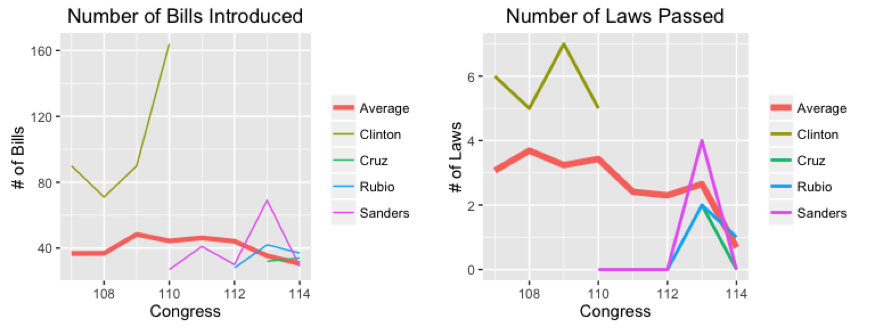
Voting analysis can give us clues to the kind of policies a president might pursue in office. But can they get legislation passed? The next two figures show the number of bills and amendments introduced by each candidate, and the number of those that eventually passed into law, along with the overall average for each Congress.
BillsAndLaws-Epstein

Note first that, although the average number of bills introduced has stayed more or less constant over time, the number actually passed has taken a nosedive in recent years. This reflects the increased partisan divisions in Congress, as well as the electorate, that have made Obama’s second term one where policy change may happen via executive actions or rulings in important Supreme Court cases, but rarely via the normal legislative route.

In terms of the various candidates, Clinton was by far the most active in terms of introducing and passing legislation; her totals are significantly above congressional averages for each of her terms in office. This makes sense in terms of her political history: Clinton entered the Senate in 2001 with a lot to prove — she had won just 15 of New York’s 62 counties in her 2000 election victory and wanted to establish herself as a legislator who could get things done. She worked hard, especially pushing programs that benefitted upstate New York’s more rural, agricultural economy, and was rewarded in 2006, winning re-election handily with a majority in 58 counties.

Sanders, on the other hand, has fewer legislative achievements to his name. He had a spurt of activity in the 113th Congress (2013-14), where, perhaps looking forward to his upcoming presidential bid, he introduced 69 measures, four of which passed into law. As noted above, Sanders has consistently represented his state’s liberal voters, but while the policies he has proposed may have been popular at home, in general they have not won sufficient support to be enacted into law.

Cruz and Rubio are about average in terms of measures introduced and below average for number passed. Neither, to date, has a major legislative initiative to their name. But see the next section, for Rubio’s record has more to it than it seems.

Co-Sponsorship

Actually passing policy means getting others to support your positions, and in today’s environment that entails getting members of the opposite party to vote in favor of your proposals, at least every once in a while.

Thus we now turn to analysis of cosponsorship trends. When a bill or amendment is introduced by a member of Congress — making them the “sponsor” of that measure — other members of their chamber can register their support for it by adding themselves as “co-sponsors.”

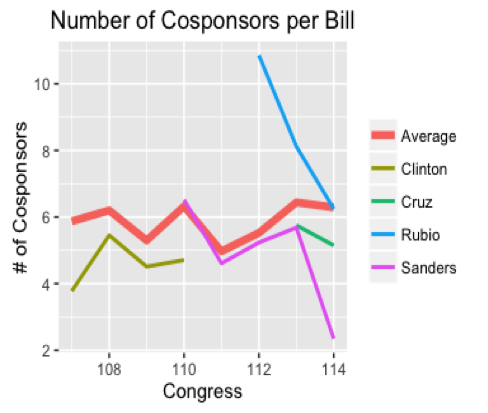
As the figure below shows, even though Clinton was far ahead of the others in terms of getting her bills passed into law, she did not have an especially high number of cosponsors per bill, on average. Neither did any of the other candidates, with the notable exception of Rubio in his first few Congresses.
Cosponsors-Epstein

As the chart shows, the few measures that he introduced in his first years in office were relatively high-profile, gaining the support of a number of colleagues. However, the efforts produced few results, one example being the immigration reform bill he introduced as a member of the bipartisan “gang of eight” after the 2012 elections. Thus Rubio’s time in the Senate — somewhat similar to his presidential campaign — started out with a flurry of activity but then faded out, as he failed to assemble coalitions to get behind his proposals.

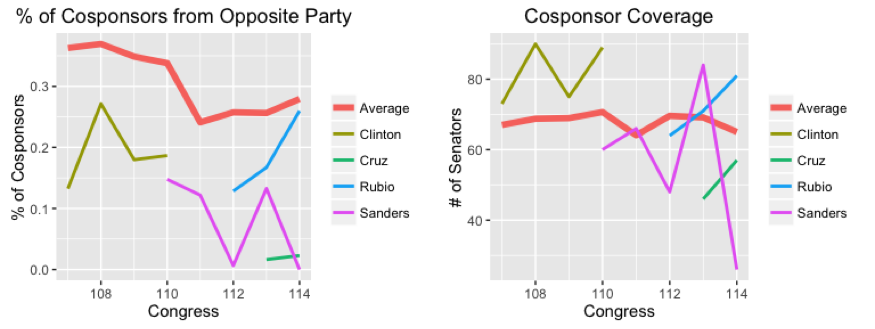
To measure the candidates’ track records of creating bipartisan coalitions, we look at two measures of their ability to attract the support of their colleagues from across the aisle. First, the percent of cosponsors who come from the opposite party. Second, a measure of “cosponsor coverage,” meaning the number of senators who cosponsored at least one measure proposed by the given candidate in the course of a single Congress.
Cosponsor-Coverage-Epstein

All of the candidates perform a bit below average in the percent of cosponsors from the opposite part, with Clinton and Rubio again doing better than Sanders or Cruz. And in the coverage measure, Clinton is relatively high, with Sanders and Rubio close on her heels (except for the most recent Congress, where Sanders has almost no cosponsors for the measures that he has introduced). Cruz is especially low in coverage, gaining three Democratic supporters in his first term, and four in this, his second term. Of course, Cruz has spent his time in the Senate mainly working to oppose existing policies (via government shutdowns and filibusters) rather than create new ones, so this is not too surprising.

Conclusions

Of course, there has been one other sitting senator — the first since John F. Kennedy in 1960 — elected to the presidency, and that is Obama, who spend four years in the Senate prior to his election in 2008. (Nixon spent two years in the Senate before becoming Eisenhower’s VP, and Lyndon Johnson was a senator when he became Kennedy’s VP.) What would this analysis have said about him?

Obama’s voting record was a tad more conservative than Clinton’s — number 18 on the list compared to her 15 — but he also represented a slightly less liberal state than she did. He proposed an average of 68.5 bills each Congress, which is higher than average, but he only passed a below-average 1.5 bills per Congress. Thus Obama had a lot of ideas about what to do, but didn’t yet have the track record of being able to work with his fellow senators to bring these ideas to fruition.

Interestingly, Obama’s bipartisan measures are all average or above average compared to the other candidates, so while trying to garner support for his bills he was able to work with Republicans fairly well. This would probably have made it even more of a surprise when, once he took office, the Republican party as a whole refused to work with him in any fashion to pass his policy agenda.

Who’s Got The Power? Measuring How Much Trump Went Banzhaf On Tuesday

The Democratic and Republican Parties each use a weighted voting system to choose their presidential nominees.  This only matters when no candidate has a majority of the delegates, and the details are complicated because the weight a particular candidate has is actually a number of (possibly independent) delegates.  Leaving those details to the side, let’s consider how much Donald Trump’s wins on Tuesday April 26th “mattered.”  The simplest measure of success, for each candidate, is how many additional delegates they each won.  As a result of Tuesday’s primaries, Trump is estimated to have picked up 110 delegates, Senator Cruz is estimated to have picked up 3, and Governor Kasich similarly is estimated to have picked up 5.

A key concept in weighted voting games is that of power.  There are literally countless ways to measure power, but one of the most popular ways is called the Banzhaf index.

If there are N total votes, and a candidate “controls” K of those votes, the Banzhaf index measures the probability, given the distribution of the other N-K votes across the other candidates, that the candidate in question will cast the decisive vote: that is, that he or she will have enough votes to pick the winner, given every way the other candidates could cast their ballots. (I’m skipping some details here.  For the interested, the most important detail is that the index presumes that the other candidates will randomly choose how to vote.)

A higher power index implies that the candidate is more likely to determine the outcome. What is key is that the power index for a candidate with K votes out of N is generally not equal to \frac{K}{N}.  For example, if a candidate has over half of the votes,[1] then that candidate’s Banzhaf index is equal to 1 (and those of all other candidates are equal to zero, and we’ll see that come up again below), because that candidate will always cast the decisive vote.
So, back to Tuesday.  Here is the breakdown of how the GOP candidates’ delegates translated into “Banzhaf power” before Tuesday’s primaries.

Candidate Donald Trump Ted
Cruz
John Kasich Marco Rubio Ben Carson Jeb
Bush
Carly Fiorina Rand Paul Mike Huckabee Total 
Delegates 846
(48.85%)
548
(31.64%)
149
(8.6%)
173
(9.99%)
9
(0.52%)
4
(0.23%)
1
(0.06%)
1
(0.06%)
1
(0.06%)
1,732
Banzhaf Power 0.5 0.1667 0.1667 0.1667 0.1667 0 0 0 0

Going into Tuesday’s primaries, Trump held just under majority of the delegates and held exactly half of the power.  More interesting in this comparison is that Marco Rubio’s power was still significant: in fact, equal to the individual powers of Kasich and Cruz.

Even though Rubio and Kasich each had less than a third of Cruz’s delegates, their voting power as of Monday was equal to Cruz’s. This is due to the fact that Rubio, Kasich, and Cruz could defeat Trump if and only their delegates voted together, regardless of how the other delegate-controlling candidates had their candidates vote.  In other words, Carson, Bush, Fiorina, Paul, and Huckabee truly had—as of Monday (and today)—no bargaining power at a contested convention.

However, after Tuesday’s results, the following happened:

Candidates Donald Trump Ted
Cruz
John Kasich Marco Rubio Ben Carson Jeb
Bush
Carly Fiorina Rand Paul Mike Huckabee Total
Delegates 956
(51.68%)
551
(29.78%)
154
(8.32%)
173
(9.35%)
9
(0.49%)
4
(0.22%)
1
(0.05%)
1
(0.05%)
1
(0.05%)
1,850
Banzhaf Power 1 0 0 0 0 0 0 0 0

By securing a majority of the delegates allocated so far, Trump’s power jumped from 0.5 to 1 and all of his opponents’ powers dropped to zero.  If the convention occurred today, they would be powerless to stop Trump.

Now, suppose that the candidates had votes equal to the actual votes (rather than delegates) they receive.  If the convention were held today under such rules, this would result in the following:

Candidates Donald Trump Ted
Cruz
John Kasich Marco Rubio Ben Carson Jeb
Bush
Jim Gilmore Chris Christie Carly Fiorina Rand Paul Mike Huckabee Rick Santorum Total
Popular Votes 10,121,996
(39.65%)
6,919,935
(27.10%)
3,677,459
(14.40%)
3,490,748
(13.67%)
722,400
(2.83%)
270,430
(1.06%)
2,901
(0.01%)
55,255
(0.22%)
36,895
(0.14%)
60,587
(0.24%)
49,545
(0.19%)
16,929
(0.07%)
25,530,125
Banzhaf Power 0.5 0.1667 0.1667 0.1667 0 0 0 0 0 0 0 0

If the popular votes were the basis of the GOP nomination and the convention were held today, then the candidates would still have the same “powers” as they did prior to Tuesday’s primaries.  Thus, on Tuesday, we arguably truly witnessed the effect of the “delegate system.”

As a final note, this power calculation clearly indicates something that I think is underappreciated about multicandidate races in majority rule settings.  To break Trump’s lock on the race, it is unimportant which candidate (other than Trump) an “unpledged” delegate decides to support.  Right now, if and only if at least 62 unpledged delegates (and I have no idea how many of them there are left right now) decide to support “other than Trump,” then the Trump’s power drops below.  In addition to (and in line with) the fact that it doesn’t matter how those delegates allocate their support across the other candidates, if 62 such delegates appeared in the hypothetical conference tomorrow in Cleveland, the powers of the candidates would be as follows:

Candidates Donald Trump Ted
Cruz
John Kasich Marco Rubio Ben Carson Jeb
Bush
Carly Fiorina Rand Paul Mike Huckabee Total
Delegates 956
(50%)
613
(32.06%)
154
(8.05%)
173
(9.05%)
9
(0.47%)
4
(0.21%)
1
(0.05%)
1
(0.05%)
1
(0.05%)
1,912
Banzhaf Power 0.97 0.004 0.004 0.004 0.004 0.004 0.004 0.004 0.004

Conclusion. There are two “math of politics” points in here. The first is that votes/delegates are definitely not a one-to-one match: indirect democracy is distinct from direct democracy—it’s always important to remember that.  The second, and more “math-y” is that, when people have different numbers of votes, it is not the case that the number of votes a person has is equal to his or her voting power.[2]

With that, I leave you with this.

PS: If you would like (Mathematica) code to calculate the Banzhaf index for this and other situations, email me.

___________

[1] I am assuming for simplicity throughout, in line with the rules of the GOP and Democratic Party, that the collective decision is made by simple majority rule.  One can calculate the Banzhaf index for any supermajority requirement as well.  As the supermajority requirement goes up, the power indices of all candidates with a positive number of votes converge to equality (guaranteed to occur when the decision rule is unanimity).

[2] For a great review of how this is important in the real world, see Grofman and Scarrow (1981), who discuss a real-world use of weighted voting in New York State back in the 1970s.

Trump, Cruz, Rubio: The Game Theory of When The Enemy of Your Enemy Is Your Enemy.

I posted earlier about truels and how the current GOP nomination approximates one.  In that post, I laid out the basics of the simple truel (i.e., a three person duel), assuming that the three shooters shoot sequentially.  Things can be different when the three shooters shoot simultaneously.[1]  Short version: Trump and Rubio aren’t allies, but game theory suggests they should both attack Cruz, in spite of this.

This is arguably a better model for debates than the sequential version, in which candidates prepare extensively prior to debate, largely in ignorance of the other debaters’ preparations. Leaving that interesting question aside, let’s work this out.  I assume that the truel lasts until only one shooter is left, and that each shooter wants to live, and is otherwise indifferent.  I’ll also assume that the best shooter hits with certainty.[2] The probability that the second-best shooter hits his or her target is 0<p<1 and the probability that the worst shooter hit his or her target is 0<q<p.

When there are two shooters left, each will shoot at the other.  Not interesting, but important, because this implies that the worst shooter wants to shoot at the best shooter in the first round. In the first round, both the second-best and worst shooters shoot at the best shooter.  Either the first best or second best shooter will be dead after this (if the second-best and worst shooter each get to shoot before the first best shooter, but miss, then the second-best shooter will be killed with certainty). There is also a chance that the worst shooter will win in the first round: the best shooter kills the second-best shooter (probability 1/3), and the worst shooter kills the best shooter (probability q<1).

What does this say about the GOP race?  Both Rubio and Trump should be shooting at Cruz.  This is a simplistic model, and it ignores a lot of real-world factors.  But that’s why it’s valuable, from a social science perspective: if (and when) the behaviors of the three campaigns deviate from this behavior, we know that we need to include those other factors.  Until then, you see, in this world there’s two kinds of models, my friend: Those with just enough to capture the logic and those who need to dig for more things to include.  We’ll see if this one needs to dig.

With that, I leave you with this.

____________________

[1]. For simplicity, I will assume that, if two shooters shoot at each other, then one of them, randomly chosen, will “shoot first” and, if he or she kits, kill the other shooter before he or she fires his or her weapon.  Note that, with this assumption, if shooter A knows that shooter B (and only shooter B) is going to shoot at shooter A, then shooter A should definitely shoot at shooter B.

[2]This assumption isn’t as strong as it appears. This is because the truel is already assumed to continue until only one player is left (note that it is impossible for zero shooters to survive, given the tie-breaking assumption).

The GOP’s Reality is Truel, Indeed

truel is a three person duel.  There are lots of ways to play this type of thing, but the basic idea is this: three people must each choose which of the other two to try to kill.  They could shoot simultaneously or in sequence.  The details matter…a lot.  I won’t get into the weeds on this, but let’s think about the GOP race following last night’s Iowa caucus results.  By any reasonable accounting, there are three candidates truly standing: Ted Cruz, Marco Rubio, and Donald Trump.  The three of them took, in approximately equal shares, around 75% of the votes cast in the GOP caucus.

The next event is the New Hampshire primary, and the latest polls (all conducted before the Iowa caucus results) have Trump with a commanding lead and Rubio and Cruz essentially tied for (a distant) second.  So, the stage is set.  Who shoots first?  And at whom?

The truel is a useful thought experiment to worm one’s way into the vagaries of this kind of calculus.  A difference between truels and electoral politics is that the key factor in a standard truel is each combatant’s marksmanship, or the probability that he or she will kill an opponent he or she shoots at.  What we typically measure about a candidate is how many survey respondents support him or her.  For the purposes of this post, let’s equate the two.  Trump is the leader, and Rubio and Cruz are about equal.

A relatively robust finding about truels is that, when the shots are fired sequentially (i.e., the combatants take turns), each combatant should fire at the best marksman, regardless of what the other combatants are doing (this is known as a “dominant strategy” in game theory).  Thus, if we think that the campaigns are essentially taking turns (maybe as somewhat randomly awarded by the vagaries of the news cycle and external events), then both Rubio and Cruz should be “shooting at Trump.”  This is in line with Cruz’s post-caucus speech in Iowa last night.

An oddity of this formulation of the truel is that it is possible that the best marksman is the least likely to survive.  This is true even if the best marksman gets to shoot first.

Is it current, or future, popularity? An alternative measurement of marksmanship, however, is not the current support, but the perceived direction of change in support.  After all, marksmanship is about the ability to kill someone on the next shot.

On this front, Rubio is currently the better marksman: his support in Iowa vastly exceeded expectations, while by many accounts (though not necessarily my own), Trump is the worst marksman.  If one buys this alternative measure, then the smart strategy for both Trump and Cruz is to “aim their guns” at Rubio.  We have a week to see who they each aim at.

Of course, a truel is a simplistic picture of what’s going on in the GOP nomination process. In reality, it is probably better to think that each candidate’s marksmanship depends on his (or her) choice of target.  Evidence suggests that it is harder for Trump to “shoot down” Cruz than it was for him to shoot down Bush.  Maybe I’ll come to that later.  For now, I’m still making sense of Santorum’s strategy of heading to South Carolina. For that matter, I’m trying to make sense of him being called “a candidate for President.”

With that, I leave you with this.

Super PAC (Bites) Man

Rick Perry’s campaign seems to be a little strapped for cash.  But, his super PACs have plenty of money. What gives?  Is this just bad management, or possibly a systemic regularity tied to the hot mess that is the race for the GOP presidential nomination?

It’s no secret that super PACs have changed the nature of the (early) election cycle.  They are currently taking in over 80% of the campaign contributions.  While this disparity is understandable (super PACs can accept unlimited donations from a single individual, whereas candidates can essentially accept no more than $5400 from any individual and $5000 from any PAC—see here), it is nonetheless striking.

Though the super PACs are well-funded, Perry’s support to date is apparently quite narrow.  Some have interpreted this as a problem with/for Perry, with which I don’t disagree, but I want to forward a different story.  Namely, I think that the narrowness of that support is at least possibly by design.  Not by Perry’s design, but rather by goals of the donors.

Super PACs are easily created and highly flexible.  They work by spending to directly affect elections, and though the ones discussed in the current media cycle are associated “with” a particular candidate, they are not bound to hold true to that association.  More importantly, as Perry’s current situation lays bare, it is actually fairly difficult for a super PAC to step in and bail out, even indirectly, a flagging campaign.  This is because of the 120 day “cooling off period” (see here) that the FEC requires before a former employee of a campaign can be “involved with independent expenditures” (e.g., hired by a super PAC). This arms-length restriction bolsters the independence of the super PACs—from the candidate(s) with which they are associated—and solidifies the sway held by a super PAC’s mega-donor.

The proliferation of super PACs is probably contributing to the bulge of GOP candidates, but the real impact of the change is not that big money is “taking over” politics.  Rather, the new wild, wild west of campaign finance has lowered the cost of entry into an all-pay auction of sorts: the evidence is clearly consistent with a story of “lots” of rich people seeking influence over the election, but the more interesting story is how these mega-donors are seeking it.  Mostly, they aren’t bidding for the same candidate’s attention.  Instead, they are jump-starting “new” campaigns.  While this might seem to imply that these mega-donors are trying to buy “their own man” into the White House, I think that it is actually better thought of as a branding strategy.  Right now, Perry’s super PACs are deploying staff and ads in Iowa (see here, for example).  Perry is polling horribly among GOP voters in Iowa (less than 1% in today’s poll—see here).  Why spend the money here?  Why spend the money on Perry at all?  Because if it works even a little, these mega-donors—and their super PAC organizations—will have more leverage bargaining with the real contenders for the nomination.

Spending money on Perry in Iowa has a great “upside” for the super PACs in terms of demonstrating their effectiveness.  Perry’s rise, if it occurs, will

  1. Look dramatic—if he polls at 2%, then his support will have doubled.
  2. Be nearly solely attributable to the super PACs, because nobody else is fighting for Perry.[1]

Together, Rick Perry is kind of like Atari or Polaroid—brand names that have positive name recognition but are available on the cheap—and presents a great opportunity for a mega-donor (and his or her campaign staff) to demonstrate their expertise, build their clout.  Running a campaign is hard, and the proliferation of mega-donors lays bare something that political scientists have known for a long time: money is a necessary, but not sufficient, condition for electoral success.  There’s “plenty” of billionaires who love attention and care about politics.  But, by definition, there are precious few “top campaign organizations.” Electoral politics is a competitive sport, and what matters is not how much money or talent you have, but how much more you have than your competitors.

If you’re depressed by the money in politics, take heart: there are two awesome parts of this take on the new reality.  First, these mega-donors are (at least partially) throwing their money around fighting one another. Second, the people being played hardest are the megalomaniacal politicians who are spending (a lot of) their own time running essentially “trial balloon campaigns.”  In other words, while super PACs might have at first seemed like a boon for candidates who sought relief from the constant need to raise money in relatively small increments from lots of donors, it seems now that they have the potential to eat exactly those candidates by being

  1. infinitely lived,
  2. legally untied to any specific campaign, and
  3. operationally having a “120-day cooling off period” barrier to insulate themselves.

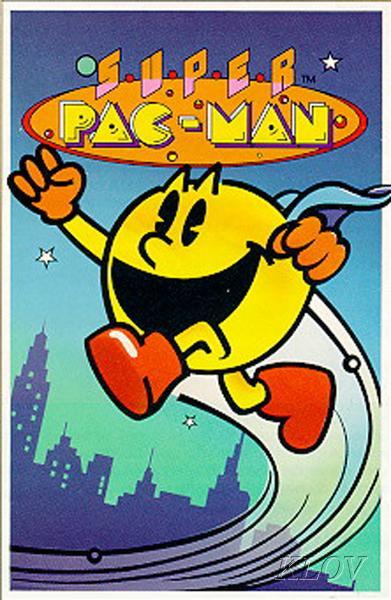
Super Pac-Man came out 33 years ago, the second sequel to Pac-Man.  Quoting wikipedia, the link may be deeper than simply nomenclature:

[Super Pac-Man’s] new gameplay mechanics were considered by many to be confusing, and too much of a change from the original two games. In particular, when Pac-Man transforms into Super Pac-Man, he was thought by some to be much more difficult to control.

Life imitates art, perhaps.  With that, I leave you with this.

[1] In addition, Perry’s campaign clearly isn’t going to be credited with any bump in the poll numbers, because it’s broke.  That raises other moral hazard problems (super PAC for candidate X might want to starve candidate X’s campaign) that are interesting, but I’ll leave them to the side for now.

This Thursday, At 10, FOX News Is Correct

FOX News just announced the 10 candidates who will participate in the first primetime Republican presidential primary debate on August 6, 2015. The top 10 were decided by these procedures.  Given that FOX is arguably playing a huge role in the free-for-all-for-the-GOP’s-Soul that is that race for the 2016 GOP presidential nomination, it is important to consider whether, and to what degree, FOX News “got it right” when they chose “10” as the size of the field. Before continuing, kudos to FOX News for playing this difficult game as straight as possible: the procedures are transparent and simple. Thoughthey have ineradicable wiggle room and space for manipulation, I really think this was an example of how to make messy business as clean as possible.  That said, let’s see how messy it turned out…

In order to gauge how important procedures were in this case, I examined the past 10 polls (data available here) to ascertain, in any given poll, who was in the top 10.[1]  The results are pretty striking in their robustness.  In spite of there being 19,448 ways to pick 10 from 17, the top 10 candidates in the final poll were in the top 10 of each of the 10 polls in 96 cases out of a possible 100.  Furthermore, in no poll was more than one of the chosen participants outside of the top 10.  Thus, there were 4 polls in which one of the debate participants was not ranked in the top 10, and 2 of these were the oldest pair in the series.

More tellingly, perhaps, is the fact that the smallest consistent “non-trivial debate group”—the smallest group of candidates that never polled at less than the size of the group in the 10 polls—is 3: Donny Trump, Jeb Bush, and Scott Walker composed the top 3 of each of the last 10 polls (that’s actually true of the last 15 polls).[2]

While I often like to be contrary in these posts, and I thought I might have an opportunity here, I have to say that, in the end, FOX News got this one right—the only direction to go in terms of tuning the size of the debate would have been down (to either 8 or 3, but I will leave 8 for a different post).  Given that logistics are the only real reason for a media outlet[3] to putatively and presumptively winnow the field of candidates in an election campaign, FOX News was, in my opinion (and possibly by luck), correct in setting the number at 10.

And, with that, I leave you with this.

______

[1] The oldest of these concluded two weeks ago, on July 20th.

[2] The reason I refer to a non-trivial debate group is that Donald Trump composes the smallest consistent debate group: he has held the number 1 spot in the past 16 polls. I will leave to the side the question of whether Trump debating himself would be informative or interesting.  I just don’t know if he is enough of a master debater, though I suspect that he loves to master debates.  Who doesn’t?

[3] Oh, yeah, I forgot to mention that Facebook is involved with organizing the debate. See what I did there?!?

The True Trump Card: You Can’t Buy Credibility

The rise of mega-donors has been an important storyline in the unfolding drama of the 2016 presidential election (for example, see here).  The presence of these donors in the political game (or at least their visibility) is partially the result of the Supreme Court’s decision in Citizens United.  But more interesting is whether the rise of these mega-donors has caused the explosion of seemingly viable (mostly Republican) contenders for the 2016 election.

The argument that Citizens United has caused the explosion in candidates is admittedly appealing.  As Steven Conn describes this argument in the Huffington Post,

Citizens United has created a new dynamic within the Republican Party. Call it the politics of plutocratic patrons, and at the moment it is causing the GOP to eat itself alive.

Continuing, Conn notes that the argument

works something like this: With the caps lifted on spending, any candidate who can find a wealthy patron can make a perfectly credible run at the nomination.

I’ve added the underline because this is where “the math” gets interesting.  If by perfectly credible, one means, “capable of spending lots of money,” then yes, I agree.  That was actually always true: the right of an individual (i.e., a “wealthy patron”to buy advertisements for any political issue/candidate has never been effectively curtailed.  Rather, the right of individuals to contribute without limit to organizations that can then do so has been, in fits and starts, regulated.

More importantly, though, the fact that anyone can do so now does not mean that wealthy patrons can guarantee that any candidate can make a “perfectly credible run” at the nomination.  As Conn notes, Foster Freiss is bankrolling Santorum’s 2016 bid.     …Does anyone think that Rick Santorum is a perfectly credible candidate for the GOP nomination?

Maybe Foster Freiss.

No, Rick Santorum is not going to win the GOP nomination.   Neither is Rick Perry. Neither is Chris Christie.  Neither is Carly Fiorina.  Neither is Bobby Jindal.  Of course, I might be wrong on any one of those five.  But I will assuredly be right on at least four.  In fact, if I wanted to type enough, I could be right about no fewer than 15 people who are currently running for the GOP nomination not winning it. (Evidence?  For the latest, see here.)

Simply put, if there are 16 “perfectly viable” candidates for the GOP nomination, then I’m throwing my hat in the ring, too.  WHY NOT?

Look, a wealthy donor can get you in the media.  That is easy, to be honest, if you have the money.  To be a credible candidate, you have to have a chance of winning.  Only one can win.  Lots can spend.  In social science, we often describe this kind of competition as an “all-pay auction.” In an all-pay auction, the highest bidder gets the prize after paying his or her bid.  All of the other bidders pay their bids and don’t get a prize.  It is a stinky, foul game.  (Kind of like running for the presidency.)

In the mega-donor world, the donors are now the bidders, and we are to believe that they want to create viable candidates through their monies spent.  But this is at odds with two points, one empirical and one theoretical.  The empirical point is that these mega-donors are often successful investors and businesspeople.  The theoretical point is that, when there is a single prize, the all-pay auction should not generally see any positive bid from more than two bidders.[1]

These mega-donors have the real-world experience to understand the theoretical point.  …So what are they thinking?

Aside from misunderstanding the game (which can not explain all of the 14 or so “out of equilibrium donors” under the simplistic all-pay model), there are two immediate explanations.  The first is vanity: these donors want to play with the “big kids,” have a roll in the hay with the DC cognoscenti, etc.  While I think that’s obviously got some purchase, it is both unsatisfying and seems too simple for billionaires.

Accordingly, the second is that some or all of these donors are playing the long game with the real contenders.  You see, what the all-pay auction analogy to multicandidate elections misses (among assuredly other things) is that the auction is actually for multiple prizes—each person’s vote is (slightly) differential in value to the bidder, because if it is not bought by me then it might go to various different candidates.

To make this concrete, suppose for simplicity that a donor supported some new candidate, “Charlie,” with money spent in a way that bought a bunch of votes exclusively from nativist (anti-immigration-reform) voters.  That would hurt some GOP candidates (such as Donny Trump, who is anti-immigration-reform) more than others (such as Jeb Bush). If I, as a mega-donor, am in favor of Trump not winning the nomination, supporting Charlie might be much more effective in the multicandidate, winner-take-all game of the GOP nomination fight than simply handing that same money to Jeb. (This is because I could take votes away from Trump—for Charlie—that Jeb could not steal away himself, thus causing Jeb to win because Trump loses votes.  This is another instance of the Gibbard-Satterthwaite Theorem.)

As Conn describes the picture, I completely agree with the main point: Citizens United might very well have unleashed a beast upon the GOP hierarchy (at least for now), because it is harder for the party establishment to control mega-donors, who can now be solicited for “simple checks” by super-PACs and 527 groups.  But, I disagree that this is because the new system increases the realm of “viable candidates.”  Rather, it simply lowers the prices of diversion, smoke, and mirrors in the nomination game.

Is that good or bad?  I’ll defer for now, but I’m perfectly willing to say that it’s neither.  It just changes the game—in the end, money matters, but votes matter more.  In other words, to paraphrase Mencken, though the ways may vary according to the institutional details, donors and voters will invariably get the government they want, and they’ll get it good and hard.

With that, I leave you with this.

__________

[1] This is a blog post, so I’m being quick about this.  But the basic idea is that the contestants have some common beliefs about their (generally differing) levels of resources (or valuations of winning) and, with few exceptions, the bidder who is capable and willing to pay the third-highest (or lower) price for the prize will not bid because he or she will not willingly sustain a bid that would win in equilibrium.

On The Possibility of An Ethical Election Experiment

The recent events in Montana have sparked a broad debate about the ethics of field experiments (I’ve written once and twice about it, and other recent posts include this letter from Dan Carpenter, this Upshot post by Derek Willis, and this Monkey Cage post by Dan Drezner).  I wanted to continue a point that I hinted at in my first post:

[T]he irony is that this experiment is susceptible to second-guessing precisely because it was carried out by academics working under the auspices of research universities.  The brouhaha over this experiment has the potential to lead to the next study of this form—and more will happen—being carried out outside of such institutional channels.  While one might not like this kind of research being conducted, it is ridiculous to claim that is better that it be performed outside of the academy by individuals and organizations cloaked in even more obscurity.  Indeed, such organizations are already doing it, at least this kind of academic research can provide us with some guess about what those other organizations are finding.

Personal communications with colleagues and readers indicated that Paul Gronke was not alone in interpreting my message in that passage as something like “well, others intervene in elections in unethical ways, so scholars don’t need to worry about ethics.”  That was not my intent.  Rather, I was trying to make the point that interventions by academic researchers are more likely to be transparent and, accordingly, capable of being judged on ethical grounds, than interventions by others.  Of course, that is a contention with which one might disagree, but I’ll take it as plausible for the purposes of the rest of this post.[1]

Reflecting further on the ethics of field experiments led me to a classical social choice result known as the liberal paradox, first described by Amartya Sen.  The paradox is that respecting individual rights can lead to socially inferior outcomes.  The secret of the paradox is that sometimes our preferences over our actions depend on what others’ do (also known as “nosy preferences”).

The link between the paradox and the ethics of experimenting on elections in the following simple way.  Let’s choose between four possible worlds, depending on whether scholars and/or political parties do field experiments on elections, and let’s take my assertion about the value of open academic research as given, so that “society’s preference” is as follows:[2]

  1. Nobody does any field experiments on elections, (the “best” option)
  2. Scholars do field experiments on elections, political parties do not,
  3. Both scholars and political parties do field experiments on election, and
  4. Partisan researchers do field experiments on elections, scholars do not (the “worst” option).

Then, let’s suppose that we have two principles we’d like to respect:

  • Noninterference in Elections: Field Experiments on Elections are Unethical if They Might Affect the Election Outcome.
  • Free Speech: Political Parties Are Allowed to Do Experiments If They Choose to.

It is impossible to respect these (reasonable) principles and maximize social welfare.  Here’s the logic:

  1. If a field experiment might affect an election, then some political party will want to do it, but the experiment would be considered unethical.
  2. Thus, if a field experiment is unethical and we respect Free Speech, then some political party will do the field experiment.
  3. But if scholars behave in accordance with Noninterference, then they will not perform a field experiment that might affect the election outcome.
  4. This leads to the outcome “Partisan researchers do field experiments on elections, scholars do not,” which is clearly inefficient.  Indeed, it is the worst possible outcome from society’s standpoint.

It is not my intent to judge the ethics of any particular field experiment study here, and I do believe that there are plenty of unethical designs for field experiments.  However, I am rejecting the notion that a field experiment on an election is ethical only if it does not affect the outcome of the election.  This is because it is precisely in these cases that others will do these experiments in non-transparent ways.  This is not the same as saying “other groups do unethical things, so scholars should too.”  Rather, this is saying “groups are intervening in elections in both ethical and unethical ways, so it is important for scholars to transparently learn from and about election interventions in ethical ways.”  To say that potentially affecting an election outcome is presumptively unethical implies that a scholar who values ethical behavior will never learn about how election interventions that are occurring work, what effects they might be having on us individually and collectively, and how society might better leverage the interventions’ desirable effects and mitigate their undesirable effects.

____________

[1] Relatedly and more generally, my post has (perhaps understandably) been read as defending all field experiments on elections.  My intent, however, was two-fold: (1) guaranteeing that a field experiment will have no effect on the outcome requires the experiment to be useless and thus is too strong a requirement for a reasonable notion of ethicality and (2) coming up with a reasonable notion of ethicality requires taking (social choice) theory seriously, during the design of the field experiment.

[2] One can substitute any private corporation/interest/government agency/conspiracy one wants for “political parties.”

Ethics, Experiments, and Election Administration

Nothing gets political scientists as excited as elections.  In this previous post, I discussed the Montana field experiment controversy. In that post, I pointed out that the ethics of field experiments in elections—e.g., in which some people are given additional information and others are not—are complicated.  In the majority of the post, I was attempting to respond to claims by some that ethical field experiments must have no effect on the “outcome.”[1]

Moving back from us egg-heads and our science, it dawned on me that the notion of an intervention (or treatment) is quite broad.  In particular, any change in electoral institutions—such as early voting, voter ID requirements, or partisan/non-partisan elections, to name a few—is, setting intentions aside, equivalent to a field experiment.[2]  By considering this analogy in just a bit more detail, I hope to make clear the point of my original post, which was that

In the end, the ethical design of field experiments requires making trade-offs between at least two desiderata:

1. The value of the information to be learned and
2. The invasiveness of the intervention.

Whenever one makes trade-offs, one is engaging in the aggregation of two or more goals or criteria […] and thus requires thinking in theoretical terms before running the experiment.  One should have taken the time to think about both the likely immediate effects of the experiment and also what will be affected by the information that is learned from the results.

Along these lines, consider the question of whether one should institute early voting.  There are two trade-offs to consider.  On the “pro” side, early voting can enhance/broaden participation.  On the “con” side, early voting can allow people to cast less-than-perfectly informed votes, because they vote before the election campaign is over.[3]

So, is early voting ethical?  Well, the (strong and/or “straw man-ized”) arguments about the ethics of field experiments would imply that this experiment/intervention is ethical only if it doesn’t affect the outcome of the election.   It is nonsense to claim that we are collectively certain that early voting has no effect on election outcomes.[4]

So, then, the question would be whether the good (increased participation) “outweighs” the bad (uninformed voting).  If there are any voters who would have voted on election day, but vote early and then regret that they can’t vote on election day, this trade-off is contestable—it depends on (1) how important participation is to you and (2) how costly mistaken/uninformed voting is to youI’ll submit that these two weights are not universally shared. 

To be clear, I favor early voting.  But that’s because I think participation is per se valuable, and most individuals’ votes are not pivotal in most elections.  That is, I think that the second dimension—uninformed voting—doesn’t affect election outcomes very often and making participation less costly is a good thing for more general social outcomes beyond elections.

But you see, that evaluation—the conclusion that early voting is ethical—is based not only on my own values, but also on an explicit, non-trivial calculation.  In thinking about the Montana experiment and similar field experiments, my point is this: if you want to be ethical, you need to do some theorizing when designing your experiment. Because an experimental manipulation of an election is—in practice—equivalent to a “reform” of election administration.[5]

With that, I leave you with this.

_____

[1] The notion of what exactly is an outcome is unclear, but it is okay for this post to just consider the question of “who won the election?”

[2] I say set intentions aside, because critics of my position (see Paul Gronke’s post, for example, which quotes a casual (and accurate) footnote from my previous post.)

[3] I am not an expert in all forms of early voting.  However, it is the case that in some states at least (Texas, for example), once you’ve voted early, you can’t cancel the vote.

[4] See, I didn’t even get into the mess that follows when one tries to figure out what an ethical democratic/collective norm would be, which this necessarily must be, since it is concerning collective outcomes.  Strong non-interference arguments in this context would nearly immediately imply that we should all follow Rousseau’s suggestion and each go figure out the common will on our own.

[5] You can easily port this argument over to the arguments about voter ID laws, where the trade-offs are between participation and voter fraud.