Make Me an Offer I Can’t Refuse (to Reject)

To all you single guys out there, it’s not how you start the date, it’s how you finish it, sir. A lot of people can, you know, start the date with flowers and candy, but if you don’t finish the date – you know what I mean? — Shaquille O’Neal

Budget negotiations are kind of like an NBA game: there’s a lot of blah blah blah, get some nachos, some more blah blah blah, Jack Nicholson throws a fit, and then BAM! the real game (sometimes) commences in a flurry right at the end.

In the current tête-à-tête between Boehner and Obama regarding the resolution of the “fiscal cliff” (and, presumably, other related issues such as the AMT exemption extension, corporate taxes, and the debt ceiling), the public stances of the two sides have moved very little. Congressional Republicans (including Boehner) have accused Obama of slow walking “our economy right up to the ‘fiscal cliff.’” By this, I assume that Boehner means that Obama has not put forward an explicit proposal that, in theory, Congress could agree to and send to Obama for his signature.

Why has Obama not made an explicit offer?  The answer to this is also the reason that budget negotiations are “like NBA games.”  A fundamental point to recognize at the outset is what is called “selecting on the dependent variable”: when you analyze high-profile negotiations — negotiations where it makes any sense for one side to ask the other to make a public proposal — there is by presumption already “more at stake” than simply the policy implications of any ultimate agreement (or lack thereof).

In other words, the fact that we have a name for the “fiscal cliff” is proof that the choice of a path around (or over) the cliff carries more than simply fiscal repercussions.  As I discussed before, there is some latent uncertainty about Boehner’s ability to deliver the votes of his GOP copartisans in the House.  (There are similar concerns about Obama’s ability to deliver Democratic votes in the House but, leaving the Senate aside for the moment, this is necessarily at least somewhat ancillary to Boehner’s ability to deliver votes, since the GOP holds a majority of the seats.)

So, one strategic question that confronts Boehner is how to get GOP votes behind a deal to send to the Senate.  But, before moving to that, consider the following point.  If the deal is to involve any changes to the tax code (for example, partially or wholly extending the Bush tax cuts), the bill must originate in the House.  In such a case, Boehner can’t wait for the Senate to “move first.”  Given that public support for tax hikes on the wealthy is high, members of the Senate, regardless of their partisan affiliation, have no incentive to step forward with their own bill.

On the other hand, while he may not say it himself, many others have claimed that Obama “has a mandate” to raise taxes (and, depending on whom you ask, cut spending).   One theory here is that the GOP might want to allow/require Obama to “own” the tax increase that would presumably be part of any public proposal he might make.  I will will call this idea — that Congressional Republicans want to firmly affix “credit” for the tax increase/spending cuts to Obama — the albatross theory. However, this theory doesn’t do enough work, in my opinion, since Obama has already owned tax increases on the rich during the campaign. In addition, the theory I describe below, which I call the whack-a-mole theory, offers exactly an opposite prediction in terms of what (perhaps some of) the GOP would do if Obama offered a proposal.

Whack-A-Mole Politics. At the heart of the whack-a-mole theory is an adverse selection problem for the GOP.  In this scenario, each member of the House is confronted with the problem of signaling his or her “true type” to his or her constituents.  While some (or even all) members may want to resolve the fiscal cliff, each of them also arguably wants to send a signal to his or her constituents about the degree to which he or she would not compromise.

Think of it this way: a member from a somewhat conservative district wants to compromise, but also wants to demonstrate that he or she is also somewhat conservative. If he or she never has something to reject prior to agreeing to a resolution of the fiscal cliff, his or her constituents have no real reason to think that he or she isn’t a Democrat in Tea Party Clothing.  Given that the Senate is not going to make a proposal, Obama must be the one to offer for the member to reject.

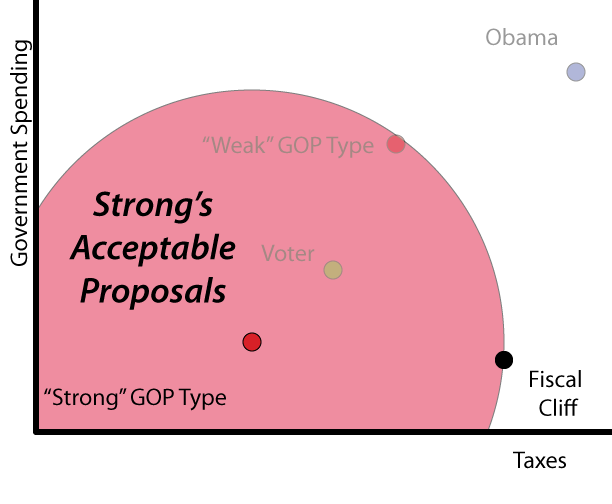
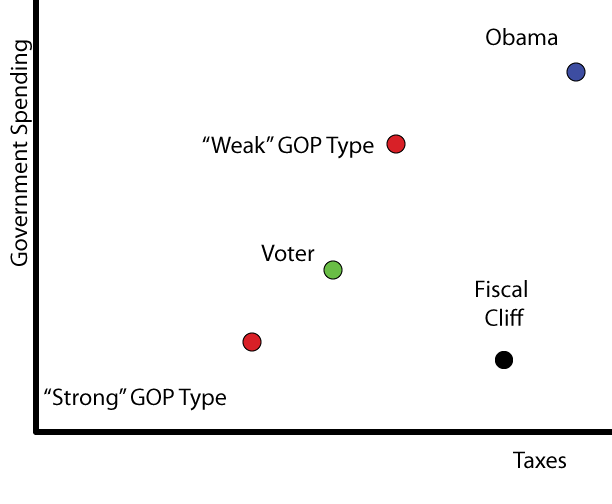
The strategic situation is captured (or, perhaps, butchered) in the graphic below.  It portrays the political bargaining space as two dimensions: taxes and spending.  For simplicity, I have located Obama’s “ideal policy” as “high taxes, high spending.”  (This is all relative.)  I have also located the hypothetical voter as “medium taxes, medium spending.” The fiscal cliff outcome is pictured as “high taxes, low spending.”

WhackAMoleSetUp-01


For simplicity, suppose that (the voter believes) there are two types of GOP incumbents: “Weak” and “Strong” Republicans.  Weak Republicans like higher taxes and higher spending than Strong Republicans.  This situation is portrayed in the next figure. The voter’s preferred levels of taxing and spending are closer to the Strong type (by design), so he or she would vote for a Strong Republican over a Weak Republican, ceteris paribus.WhackAMoleTwoTypes-01


If presented with a take-it-or-leave-it proposal, (the voter thinks that) either type of incumbent would accept any proposal that is closer to the incumbent’s most-preferred combination of taxes and spending than the fiscal cliff.  This set of proposals is pictured for each type in the next two figures.
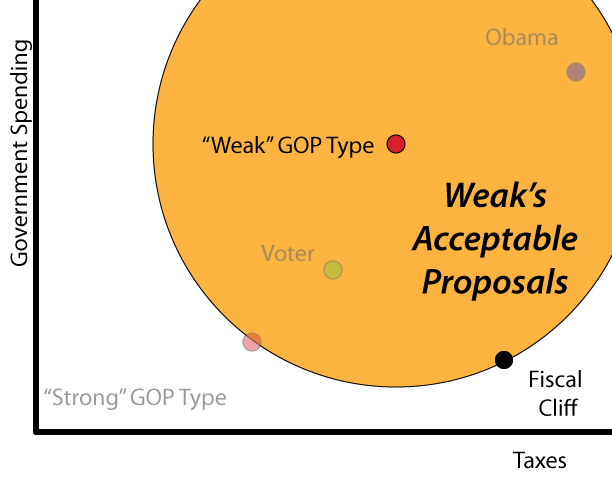
WhackAMoleWeakType-01   WhackAMoleStrongType-01

Now, if we overlay these two figures, you find the sets of proposals that (the voter believes) would distinguish the Strong and Weak types of incumbents.WhackAMoleAcceptanceRegions-01
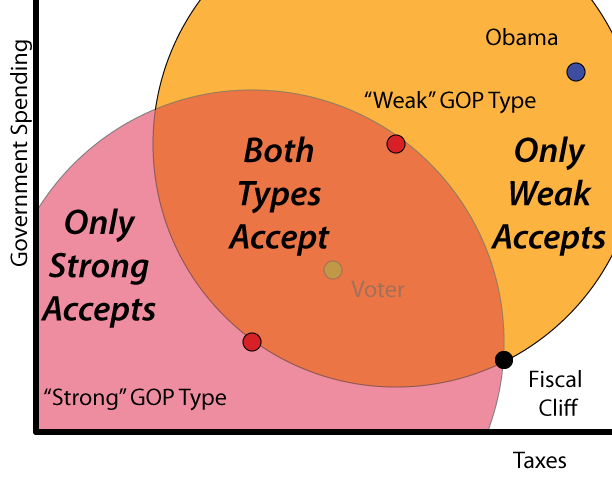
Okay, all well and good.  Intuitively, Weak types accept proposals closer to Obama’s most-preferred combination than do Strong types.  There are some proposals that both types would accept.

Now think about the fact that Obama does not, in fact, get to make a take-it-or-leave-it offer to the House.  In fact, the reverse could be taken as a rough approximation of the situation.  This suggests why the House GOP wants to make it seem like Obama should make a proposal — why he “has a mandate to raise taxes,” why this is the “time for him to lead.”  To the degree voters think that rejecting an offer from Obama carries some risk of falling off the fiscal cliff (I won’t belabor the details of that here), both Strong and Weak types of incumbents in this example have an electoral reason to elicit a proposal from Obama. In particular, if Obama made a proposal, he would face two choices:

  1. Propose something that only weak types would accept, or
  2. Propose something that both types would accept.

(Proposing something that weak types would reject either results in policy really far from what Obama wants—so that he would then need to “pull a McConnell” and veto his own bill—or gets rejected with certainty by both types and doesn’t change the voter’s opinion about the GOP incumbent’s type.)

Presuming that electoral pressures on the incumbent are strong enough, choosing Option 1 leads to a rejection by both types and the GOP incumbent scoring “electoral points” with the voter regardless of the incumbent’s true type. (Note to my game theory-aware readers: no, this belief formation by the voter is generally inconsistent with the incumbent’s behaviorI must defer my discussion of voter’s beliefs until another time.  Let’s just say that I am not sure how many voters regularly apply second-order logic to figure out that both types have an incentive to reject any proposal that only a weak incumbent would accept. Moving on…)  In a political sense, then, Obama has an incentive to not propose and withhold the House GOP incumbents any chances to score points with their constituents by rejecting/attacking Obama’s proposal in an attempt to show that, yes, they will avert the fiscal cliff, but only along a conservative-enough path.

Option 2 is viable for Obama, but represents a distinct loss to Obama in terms of policy.  That is, making such a proposal would provide Obama with a bill from the House that Obama would sign, but it is presumably worse (farther away from his preferred combination of taxes and spending) than he might be able to get if he forces the House to send something through the Senate first.

Please Let Me Refuse You…  Before I Agree with You. The basic idea I want to get across here is that the GOP may have an incentive to get Obama to make a proposal because they want to reject it initially–directly the opposite of the “albatross” theory discussed above.  The question of what Obama “should” do in this situation is more complicated, and requires a theory of the importance/role of time (and the Senate).

Speaking of time, I’m out of it right now.  Maybe I’ll come back to the proposal problem in a later post.  After all, like an NBA game, the real exciting stuff will probably occur at the end, as (in my opinion — and maybe the public’s) Obama doesn’t need to provide the GOP any opportunities to prove their bona fides. For now, I leave you with this.


The Triple-Ex Budget Trick or, the Alternative Maximum Cliff

Of course, the fiscal cliff is attracting a lot of attention (including by me).  This is understandable, as it has been built up for two years, follows directly from the current partisan-cum-policy wrangling of the Democrats and GOP, and — most importantly — stars Barry O. and Johnny B. in a wacky “odd couple-meets-buddy film” romp through the fallow weeks of the NBA season.

But a much more sinister, almost art-film-esque drama is silently brewing and gaining steam in DC as well.  The almost indecipherably and entirely incongruously-named “Alternative Minimum Tax Exemption Extension” issue remains unresolved.  (Here’s a good succinct take on it.)

What is this dark horse, you ask?  Well, the basics of taxation are hardly basic. The Alternative Minimum Tax, or AMT, is essentially a second tax system intended to tax the rich. (Here’s a nice description with some examples.) In an imperfect nutshell, the idea of the AMT is that you calculate your federal income tax the normal way, calculate your income tax according to the AMT and then pay the higher of the two (that’s the key incongruity of the naming system, in my opinion). The details are potentially very complicated, because the AMT is designed partly as a stop-gap protection against some of the tax code’s historically more-abused deductions (i.e., “loopholes”).

If you know anything about the AMT, you probably know that it is not “inflation adjusted.”  Oddly, the AMT is pretty close to a flat tax (26% up to $175K and then 28% on the income over $175K).  If that were “it,” inflation adjustment would be a truly minor issue. However, as you might expect, that’s not “it.”

Federal income taxes have three big components aside from rates and brackets.  These are deductions, exemptions, and credits.  Credits are simply refunds in another guise (though, while some can result in you paying negative taxes, most do not.  In that case, a credit results in a refund only to up to the amount that you already paid in taxes in the first place).  I will not discuss them in any more detail here, as they are not really related to this debate.

A deduction is an amount you reduce your taxable income by.  A famous (and currently debated) example is the homeowner’s mortgage interest deduction. If you earn $75K and pay $10K in interest on your home mortgage, your taxable income (aside from other deductions, etc.) is $65K.  Money spent on deductible expenses is often called “pre-tax money,” because in a real sense you get to pay it before it gets taxed.

Under the AMT one loses many common deductions and other’s homeowner’s mortgage.  Many of these increase in nominal value with inflation, so there’s one implicit reason people refer to the AMT as not inflation adjusted.

More important for this debate is the exemption. In a nutshell, an exemption is a deduction that you get without spending any money.  It’s kind of a catch-all allowance that reduces one’s taxable income.  In the standard income tax system, a taxpayer gets an exemption equal to $3,800 for each taxpayer and dependent.  (In addition, an individual gets a $5,950 standard deduction (couples get $11,900), which is essentially an exemption that one can take if one doesn’t claim (most) other deductions.)  Under the AMT, on the other hand, the exemption is much higher.  In 2011, it was $48,450 for an individual, and $74,450 for a married couple.

Note. Some day I might write about the astonishing “marriage penalty” contained in the AMT (the first hint: 2 x $48,450=96,900>74,450.). For now, simply note that when I say “married” below, I technically mean “Married, filing jointly,” because I have no idea why one would do otherwise if you knew your were going to pay the AMT.)  In addition, I am not going talk here about the “rolling back” of the exemption, but it does figure where appropriate into some calculations at the end of the post.  (shut up. – ed.)

Calculating AMT. So, to keep it simple, let’s just call the AMT a 27% flat tax on income after the homeowner’s interest deduction and the exemption.  Then, one’s AMT is essentially

AMT = 0.27 (Income-Mortgage Interest-$48,450) if you’re single, and
AMT = 0.27 (Income-Mortgage Interest-$74,450) if you’re married.

…Of course, in reality things are a little more complicated, but I’m trying to make a simple point here. (too late – ed.)

But…WHAT IS THE ALTERNATIVE MAXIMUM CLIFF?!?   Ahh, yes. “The Alternative Maximum Cliff” is approaching because the 2011 level for the exemption was the result of an extension passed by Congress that expired at the end of 2011, returning the exemptions to $33,750 for individuals and $45,000 for couples.  So…the current AMT is

AMT = 0.27 (Income-Mortgage Interest-$33,750) if you’re single, and
AMT = 0.27 (Income-Mortgage Interest-$45,000) if you’re married.

The biggest tax increase as a result of non-extension of the exemption will be for a married couple making about $350K a year.  And, no, nobody should cry for such people. (That’s why this is kind of shocking – ed.) Such a married couple faces a tax increase — even holding the Bush tax cuts fixed and assuming the fiscal cliff is completely delayed — of $7,951.50.  That’s a 2% tax increase in terms of their actual income.

The final and even more important point about this is as follows.  The couple I just described was almost certainly paying AMT last year, too.  However, if Congress does not extend the exemption, the number of people who owe AMT will jump enormously.  In particular, the exemption is used to calculate AMT tax liability, and you owe the AMT if your AMT tax liability is higher than your standard tax liability.  So, a drop in the exemption potentially affects every individual or married who earns moderately high incomes.

But, “Will the (new) AMT affect me?”  Here’s a highly approximate answer for most people. This is for the new system if there is no extension—if there is an extension, the system will likely be almost the same as last year’s, so your status from last year return is a good (but imperfect) guess about this year’s.

Denote your gross income by Y. Add your standard exemptions under the regular income tax system (for a family of four, this is $15,200) to your state and local income taxes.  Denote this amount by X. Then, check my Jeff Foxworthy-esque “if-thens” below:

If you’re married, then

If Y < $150,000 and > $48,600 – 0.08 * Y, then you might owe AMT.
If $150,000 < Y < $450,000 and > $71,280 – 0.35 * Y, then you might owe AMT.
If Y > $450,000 … then “why, you might go screw yourself.”

If you’re single, then

If X > $112,500 and > $36,450 – 0.08 * Y, then you might owe AMT.
If $112,500 < Y < $247,500 and > $66,825 – 0.35 * Y, then you might owe AMT.
If Y > $247,500 … well, you know.

What’s the politics of this?  Well, the confluence of this “opportunity” and the fiscal cliff is interesting.  Essentially, if Congress wants to play by its budget accounting rules, it can do so more easily by allowing the exemption extension to expire.  Call it the Triple-Ex budget trick. I just came up with that. So…time to retitle this baby and sign off, leaving you with this.


Let’s Get Fiscal, Cliff!

With the 2012 election firmly in the rearview mirror, the discussion has turned to the impending fiscal cliff.  In a nutshell, the looming budget cuts (sequestrations) and tax increases are the result of the 2011 budget deal that increased the debt ceiling and staved off the need for further budget wrangling between the GOP and Democrats until, well, now.

Arguably, the 2011 budget deal represented a kind of agreeing-to-disagree (or, perhaps, “wait and see”) approach with respect to the hard choices facing aspiring budget balancers.  As I’ve written about before, the simple reality is that the earnest budget balancer must raise revenues in some fashion. This was perhaps okay with GOP glitterati, but definitively not if this revenue came about as the result of an arguably transparent increase in marginal tax rates.  (Rather, we should have a tax cut that was (more than) offset by limitations on deductions, which is not only a silly and cynical move to obfuscate, but doubly disingenuous, insofar as it misdirected attention from the absolutely unfair and economically unwarranted differential treatment of capital gains and interest income.)

So, anyway, with President Obama’s reelection, the bargaining game is a little clearer now.  Here’s where the “math” of this topic comes in (though there’s some math inherent in the preceding soapbox topping, too).  The fiscal cliff empowers Obama to the degree that he fears the triggers of the 2011 agreement less than do Boehner and his GOP colleagues (not to mention McConnell and his GOP colleagues).

In my corner of the spectrum, this is to my knowledge often referred to as either “Romer-Rosenthal bargaining” (due to Romer and Rosenthal (1978)) or, perhaps, crisis bargaining.  I often refer to this situation as the former, but to be fair and transparent, it’s really not.  The details are not that complicated, but the simplest explanation is that Obama doesn’t actually get to commit to a proposal.  Rather, he can make non-binding statements about what he would or would not veto, similar to Matthews (1989).

So what?  Well, theory indicates that there are two questions that are central to determining how this plays out (supposing that all of the players are rational and believe that each other is rational, and so forth—but if that doesn’t hold, then, well, you’re on your own, kid).  Making things (overly) simple and presuming that the Senate Democrats have the same preferences as President Obama, these two questions are:

1. What is the set of outcomes that both the GOP and Obama prefer to falling off the cliff?

2. What are the relative costs to the GOP and Obama of delaying an agreement between now and then?

An interesting and general characteristic of traditional, complete information bargaining models (which assume that, in this example, both Boehner and Obama know the answers to questions 1 and 2, above, and know that each other know the answers to these questions, and so on…) is that delay will not occur.  In other words, presuming (as seems realistic, given market reactions) that neither Obama nor Boehner prefers to wait to secure any given resolution to the crisis, there should be no delay in reaching this agreement.

To be practical about the matter, I don’t think they have refuted that prediction yet.

However, I also do not believe that Obama knows how much Boehner can stand delay in reaching agreement.  In particular, Obama seemingly has no interest in delay, as he has real matters to deal with, but Boehner has a much less transparent position.  Should he resolve this issue because of the uncertainty’s effects on financial markets?  Or would resolving it too quickly undermine his ability to corral his more boisterous copartisans?

This uncertainty, which I believe is definitively descriptive of Obama’s beliefs about Boehner (particular after the 2011 experience), might very well partially characterize Boehner’s beliefs about his own standing.  Regardless, it raises the important possibility of delay prior to ultimate agreement emerging as “option value” for Boehner.  That is, even if (or, actually, particularly if) Boehner is completely certain about, and assured in, his own standing with the GOP caucus, he has an incentive to vacillate, preen, and stonewall while dealing/negotiating with Obama regarding the final resolution to avert the fiscal cliff.

Note that this prediction comes about precisely in the absence of any assumed “ego rents” on the part of Boehner.  In a nutshell, the uncertainty about Boehner’s bargaining position relative to his own caucus can generate sufficient incentives for him to “act the diva,” and seem to hold court in a fashion befitting LeBron’s act leading up to “The Decision.”  The simple explanation of the strategic incentives underlying this is that Boehner can utilize Obama’s uncertainty about Boehner’s bargaining ability to make it appear like, even if Boehner does “care at least as much as Obama” about resolving the fiscal cliff in an expeditious fashion, that Boehner can’t “deliver a deal” equal to Obama’s “reservation price” (or, in other words, that Boehner can’t get his caucus to agree to Obama’s demands).  The implicit value to Boehner is that Obama, on the margin, will give in a little to secure what he perceives as the marginal certainty of securing a deal from Boehner’s copartisans.  In other words, at the end of the day, as 2011 purportedly demonstrated, Boehner may ironically (but completely classically from a game theoretic vantage point) benefit from being able to portray himself (accurately or not) as not being able to corral his own troops.  “Sir, I told them gruel was sufficient to survive the night, but they simply insisted they’d die without gruyère.”

In such a setting, delay is essentially inevitable: given such uncertainty on the part of Obama about Boehner’s ability to deliver his own caucus (which is essentially the same as Obama being unsure about Boehner’s own “reservation price”), Boehner will/should at least “test the waters”–probably by losing/delaying some sort of test vote in the House.

Why does this matter? Well, once you recognize that Boehner has this incentive, then one recognizes that Obama has an incentive to overstate his willingness to “wait the GOP out.”  In other words, Obama’s uncertainty abut the GOP’s ultimate and effective preferences (more appropriately, the shared knowledge of Obama’s uncertainty) creates an incentive for Obama to create uncertainty about his own resolve.

Where does this end?  Well, my (and let me be clear it is at best a) guess is that the two sides agree to letting the Bush tax cuts expire for the top 2% of earners, limit deductions for something like the top 5% of earners, and take “halvesies” on some of the (discretionary & non-military) spending cuts.  I’ll leave it for another post, but these revenue tricks will probably net much less than one might expect if you apply the straightforward calculations based on the normal tax code, because a lot of the top 5%, not top 1% of households are already paying the alternative minimum tax (AMT) and accordingly having their deductions rather severely curtailed.  Thus, the “new revenue” from such a deal would be muted relative to expectations.

I am not sure that this is a bad outcome.  I feel like everybody (all 28 of us) who is paying attention to the details of this important part of the federal budget dynamic is implicitly hoping for a take-it-once-fix-it-all pill, and I also feel that all of us know that this might work ceteris paribus, but that nothing with respect to fixing a ~$1 trillion deficit within a year or two should be taken as ceteris paribus.

On that note, I leave you with this.

Debits and Credits: Simple Budget Algebra

The US Federal Government faces a looming “fiscal cliff” as a result of current law calling for a simultaneous set of across-the-board cuts in spending and a rise in various tax rates.

There are many interesting aspects to this scenario, particularly given the divided partisan control of the two chambers of Congress.

Digression. Because Congress must send something to the President’s desk before he can sign it into law, this division is in some ways sufficient. The fact that this is an election year makes it even more interesting, as the collective impact of members’ electoral incentives in the House and Senate are quite different due to the overlapping electoral schedule in the Senate.  One final twist in this saga is the fact that this is the first election after the 2010 reapportionment of the House, meaning that a few members are running against each other and many more members are running for reelection in altered districts.  But much of that is a matter for discussion in a later post.)  

Today, I want to focus on a related question:

How might the federal budget be balanced without increasing revenues?

Before continuing, let me be clear:

  1. I am not arguing in favor of any particular solution (or even that an unbalanced budget is a problem that needs to be solved), but…
  2. I am arguing that balancing the budget without new revenues would require spending cuts that are either
    1. politically impossible (e.g., cutting Social Security without (permanently) cutting payroll taxes; slashing the defense budget),
    2. ridiculous (e.g., eliminating veterans’ benefits; shutting down the FBI), or
    3. both (e.g., eliminating Medicaid).

Digression. Yes, I do believe that the “Norquist Pledge” is incompatible with responsible government and/or the general maxim to not sign a pledge you don’t intend to uphold.

My purpose here is simply to provide a brief introduction to the budget and make the structure/composition of federal spending as clear as possible.  After all, it is not surprising that the federal budget is in some ways complicated and, after all, involve numbers that we rarely use and all rhyme with “Maximilian.”  What is a little surprising is that the federal budget can be described in fairly succinct terms that are also politically meaningful.

Note: All statistics reported here were drawn directly from the various historical tables/projections produced by the Office of Management and Budget. One could do the same thing using numbers from the Congressional Budget Office, too. I have no reason to believe that the differences would be particularly interesting.

Q. What is the size of the budget deficit?This is simultaneously a simple and complicated question.  First, for which year?  I will focus on the projected 2012 budget deficit.  Past budget numbers are obviously less desirable to use, and more distant projections are both (understandably) less reliable and (generally) partisan.  Second, “on-” or “off-budget?”  I will include “off-budget” items, too.  This is a judgment call, as this brings in most notably Social Security, which makes the corresponding budget deficit smaller.  (Precisely, federal trust funds are currently generating a surplus of a hair shy of $100 billion, which is about 7% of the total 2012 deficit. Oops, that gave it away.)

A.
The 2012 budget deficit is $1.32 trillion. (The on-budget 2012 deficit is $1.42 trillion.)

Q. How much does the federal government spend?

A. With the caveats discussed above about the definition of the deficit, the federal government is projected to spend $3.8 trillion in 2012.  (Thus, revenues are projected to be $2.48 trillion.)

Q. What are the ten largest categories of spending?This, too, is a complicated question.  While a dollar is a dollar most days of the week, federal spending is famously not so simple.  Broadly speaking, spending comes in two forms: discretionary and non-discretionary.  Non-discretionary spending consists of two main components: “entitlements” and repayment of federal debt.  I will return to these distinctions below.  For now, let’s just treat a dollar as a dollar.

A. The ten largest categories of spending are (I’ll come back to the ones in quotes):

  1. Social security ($778 billion)
  2. Defense ($716 billion)
  3. “Income security” ($580 billion)
  4. Medicare ($484 billion)
  5. Health  ($362 billion) — This is mostly, but not entirely, Medicaid.
  6. Net interest ($225 billion)
  7. Education, Training, Employment, and Social Services ($139 billion)
  8. Veterans benefits and services ($130 billion)
  9. Transportation ($103 billion)
  10. Commerce and Housing Credit ($80 billion)It is useful to note that top top 3 categories account for over 50% of the federal government’s projected spending.  Furthermore, the top 2 categories are larger than the projected deficit.  

Q.What the heck is “Income Security,” and where can I get some?

A.
The five largest individual subcategories in this category of federal spending are:

  1. Federal employee retirement and disability ($127 billion)
  2. Food and nutrition assistance ($113 billion)
  3. Unemployment compensation ($108 billion)
  4. Housing assistance ($60 billion)
  5. General retirement and disability insurance (NOT social security) ($8 billion)Thus, if you break these out individually, they would each rank no higher than 8th. As far as getting some of it, clearly the best way is to get a job with the federal government.

Q.What would I have to cut to balance the budget without increasing revenues?

A. Well, this is complicated—what’s fair game?  I will presume that net interest is off the table.  Similarly, though with less conviction, Social Security and Medicare are tough nuts to crack and, at least right now, the true impact of Social Security on the budget is small (regardless of whether positive or negative), unless one thinks that we could cut benefits without cutting the payroll taxes that are deposited into the Social Security trust fund.  First, consider how to answer the question without cutting defense spending (because, among other reasons, defense spending is a very complicated and variegated category).

These add up to about $2.2 trillion, or about 90% of projected 2012 revenues.
This plan leaves approximately $300 billion left to spend….and this is without funding veterans’ benefits, the FBI, federal prisons, the INS, or the federal courts…not to mention food stamps, highways, unemployment insurance, student loans….  In fact, there’s not enough even to fund Medicaid at its current levels.

A2. There’s no simple answer (or, rather, there are lots of simple answers—it’s just not clear what the “right one” is).  But reversing the logic makes clear what is not a very effective approach to balancing the budget: cutting discretionary domestic spending.  For example, suppose that the federal government simply and completely “got out of the business” of things like food assistance, unemployment insurance, pensions for federal employees, transportation projects like the interstate highway system, high speed rail, public transportation grants to state and local governments, higher education, research, and the like.  The total savings of these cuts?  Less than $600 billion. It’s a lot of money, to be sure, but that is less than 50% of the budget deficit.  In other words, even if the federal government eliminated all discretionary spending, we would still be running a deficit of over $700 billion.

In sum, if one believes that the most important priority for the federal government is to balance its budget (and, again, I do not think this should be the most priority to either conservatives or liberals), then you must also believe, as a corollary, that one or more of the following must be done:

  1. social security and/or medicare must be cut (without cutting payroll taxes commensurately),
  2. the defense budget must be slashed, and/or
  3. federal revenues must be raised.
(As a matter of constitutional fidelity and good taste, I withhold the option of defaulting on the debt.  It’s not nearly as effective a deficit cutter as some might think, anyway.  That’s why people still lend us money at interest rates essentially equal to zero.)

Hopefully I’ll find time in the near future to explain the structure of the revenue changes that have been proposed and/or might occur if we fall off the “fiscal cliff.”  In the meantime, I leave you with this.