Quid Pro Status Quo: A Tale of Two Tails

In my previous post, I discussed the Senate’s consideration of a continuing resolution (or CR) that includes some provisions relevant to gun control.  In so doing, I mentioned a form of unanimous consent agreement, or UCA, (like this one) that the Senate has been using for consideration of measures that would presumably otherwise fail to obtain cloture.

Leaving aside the finer points of cloture, the key aspect of this UCA is that it guarantees a vote on the amendment in question but requires 60 votes (a three-fifths majority, like cloture) for passage.  Upon reflection, two of the first four amendments to the CR to receive consideration are particularly illustrative of the parties’ collective strategies of position-taking when compared side by side.

The first amendment considered by the Senate was offered by Ted Cruz (R-TX).  It was actually an amendment to an amendment in the nature of a substitute (i.e., a complete replacement for the CR) offered by Sens. Mikulski (D-MD) and Shelby (R-AL), the chair and ranking minority member, respectively, of the Senate Appropriations Committee.*

The second amendment I wish to compare it with is the one, mentioned in the previous post, offered by Sen. Harkin (D-IA), which was also an amendment to the Mikulski-Shelby substitute.  It proposed to increase spending on a slew of Democratic priorities, including

special education, childcare subsidies, The Ryan White AIDS Drug Assistance Program, suicide prevention, aid for first-in-their-family college students, food safety, lead poisoning screening for kids in this country, diabetes prevention, and worker safety.

In addition, as I pointed out in the earlier post, this amendment essentially proposed returning to the substance of the Labor-Health and Human Services appropriations bill except for any additional spending on Obamacare.

Thus,

  1. a vote for Cruz’s amendment was a vote against Obamacare (or, perhaps, “big government”), and
  2. a vote for Harkin’s amendment was a vote for traditional Democratic priorities.

Note the order of the votes—Reid essentially allowed Republican incumbents to take clear positions against Obamacare—prior to at least a handful of these Senators voting for the CR next week.  Then McConnell and Reid (essentially) agreed to a UCA under which Democrats would get a chance to cast themselves as pro-Democratic priorities sans
Obamacare.  This quid pro status quo did not threaten the CR, because Cruz’s amendment did not have majority support (hence, no need for a UCA, assuming no Democrat filibustered, which they didn’t) and Harkin’s amendment would not receive 60 votes (but it did receive majority support, hence the need for the UCA to obviate a Republican filibuster).

Thus, this sequence arguably represents a classic, cooperative logroll between the parties (really, between the incumbents of the parties).  Policy was not put at risk, but both parties’ incumbents got to take at least one good position-taking roll call vote.  A larger take on this trade-off—a classic “question” in political science—was recently offered by Greg Koger, Hans Noel, and—well—Greg Koger.  Well worth the read.

I won’t weigh in on the larger question at this time (though I have offered a take on it in published research (ungated version)).  Instead, it is important to note that sometimes the parties work together by agreeing to stand apart.  (Also, I have already talked about part of this dynamic with the fiscal cliff, though from a different angle.)

With that, I leave you with this.

___________________

* If my reading is true, Sec. 110 (Cong. Rec. S1613)  and Sec. 514 (Cong. Rec. S1619) contain the provisions (3 in Sec. 110 and 1 in Sec. 514). The fact that the Senate is using an amendent in the nature of a substitute to the House version of the CR means that—at least from a practical-cum-technological standpoint—it is even harder to find “the Senate’s version” of the CR.  This approach also greatly expands the “voting tree” for consideration of the CR.

Showdown at Uzi Gulch: Putting the Glock in the Spiel

The Senate is considering a continuing resolution (CR) that both extends funding operations of the federal government through the rest of the fiscal year (Sept. 30, 2013) and also makes permanent several provisions that stymie enforcement of gun control laws. While the reality is that the provisions in the Senate bill do not represent a significant change in the day-to-day enforcement of gun control, making the provisions permanent represents a significant step “backward” in light of the Newtown school massacre and the 57% of Americans who favor renewing the ban on assault weapons and the 52% who favor “stricter gun control laws.”

So, what’s the strategy here?  First, it is important to remember that the CR is a very potent vehicle: Obama could veto it, as Clinton did in 1995, causing the federal government to “shut down” during his struggles with the GOP-controlled 104th Congress.  However, given (1) the fiscal cliff debate & currently ongoing sequester and (2) the fact that the Democrats hold a majority of seats in the Senate, the analogy between the two situations is not a perfect one.  Simply put, it is not clear that Obama would win the “public approval game” following a veto as Clinton did.

But the more important point is that Senate Democrats are facing a very “tough map” in the upcoming 2014 midterm elections. In particular, at least 7 Democratic seats are up for election in closely divided states where support for tougher gun control is probably not a winning electoral gambit, ceteris paribus: Alaska, Arkansas, Iowa (open seat), Louisiana, Montana, North Carolina, and South Dakota.  So including these provisions might actually be a gift to Obama in some ways.  Democrats so electorally disposed can reaffirm their anti-gun control bona fides by voting for this CR and Republicans can more easily explain their vote to fund the government as a pro-gun rights vote. More interestingly, however, are two strategic possibilities that might come up as this story unfolds over the next week.

  1. A Senator’s anti-gun control bona fides would arguably be even better established by voting for an amendment that would strip the anti-gun control provisions.
  2. Similarly, a Senator’s pro-gun control bona fides could be similarly established by voting for an amendment in line with an even-more-anti-gun control provision rumored to be supported by some in the House.

These possibilities highlight an awesome implication of the Senate’s supermajority (“60 vote”) requirement for cloture.  Specifically, Reid and McConnell can broker an agreement (known as a unanimous consent agreement, or UCA) under which a pro-gun control amendment and an anti-gun control amendment are each considered and debated for a fixed amount of time and then voted upon, with each amendment requiring 60 votes to be approved. This agreement would allow Senators to vote for and/or against gun control measures while posing no real threat to the underlying CR, which is needed prior to March 27th.

Note that this type of UCA is not just some theoretical creature—it has already been used during the consideration of this bill.  And, furthermore, in line with the yarn I am spinning, the amendment in question* (sponsored by the retiring Senator Harkin from Iowa) failed with a majority of votes on a party line vote.  Thus, even though everyone presumably knew this amendment would fail under the terms of the UCA, it was nonetheless duly considered and the subject of a roll call vote. Finally, the starting point of my fantastic tale of legislative chicanery is that THAT VOTE IS THE POINT.  By agreeing to push the supermajority requirement back from ending debate to actual passage, Senators can go “on the record” about a majority-favored policy change with a vote that changes nothing.

We’ll see what Reid and McConnell do, but note that the consideration of Harkin’s amendment is telling in many respects, particularly given the huge number of amendments that have already been submitted to the CR and the queue of gun control bills now awaiting consideration, each of which could be considered under this type of UCA as well, of course.

With that, I leave you with this.

____________________________________________________________________

* For the curious, Harkin’s amendment was complicated, but Harkin’s summary of it from the floor (Congressional Record, p. S1742) included these interests:

special education, childcare subsidies, The Ryan White AIDS Drug Assistance Program, suicide prevention, aid for first-in-their-family college students, food safety, lead poisoning screening for kids in this country, diabetes prevention, and worker safety.

What is really interesting to me about this amendment was that it was essentially the substance of the Labor-Health and Human Services appropriations bill that had been negotiated between the chambers a few months ago minus appropriations for the Affordable Care Act (“Obamacare”), a point that Harkin clearly and repeatedly expressed in his comments on the amendment.

Harkin’s amendment thus allowed Democrats to vote in favor of some clear Democratic “issues” without making them vote in favor of Obamacare. I’ll leave that for another day, but note that Ted Cruz’s amendment the CR to defund Obamacare entirely was rejected on a similar party-line vote.  And, furthermore, note that the absence of Senator Joe Manchin (D-WV (!!)) for this vote and the hubbub surrounding his non-vote on this amendent underscores the electoral dynamic at play on these types of votes.

Losing to Win: Nobody Puts Boehner In The Corner

In light of my take on last night’s legislative shenanigans, a few very smart people have asked me, in a sense, “sure, perhaps, but do you REALLY think that’s what happened?”  Most of these objections (and the media’s narrative) suggest that Boehner thought he had enough votes for H.J.Res.66 and, upon seeing the too-close-for-comfort on  HR 6684, realized that he did not.  In other words, Boehner miscalculated, pure and simple.

This is a very good question for a number of reasons.  First, it correctly implies that I don’t really know what was going through any of the relevant actors’ minds in the days leading up to yesterday, not to mention what everybody was thinking last night.

Second, the question provokes one to think about what strategic analysis is supposed to do.  In some ways, my answer to this is classically dodgy.  Game theory is prescriptive: properly done, it informs the analyst about what one should do. Even then, it requires that you have some idea about how the other people are going to act.

More importantly, game theory is not supposed to (and generally can’t) tell you why somebody did something.  Furthermore, this statement isn’t merely some escape clause along the lines of “well, it’s just a model.”

No, the very foundations of game theory and strategic analysis lead logically to the conclusion that in some circumstances, rational/strategic behavior will necessarily not be indicative of what motivates it.  It is not too strong in my opinion to assert that this fact is the “heart” of signaling models, which have played a key role in my yammering about recent events.  (And are at the heart of the classic movie clip I posted in my previous post.)

Think of it this way: suppose (1) that everyone thinks that he really wanted to win that vote last night (I’ll come back to this in a second) and (2) that Boehner also wants to get as “conservative of a deal” as possible from the Democrats in averting (or, perhaps, in response to falling off) the fiscal cliff.  Point (2) is of course known by everyone.  After reading this post, Democrats also realized that Boehner might claim to not be able to deliver GOP votes for a moderate (much less liberal) resolution of the fiscal cliff. Accordingly, they and Obama tell Boehner “maybe you can deliver ’em, maybe you can’t. You don’t have any reason to tell us (particularly in private) that you can.  Prove it.”

Now, point (1) of my supposition — that Boehner doesn’t want to bring out a bill that doesn’t have the votes — comes into play.  According to this supposition, Boehner would not bring forward a bill and then pull it without it getting a vote unless he didn’t have the votes.

If we really believe that we know exactly how much Boehner “wanted to have and win that vote” on H.J.Res. 66 last night, we can form a reasonably precise estimate of Boehner’s beliefs about the GOP votes heading into last evening.  But, if our belief about this is too high — i.e., if we think Boehner wanted to win (or, didn’t want to lose/pull) that vote more than he really did — the Boehner has an incentive not only to stage a dramatic “let’s vote….oh no, let’s stop!” AND he and his other policy-interested GOP colleagues have an incentive to bolster and shepherd the narrative of, “aww shucks, poor Boehner….He really screwed that one up.”  Because to say that it wasn’t that big a deal implies that the whole melodrama should be taken as simply a larger and more elaborate way of simply claiming to not have the votes.

This brings me back to the first part of the supposition.  There’s been increasing talk (and here) about whether Boehner might not be reelected Speaker on January 3rd because of all of these shenanigans.  I have separate thoughts on that, but they’re outside of the current discussion. (Short version: no, he need not fear, in my opinion.)  But this kind of talk is exemplary of the second-order incentives I am talking about in terms of Boehner and the GOP stoking (or at least not dousing) the flames of a narrative of a rowdy/uncontrollable/maverick GOP conference. The whole act of bringing up and then not taking a vote on an unpopular, dead-in-the-water tax bill is pointless unless observers think that this was costly to the man who made it happen: Boehner. 

(I might come back to discussing the apparent conflict between this and the conference’s solid affirmation of Boehner’s leadership in another post.  I’ll simply note at this point that I’m not seeing many quotes from GOP members alluding to that public support.)

(Similarly, I might revisit the intriguing point about why Boehner didn’t actually just go ahead and have the vote.  Short version: I think it might have passed.)

Well, that’s it for now. Thanking those of you who have read and questioned for pushing me to think even more about what I can and, more importantly, can’t do, I leave with you with this.

ApocaCliff Now: Boehner “Lost,” But Does He Really Mayan?

Note: a road map is in order. I first describe what happened tonight in the House of Representatives.  Then I discuss one game theoretic take on Boehner’s “pulling of `Plan B’…”

Tonight, the House of Representatives passed a rule, H.Res.841, that called for the consideration of two measures, HR 6684, and H.J.Res.66.  Both of these bills are illustrative in terms of how the House Republican leadership is dealing with the fiscal cliff “crisis bargaining” situation.  The rule passed the House by a vote of 219-197, with 13 Republicans voting against it and no Democrats voting in favor of it.

The first business brought up by John Boehner under the rule was HR 6684.  The bill, titled “Spending Reduction Act of 2012,” puts off the sequestrations (spending cuts) component of the fiscal cliff and makes some other cuts.  Aside from the sequestration aspect, the bill is a bit of a hodgepodge.  Some of the various items are potentially important and subtle, but beyond the scope of this post.

(As an aside, the CRS summary of HR 6684 describes the bill as containing this doozy:  “Amends the Congressional Budget Act of 1974 to authorize the chair of the Committee on the Budget of the House of Representatives or the Senate to make adjustments to any legislative measure to conform to the discretionary spending limits of this Act.”  I have a hard time seeing the Senate agreeing to that.)

HR 6684 was considered under a closed rule, with all points of order waived.  After an hour of debate, as specified in the rule, HR 6684 passed the House by a vote of 215-209, with 21 Republicans voting against it.  Note that 7 members did not vote (with Rob Bishop (R, UT) voting “present” and 6 other members not voting at all): the bill duly and properly passed…but just barely. (My friends at Voteview, as usual, provide a timely and interesting take on this vote.)

After this nailbiter, maybe Boehner headed out to have a cigarette and calm his nerves, leaving the House to consider and agree (in a nonunanimous but bipartisan way) to a conference report dealing with the 2013 Defense Appropriations bill and then suspended the rules to

  1. Name the VA medical center in Spokane, Washington, the “Mann-Grandstaff Department of Veterans Affairs Medical Center” (which Scott Rigell (R, VA) bravely stood alone in opposing),
  2. Designated the VA facility located at 9800 West Commercial Boulevard in Sunrise, Florida, as the “William ‘Bill’ Kling VA Clinic” (which was unanimous), and
  3. Designate Mt. Andrea Lawrence. (which 6 Republicans and 1 Democrat opposed)..

The House then went into recess for 2 hours, during which Boehner met with his GOP colleagues behind closed doors.  He then issued this press statement:

“The House did not take up the tax measure today because it did not have sufficient support from our members to pass.  Now it is up to the president to work with Senator Reid on legislation to avert the fiscal cliff.  The House has already passed legislation to stop all of the January 1 tax rate increases and replace the sequester with responsible spending cuts that will begin to address our nation’s crippling debt.  The Senate must now act.”

Now the game theory.  It is interesting to consider Boehner’s incentives (as well as those of GOP members as a whole) at this juncture.  As I wrote earlier, even if Boehner can reliably command/deliver the votes of a majority of the House, he nonetheless has a strategic incentive to appear to lack control of his caucus conference.  In addition, as I also pointed out earlier, some GOP members may have an incentive to appear to take a hard line.

As The Hill’s Russel Berman put it tonight, Boehner “argued that his fallback plan was the best the House could do in the absence of a broader deficit agreement with the president.” I now come to the point of this post: tonight’s vote was strategic.  The possibility of a vote on Plan B happening tonight was brought up voluntarily by Boehner. As is now obvious, he didn’t have to take this vote today. More importantly, he didn’t have to suggest that he would take this vote today. (Also, note that while Boehner may have spent the day twisting arms, counting votes, and trading horses, the consideration of “Plan B” began just in time for evening news on the east coast.)

So, maybe Boehner was surprised by the vote on HR 6684 and backtracked out of necessity.  Or, perhaps he knew/suspected that he didn’t have the votes for one or both bills.  By bringing up a vote and then canceling it (and by perhaps coincidentally doing it during the evening news), Boehner got a public spotlight on “Plan B” and, arguably, now made a point that, among some of his conference, even exempting millionaires from a tax cut is simply a bridge too far for his conference.

The “math of politics” here is a second-order application of Boehner’s incentive to appear to not have the ability to deliver votes.  That is, purposely staging a vote that will ultimately not happen can be a strategic response to (for example) Democrats labeling claims that Boehner “does not have the votes” a bluff.  (Here, a “second-order application” means applying knowledge of the first-order incentives to figure out what your incentives become once others realize your first order incentives.  See my link at the end of the post for a far better illustration of this.)

In game theory, there is an important distinction between what are called “costly signals” and “cheap talk messages.”  In a nutshell, cheap talk messages are like me telling you that I really think the Pittsburgh Steelers will win the 2013 Super Bowl and costly signals are like me betting $100 that they will. (And, sadly, no, I’m not betting the $100. Also, consider this point the next time you hear someone say “if I were a betting man…”)

From a game theoretic point of view, cheap talk messages can not credibly reveal certain types of information. For example, suppose that you’re in a watering hole on Carson St. before a Steelers game and, like everyone else in this watering hole, you want to impress everyone that you are truly the most confident/optimistic Steelers fan.  Well, if simply saying that you think the Steelers will win the Super Bowl would impress everyone in this way, then everyone else would say this, too.

On the other hand, if you bet $100 on the Steelers and some of those present aren’t as optimistic as you, then some or all of those people will not mimic you and accordingly not send as strong a signal as you do about your faith in the Steelers.  As a result, you will (or should) accordingly be viewed as a greater Steelers fan by your fellow patrons.

A similar analogy for what Boehner might have done tonight is as follows.  When I tell you that I love you and nobody else is around, that’s cheap talk.  When I tell you the same thing in front of thousands of people, that’s a costly signal.  It’s costly in the second case because the presumption is nobody likes to be rejected in public. So, when observers describe tonight as “a major defeat for Boehner that will give significant leverage to Obama in talks on a deal to prevent looming tax hikes and spending cuts,” say that Boehner “had hoped to demonstrate Republican unity by passing a bill through the House,” or conclude that “any bargaining power Boehner had with Obama — or hoped to have — is gone.  … What happened on the House floor tonight made a bad bargaining situation for Boehner that much worse,” my natural contrarianism leads me to pause.  Boehner set this situation up for himself.  Boehner knows how to count votes.  And, importantly, Boehner and the GOP had this “problem” before during the Boehner-Obama-Cantor “Grand Bargain” drama that eventually led to the fiscal cliff, and it is interesting to note that the last time, some pointed to whack-a-mole dynamic hiding in the failure of the Grand Bargain, with John Bresnahan, Jonathan Allen & Jake Sherman writing at the time that

Details of the potential “big deal” with President Barack Obama leaked before House members were briefed on the broad outlines of any agreement. “That was a huge problem,” acknowledged a top House Republican aide. “Boehner got way out in front of where he should have been. He pulled back because he had to do so.”

So, in conclusion, I agree with Chris Cillizza that tonight’s drama “was a gambit by Boehner designed to be a show of force to President Obama. This was Boehner putting himself out on a limb in hopes wavering members would follow him. This vote mattered to Boehner.”  Oh, yes, this vote mattered.  But I think it’s too early to conclude like he does, that Boehner “lost it.”  Good signaling games often have more than touch of irony.  Such is the case here.  In particular: losing can be better than winning but only if you do it in public and people think you don’t want to lose.

I leave you with this classic moment of game theory in film.

Make Me an Offer I Can’t Refuse (to Reject)

To all you single guys out there, it’s not how you start the date, it’s how you finish it, sir. A lot of people can, you know, start the date with flowers and candy, but if you don’t finish the date – you know what I mean? — Shaquille O’Neal

Budget negotiations are kind of like an NBA game: there’s a lot of blah blah blah, get some nachos, some more blah blah blah, Jack Nicholson throws a fit, and then BAM! the real game (sometimes) commences in a flurry right at the end.

In the current tête-à-tête between Boehner and Obama regarding the resolution of the “fiscal cliff” (and, presumably, other related issues such as the AMT exemption extension, corporate taxes, and the debt ceiling), the public stances of the two sides have moved very little. Congressional Republicans (including Boehner) have accused Obama of slow walking “our economy right up to the ‘fiscal cliff.’” By this, I assume that Boehner means that Obama has not put forward an explicit proposal that, in theory, Congress could agree to and send to Obama for his signature.

Why has Obama not made an explicit offer?  The answer to this is also the reason that budget negotiations are “like NBA games.”  A fundamental point to recognize at the outset is what is called “selecting on the dependent variable”: when you analyze high-profile negotiations — negotiations where it makes any sense for one side to ask the other to make a public proposal — there is by presumption already “more at stake” than simply the policy implications of any ultimate agreement (or lack thereof).

In other words, the fact that we have a name for the “fiscal cliff” is proof that the choice of a path around (or over) the cliff carries more than simply fiscal repercussions.  As I discussed before, there is some latent uncertainty about Boehner’s ability to deliver the votes of his GOP copartisans in the House.  (There are similar concerns about Obama’s ability to deliver Democratic votes in the House but, leaving the Senate aside for the moment, this is necessarily at least somewhat ancillary to Boehner’s ability to deliver votes, since the GOP holds a majority of the seats.)

So, one strategic question that confronts Boehner is how to get GOP votes behind a deal to send to the Senate.  But, before moving to that, consider the following point.  If the deal is to involve any changes to the tax code (for example, partially or wholly extending the Bush tax cuts), the bill must originate in the House.  In such a case, Boehner can’t wait for the Senate to “move first.”  Given that public support for tax hikes on the wealthy is high, members of the Senate, regardless of their partisan affiliation, have no incentive to step forward with their own bill.

On the other hand, while he may not say it himself, many others have claimed that Obama “has a mandate” to raise taxes (and, depending on whom you ask, cut spending).   One theory here is that the GOP might want to allow/require Obama to “own” the tax increase that would presumably be part of any public proposal he might make.  I will will call this idea — that Congressional Republicans want to firmly affix “credit” for the tax increase/spending cuts to Obama — the albatross theory. However, this theory doesn’t do enough work, in my opinion, since Obama has already owned tax increases on the rich during the campaign. In addition, the theory I describe below, which I call the whack-a-mole theory, offers exactly an opposite prediction in terms of what (perhaps some of) the GOP would do if Obama offered a proposal.

Whack-A-Mole Politics. At the heart of the whack-a-mole theory is an adverse selection problem for the GOP.  In this scenario, each member of the House is confronted with the problem of signaling his or her “true type” to his or her constituents.  While some (or even all) members may want to resolve the fiscal cliff, each of them also arguably wants to send a signal to his or her constituents about the degree to which he or she would not compromise.

Think of it this way: a member from a somewhat conservative district wants to compromise, but also wants to demonstrate that he or she is also somewhat conservative. If he or she never has something to reject prior to agreeing to a resolution of the fiscal cliff, his or her constituents have no real reason to think that he or she isn’t a Democrat in Tea Party Clothing.  Given that the Senate is not going to make a proposal, Obama must be the one to offer for the member to reject.

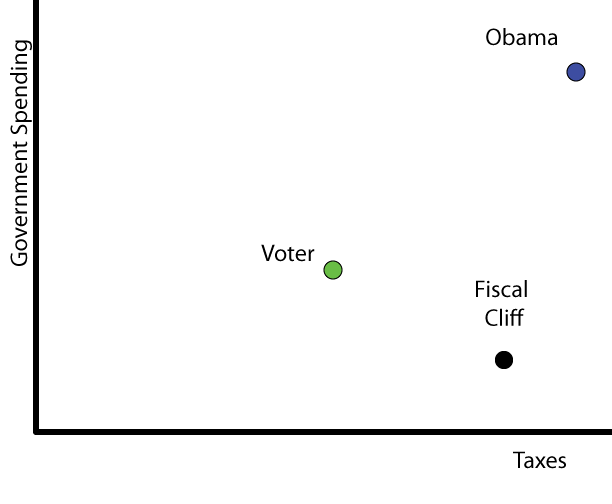
The strategic situation is captured (or, perhaps, butchered) in the graphic below.  It portrays the political bargaining space as two dimensions: taxes and spending.  For simplicity, I have located Obama’s “ideal policy” as “high taxes, high spending.”  (This is all relative.)  I have also located the hypothetical voter as “medium taxes, medium spending.” The fiscal cliff outcome is pictured as “high taxes, low spending.”
WhackAMoleSetUp-01


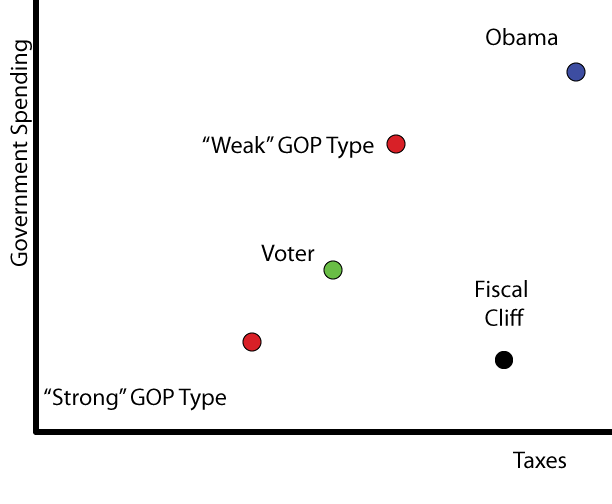
For simplicity, suppose that (the voter believes) there are two types of GOP incumbents: “Weak” and “Strong” Republicans.  Weak Republicans like higher taxes and higher spending than Strong Republicans.  This situation is portrayed in the next figure. The voter’s preferred levels of taxing and spending are closer to the Strong type (by design), so he or she would vote for a Strong Republican over a Weak Republican, ceteris paribus.WhackAMoleTwoTypes-01


If presented with a take-it-or-leave-it proposal, (the voter thinks that) either type of incumbent would accept any proposal that is closer to the incumbent’s most-preferred combination of taxes and spending than the fiscal cliff.  This set of proposals is pictured for each type in the next two figures.
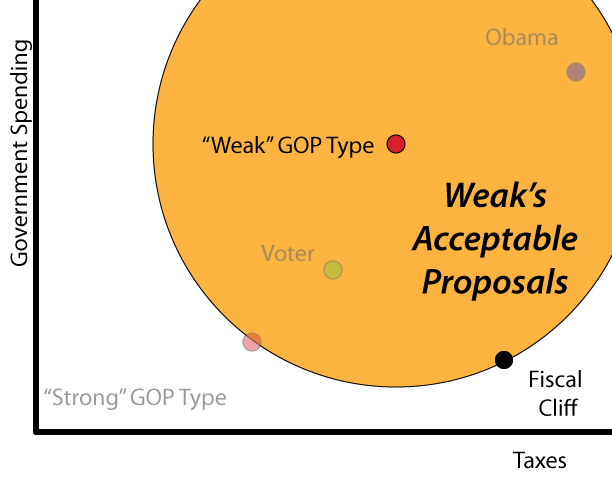
WhackAMoleWeakType-01   WhackAMoleStrongType-01

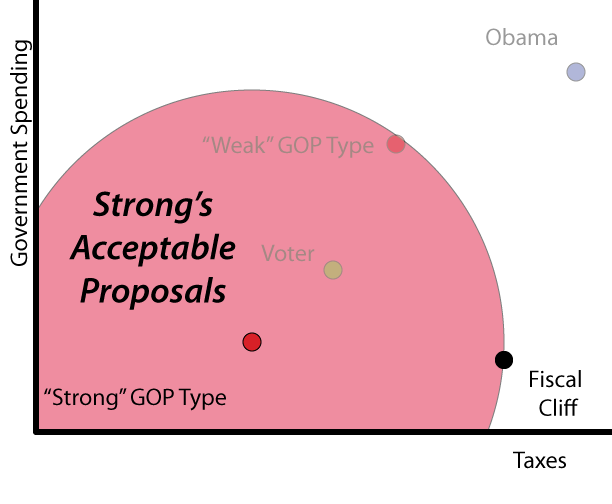
Now, if we overlay these two figures, you find the sets of proposals that (the voter believes) would distinguish the Strong and Weak types of incumbents.WhackAMoleAcceptanceRegions-01
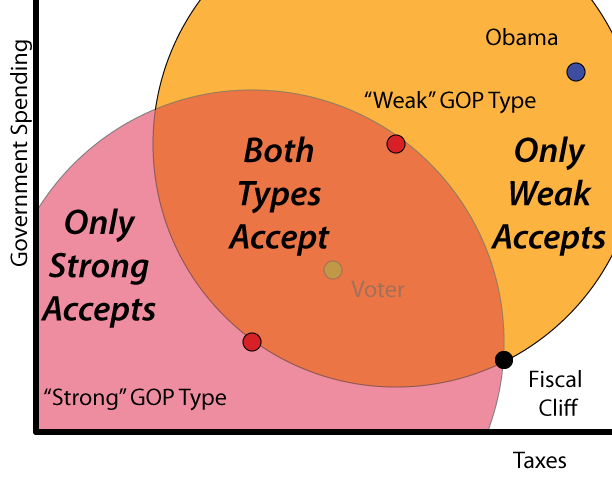
Okay, all well and good.  Intuitively, Weak types accept proposals closer to Obama’s most-preferred combination than do Strong types.  There are some proposals that both types would accept.

Now think about the fact that Obama does not, in fact, get to make a take-it-or-leave-it offer to the House.  In fact, the reverse could be taken as a rough approximation of the situation.  This suggests why the House GOP wants to make it seem like Obama should make a proposal — why he “has a mandate to raise taxes,” why this is the “time for him to lead.”  To the degree voters think that rejecting an offer from Obama carries some risk of falling off the fiscal cliff (I won’t belabor the details of that here), both Strong and Weak types of incumbents in this example have an electoral reason to elicit a proposal from Obama. In particular, if Obama made a proposal, he would face two choices:

  1. Propose something that only weak types would accept, or
  2. Propose something that both types would accept.

(Proposing something that weak types would reject either results in policy really far from what Obama wants—so that he would then need to “pull a McConnell” and veto his own bill—or gets rejected with certainty by both types and doesn’t change the voter’s opinion about the GOP incumbent’s type.)

Presuming that electoral pressures on the incumbent are strong enough, choosing Option 1 leads to a rejection by both types and the GOP incumbent scoring “electoral points” with the voter regardless of the incumbent’s true type. (Note to my game theory-aware readers: no, this belief formation by the voter is generally inconsistent with the incumbent’s behaviorI must defer my discussion of voter’s beliefs until another time.  Let’s just say that I am not sure how many voters regularly apply second-order logic to figure out that both types have an incentive to reject any proposal that only a weak incumbent would accept. Moving on…)  In a political sense, then, Obama has an incentive to not propose and withhold the House GOP incumbents any chances to score points with their constituents by rejecting/attacking Obama’s proposal in an attempt to show that, yes, they will avert the fiscal cliff, but only along a conservative-enough path.

Option 2 is viable for Obama, but represents a distinct loss to Obama in terms of policy.  That is, making such a proposal would provide Obama with a bill from the House that Obama would sign, but it is presumably worse (farther away from his preferred combination of taxes and spending) than he might be able to get if he forces the House to send something through the Senate first.

Please Let Me Refuse You…  Before I Agree with You. The basic idea I want to get across here is that the GOP may have an incentive to get Obama to make a proposal because they want to reject it initially–directly the opposite of the “albatross” theory discussed above.  The question of what Obama “should” do in this situation is more complicated, and requires a theory of the importance/role of time (and the Senate).

Speaking of time, I’m out of it right now.  Maybe I’ll come back to the proposal problem in a later post.  After all, like an NBA game, the real exciting stuff will probably occur at the end, as (in my opinion — and maybe the public’s) Obama doesn’t need to provide the GOP any opportunities to prove their bona fides. For now, I leave you with this.