
Last week I asked you to take your hand off the lever. The argument, compressed, was that the designer we kept reaching for — the planner who would tune the network so cooperation paid and nobody got fleeced — dissolves the moment you write him into the model. There is no seat at the controls. A few days in Tokyo did nothing to soften the conclusion, so I will let it stand. But a lever with no hand on it does not stop moving, and a population that nobody steers still ends up somewhere. That is the question Post 3 left sitting on the table, and it is the only one left worth asking: if no one is on the lever, what is?
The answer is a probability, and it has a name that says exactly what it does. Take the population from the first post in this series — \(N\) nodes, each carrying one of two conventions for splitting the cost of a cooperative act, the equitable one and the uniform one. Now drop a single mutant into a population that otherwise agrees: one node, against the grain, splitting costs the other way. The fixation probability is the chance that this lone deviation propagates until everybody copies it — the odds that one node’s convention becomes everyone’s. Call it \(\rho_E\) when an equitable mutant invades a uniform world, and \(\rho_U\) for the reverse.
The number to keep your eye on is \(1/N\). A mutant carrying no advantage at all — pure relabeling, no payoff consequence — still fixes sometimes, by sheer luck, and it does so with probability exactly \(1/N\). That is drift: a fair lottery with \(N\) tickets, the newcomer holding one. Selection earns its keep only when it moves \(\rho\) off that mark. A convention is favored when its fixation probability clears \(1/N\), and one convention is selected over the other when \(\rho_E\) and \(\rho_U\) disagree. Everything that follows is bookkeeping on those two numbers.
What drives \(\rho_E\) and \(\rho_U\) apart is not mysterious, and it is not new to this post — it is the arithmetic from the last two. Under the equitable convention every node nets \(b – c\) on any network you care to draw, the identity we built by engineering the cost split so the books always balance no matter who you are wired to. Under the uniform convention a node nets \(b/2 – c + (b/2)\sum_j 1/k_j\), summed over its neighbors \(j\) with degrees \(k_j\), and that figure swings with the company you keep: a node leaning on high-degree neighbors collects little, a node surrounded by leaves collects a windfall. So the contest between \(\rho_E\) and \(\rho_U\) is, underneath, a contest the degree sequence has already half-decided. Fixation does not weigh the conventions in the abstract. It weighs them as they land on this graph, at this node, against these neighbors.
Here is where the finite population earns its complications. Post 1 ran on the replicator equation, which is a deterministic flow: write down the gradient of advantage, follow it downhill, arrive. That picture is exactly true in one limit — an infinite population, where the law of large numbers irons the noise flat and the average is the outcome. Shrink the population to something countable and the gradient survives but stops dictating. It becomes a bias on a random walk. The advantageous convention is more likely to spread on any given step, and still loses constantly, because a coin weighted toward heads comes up tails all the time. Drift and selection share the wheel, and in a small enough world drift has the stronger grip.
So make mutation rare, which is the regime that does the real work. When new conventions arrive seldom enough that each one resolves — fixes or vanishes — before the next appears, the two timescales separate cleanly: the fast clock on which a single contest plays out, and the slow clock on which contests get started. The population then spends almost all of its time monomorphic. Everyone equitable, or everyone uniform, with brief contested interludes that the dynamics settle quickly.1 The long run then collapses onto a two-state Markov chain that hops between the all-equitable state and the all-uniform state, and the rate of each hop is proportional to the fixation probability of the mutant that triggers it. A chain that simple has a stationary distribution you can write in one line:
\[ \frac{\pi_E}{\pi_U} \;=\; \frac{\rho_E}{\rho_U}. \]
The population sits in the equitable convention in proportion to how readily equitable mutants take over uniform worlds, relative to the reverse. That ratio is the selector. It is not a planner weighing welfare and reaching for a dial; it is a vector the dynamics compute, a fact about the graph and the update rule that no one in the system authored and no one in the system can read off.
And “local updating” is not one rule but a family, which is the detail that turns the whole question from biology back into mechanism design. Whether a node copies a neighbor chosen at random, or a vacancy gets filled by neighbors weighted by how well they are doing, or each node simply imitates a neighbor in proportion to that neighbor’s payoff — the imitation rule that microfounds Post 1’s replicator in the first place — changes which graphs amplify selection and which smother it. Same network, different verb, different wheel. You do not get to ask which convention wins without first fixing how, exactly, a node decides whom to become. The update rule is not a modeling nuisance you abstract away; it is half the answer.
The transition rates are not handed down from nowhere, and this is where the geometry of the earlier posts comes back to collect. Imitation runs along edges — a node can only copy a neighbor, never a stranger across the graph — so the network decides which mutations can even begin to spread and how far drift carries them before selection notices.2 The closed-form \(\beta\) from Post 2, the sum of inverse neighbor degrees, is the payoff a node collects under the uniform convention, and on a hub-and-leaf graph it is wildly unequal. A hub and a leaf hanging off it do not face the same lottery when a mutant appears beside them. The hub, copied by everyone who touches it, amplifies whatever it carries; the leaf, copied by almost nobody, is a near-dead end where good ideas go to drift quietly to zero. Reachability is the blunt version of the same point: not every configuration sits one mutation away from every other, and the network’s connectivity is the support of the entire process. The wiring is the wheel.
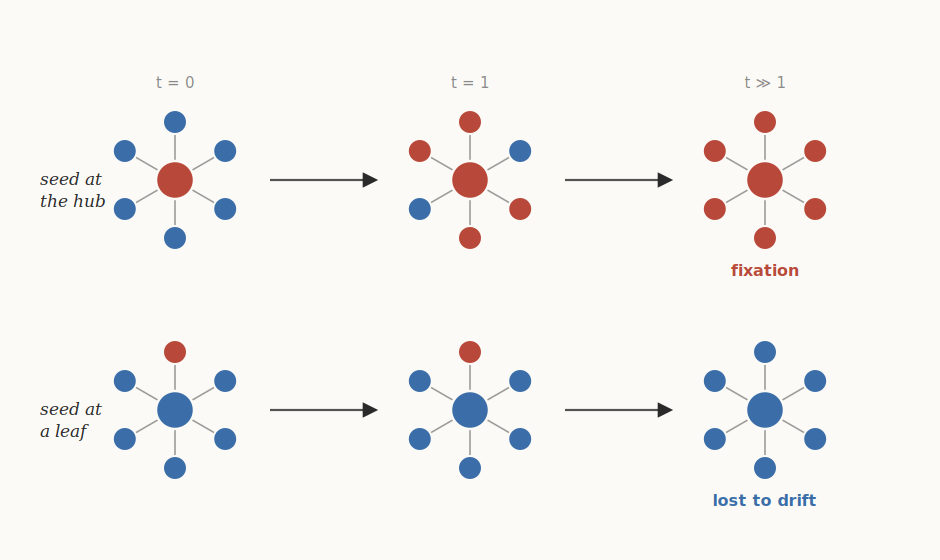
Step back and notice what just happened to the designer. In Post 3 we dissolved him — proved there was no coherent seat from which to tune the system in everyone’s interest. What we did not do, what we could not do, was dissolve the selection. The pressure we kept wanting to hang on a planner did not evaporate when we showed the planner was impossible. It relocated. It migrated into the mutation–selection–drift process and went on pushing exactly as hard, indifferent to the fact that its previous tenant had been evicted. This is the conservation of impossibility in its plainest dress: you can refuse to put a hand on the lever, but you cannot make the lever stop. The agency is conserved across the proof that no one holds it. It simply stops being anyone’s.
One last thing, because it is the hinge into next time. Stand inside a population that has fixed on the equitable convention and ask how it got there. From the inside you cannot tell whether selection chose it or drift dropped it there by accident; at the fixed point the two stories are observationally equivalent, the same monomorphic calm whether it was earned or stumbled into. Only the counterfactual separates them — would a uniform mutant have swept just as easily? — and the counterfactual is precisely what a node copying the neighbor in front of it never gets to run.3 Which sets up the question I want next: can we stand outside the thing and judge it — globally, normatively, in the language of welfare — when every member of it sees only locally? That is among the oldest questions in social choice, and it comes with names attached: Sen on the impossibility of a Paretian liberal, Arrow underneath all of it, and McKelvey and Schofield on what majority rule does once you let it wander off the median.4
The Dead had the shape of this before the population geneticists got to it — a wheel that keeps turning whether or not a hand is on it, the small one driven by effort and the big one by something you would not call effort at all. That is the answer to the question I opened with. Nobody is on the lever. The wheel turns anyway. With that, I leave you with this.
Notes
1 The reduction of the rare-mutation regime to a Markov chain over the monomorphic states is Fudenberg and Imhof, “Imitation Processes with Small Mutations,” Journal of Economic Theory 131 (2006): 251–262. The stationary distribution then depends only on the fixation probabilities, which is what lets a one-line ratio do so much.
2 That network structure can amplify or suppress selection — turning some graphs into machines that fix advantageous mutants far above the well-mixed rate and others into machines that bury them — is Lieberman, Hauert, and Nowak, “Evolutionary Dynamics on Graphs,” Nature 433 (2005): 312–316. The hub-as-amplifier intuition is doing honest work here, not decoration.
3 The counterfactual a locally-updating node cannot run is also the seam Maggie and I keep pulling on in a companion paper: what changes when a node imitates not a neighbor’s convention but its neighbor’s perceived position in the network — emulation aimed at how central you look rather than at what you do. More on that when it is further along; her end of it lives at elizabethmpenn.com.
4 McKelvey (1976) and Schofield (1978) between them established that majority rule over more than one dimension generically has no stable point and can be steered anywhere — the chaos in this blog’s subtitle. I learned those theorems, and most of what I know about how to read them, from Norman Schofield.
2 thoughts on “The Odds of Becoming Everyone (or, “Who’s on the Lever Now?”)”
Comments are closed.