Game Theory is Punk

I’ve joked before with people that I liken social science models to rock songs.  My actual mapping is horribly incomplete.  So I’ll set that chatter to the side.

That said, the practice of modeling, in my experience, is a lot like rock ‘n roll.

You give me a topic, and I’ll think for a minute, make an awkward joke to stall, and then say, “well…I think we can throw in a bit of Romer-Rosenthal, maybe a touch of Crawford & Sobel, plus a flourish of valence, and Voilà! … We have a model.” (Participants at EITM 2013 can vouch for this…for better or worse.)

But….I’m serious. Modeling is a delicate balance of divine insight and practice.  And, given the relative and regrettable scarcity of divinity in practice, more practice than insight.

Modeling requires balancing (1) a substantive question, (2) generality, (3) the finitude of time. It lies at the heart of both what are putatively purely-empirical and purely-theoretical enterprises (the only class of social science theory that is “not-putatively-but-actually-purely-and-absolutely-theoretical-and-therefore-unambiguously-correct-and-applicable” is social choice theory.)  Methodologists, game theorists—they all rightly make assumptions to get to the point of their argument.

This is ROCK AND ROLL: YOU HAVE TO FIGHT FOR YOUR RIGHT TO MODEL.

If I said, “tell me how to make a yummy dish,” you’d ask “what’s yummy?” If I, being as obstinate and/or distracted as I usually am, did not answer—you’d have to make some assumptions about what I might like. If you assumed that I liked what everybody else liked, you’d probably hand me “Joy of Cooking.”  On the other hand, if you assumed I asked because I’d looked in the Joy of Cooking and not found what I liked, you would appropriately presume that I wanted something other than “the normal,” and you’d then be  seen by the outside world as playing punk. You’d probably (rightly) take off-the-shelf tools, utilize standard analogies, and leverage structure that threatens few to provide me with a new conclusionThat’s punk.

[During the perhaps overly-artsy bass solo, let me confess that not all punk is good. But all punk is, tautologically, punk.]

…Cue big build, drum crescendo, and….harmonic ending that sends crowd into rhapsodic frenzy…

Ok, What I’m saying is a short thing: good (formal/stat/etc) modeling is punk: it takes “old” tools, “expected” tricks, and combines them to “make the house rock,” or “get the message across.”  (Lucky are those situations when “the house rocks to the message.”)

Does the Pixies anthem “Gouge Away” address every possible situation?  Is it robust to every ephemeral, existential robustness barrage one might throw at it?

Hell no. That’s why the phrase “holy fingers” is so haunting. After all, “holy fingers” are rare unless you count Chicken Fingers ™.

So, when you want to say “well, your explanation for that is just an example, I’ll just say `Get Over It.’ … And then I’ll be gone, making more noise pop, playing a flying Fiddle to the Quotidian.

With that, I leave you with this.

So, What Now?

I just came off sabbatical.  It’s nice to be teaching again.  It’s also the cause for a moment of reflection.

This post isn’t about the strategic calculus of real-world politics. Rather, it’s (sort of) about the strategic career calculus of political science.

There are several milestones in the typical academic career. A key question at each is, “what next?”  This question gets harder and harder to answer precisely because, in general, the set of acceptable answers enlarges each time. In my current case, the question boils down to, what do I want to produce?

I just turned 40, which provokes the panoply of trite musings about what one has left, and will leave, behind.[1] Should I write another book?  Should I continue the fun but/and frustrating struggle to publish journal articles?  Should I pursue administrative tasks? Should I get a real hobby?

These are tough questions, and I don’t know what the ultimate answer will “be,” but I think they represent an important reality of being a professor.  In the end, if you’re lucky, you truly become your own boss (within certain bounds).  That’s a good but/and scary thing.

Writing and publishing is, at least to me, a lot like the “typical” picture of drug addiction: the first couple of successes are so awesome. I mean, the first time you’re published, the first time you’re cited, the first time one of your articles gets a second cite, the first time more than one of your articles is cited in the same paper… these moments seriously rock.  (If these things don’t rock your boat, then I predict you wouldn’t pursue publishing in the first place.)[2]

But “the buzz” dulls—not in a “woe is me” way, mind you—and the quest for the next step gradually emerges.

Perhaps coincidentally, I spent the past 36 hours or so pursuing an active “twitter life.”  That is, I thought it would be fun to see how much I could chum the twitters by being really “active.”  After finally remembering to delink my twitter and facebook accounts (sorry it took me so long, FB friends), I have now realized (unsurprisingly) that “the buzz” there is the same.  Tweet favorited? Hells yeah.  Get a reply from someone you know?  That’s right…the conversation IS STARTING.  Get a reply from someone you don’t know?  Yeah, that’s what social networking is all about. Get an RT from someone with a bunch of followers? BOOYAH.  Watch the followers gather, people!

But, in the end, you even more quickly run into the same question: what next?

If you’ve been reading, you’ll realize that this isn’t a diss on twitter.  It’s life.

The scary part of all of this is a simple reality: if you like attention,[3] the game never ends, regardless of its format.[4]  But, before one says “well, seeking attention is unseemly,” I’ll note that the same is true from those who seek prestige/authority/influence as well.  The realities differ in details, but the maxim “what have you (for me) done lately?” still holds in most cases.  Memories fade fast, competitors and distractions emerge even more quickly….you’re only as good as your last outing.

Why say this? Well, its my blog, and it’s what I’m thinking about.  But, more universally, it’s at the heart of the (generally unsolicited) advice I offer to graduate students:

Before anything else, figure out what you care about. Divine what you won’t mind being bullied about. And definitely rule out the things you can’t stand thinking about.  Best case scenario, you’re going to be doing this, essentially alone and sailing into a mixture of indiscriminate indifference and poorly-disguised disdain, for years to come.

I’ve found that it’s worth it.  But the world isn’t black-and-white: there’s always a “what’s next?” right around the corner.  Maybe my point is that, these moments of reflection—seemingly inevitably tinged with a genteel bouillabaisse of self-doubt and fatalism—are what’s next. They are the detritus of self-renewal, the requisite weigh stations of producing.

With that, I leave you with this.

______________

[1] I was told by a close friend that this is a very “male” worry, but whether that is true in general is irrelevant, as that description is vacuously true in this case.

[2] Everything I describe here can be mapped into performing/creating in general. It’s all about taking the risk and seeing, nay feeling, it “pay off.” By pay off, I mean simply “get noticed.”

[3] And, I do.

[4] Okay, I’ll take notice of what I’ll call the J.D. Salinger category, which is the rarest of beast: the creator who arguably gets more attention by doing nothing.

The Noted Is Always Notable

…but the notable is frequently unnoted.

This post, along with the always thought-provoking repartee with my friend Chris Bonneau, inspires me to write a  post about selection effects and their ability to magically turn a mountain into a molehill.  The short version of the story is that a brouhaha was breaking out at the University of Colorado-Boulder regarding Patricia Adler, a Professor of Sociology whose course in “Deviance in US Society” (which looks fascinating) attracted unwelcome attention.  I will dispense with the details of the case, but note that Adler was ultimately not formally punished. As a faculty member myself, I rightly and consciously adopt a default position of “the critics generally know less about how to do it than the faculty member and, accordingly, often have even worse motives when they attempt to intervene.”

But, to be clear, this post is not about Adler’s case, per se. Rather, and I think more fairly, this post is about the argument advanced by  in the post linked at the beginning.  In a nutshell, Schuman—or her copyeditors—argues in the subtitle:

How would you like it if a bunch of online randos could get you fired? That’s life for professors.

Well, I wouldn’t like it. Indeed, you could omit the “online” qualification.  Or, for that matter, substitute “anyone” for “a bunch of online randos.”  But, more to the point—and I feel bad picking on Schuman, because it’s a common mistake in this kind of crisis post mortem and I believe the intentions are (very) good—Schuman’s argument is prone to a classic selection effect.

Specifically, the article presents no evidence that “online randos” (i.e., some sort of viral flame against Adler) had provoked the CU-Boulder administration’s initial actions.  In some searching, it seems that what did provoke it is still unclear.  The remarkable thing about viral anti-intellectual vitriol is it tends to be VERY CLEAR.  (Doubt it?  Just click here.) So, let’s suppose that some soon-forgotten wave of outrage from the “internet review board” did not actually bring upon the Adler brouhaha.

No, the viral storm started after Adler (understandably) went public about the burgeoning brouhaha.  And, to repeat myself, Adler was ultimately inconvenienced, but not otherwise punished. Yes, I am sure that the ensuing viral maelstrom attracted vitriolic detractors.  But, to be honest, if you’re in the middle of a brouhaha and you surf the blogosphere, it’s not really reasonable to expect not to find a deluge of derogatory detritus.

Caveat surfor, as the Roman kids say.

In fact, in spite of the anti-Adler/anti-Sociology/armchair-intellectual/professional-anti-intellectual invective that followed the initial splash of Adler’s tribulations, again…she was ultimately not formally punished.  So, this isn’t about the internet (even potentially) getting a professor fired.  Rather, it’s more likely reflective of the reality that a tenured professor at a nationally prominent university being investigated/harassed by her administration is/was per se notable.  (Let’s hope it stays that way.)

Before concluding, let me provide a simple, three-pronged analogy to this:

  1. Internet criticism of President Bush caused his inept performance during and following Hurricane Katrina,
  2. Internet criticism of President Obama caused his inept performance with respect to Benghazi and/or the Affordable Care Act rollout, and
  3. Internet criticism of Governor Christie caused his inept handling of traffic leading to George Washington Bridge.

Of course, none of those causal stories seems plausible.  As much as I am suspicious of those who spend precious time pestering faculty, I really doubt that the ex post ranting of “online randos” was somehow the ex ante cause/inducement of her troubles and travail.

With that, I leave you with this.


You’re Welcome for the Thankless Thanks

Tonight’s Golden Globes reminded me of a point I haven’t seen made (though I am sure somebody has made it).  Namely, why do actors and actresses thank a whole bunch of other people when they are on TV in front of millions of viewers who hate watching actors and actresses thank a whole bunch of other people?  After all, it is arguable that awards shows are clearly and only about the viewers.  Right?

Well, a quick point is in order.  A “thank you” is like a gift—it is more meaningful when it is costly and demonstrates that the thanker “thought of” the person being thanked. The seconds one gets to speak on live TV are precious and fleeting.  More importantly, an actor or actress sacrifices a lot (e.g., of at least hypothetical accolades) by not giving some meaningful speech and instead thanking one’s agent, producers, etc. This is even more true given the fact that nobody likes listening to such acknowledgments.

The fact that the time is limited and the awardee presumably had to prepare the list of people to thank without knowing for certain that he or she would actually win merely amplifies the cost—and accordingly, the meaningfulness—of the “gift” of the thanks.

But, here’s the kicker: the fact that we, the audience members, hate listening to “a list of thank you’s to otherwise anonymous industry people” bolsters the value and, accordingly, the incentive for actors and actresses to do this.  So, in a nutshell, it’s kind of Alanis-esque: the fact that viewers of award shows hate listening to lists of thank you’s ironically causes /induces actors and actresses to get up on live TV and run through lists of thank you’s.

And, with that, I leave you with this.

Ironic, quick second takes on sequential rationality

I just finished writing this meandering post about sequential rationality. Subsequently, I thought of these better examples that come from different angles.

First, a classic example (mostly) of failures of sequential rationality: food challenges. In most cases, most people who think they can eat that amount of food can eat that amount of food. They just end up, part of the way through the challenge, not wanting to do so.

A so-so story about motivation that, upon reflection, suggests an interesting take on harnessing “nonsense” intrinsic motivations to overcome sequential rationality/commitment problems: Jerry Seinfeld’s “don’t break the chain” tip for writing. (But, how do I motivate myself to bother writing the “X” on the calendar? I’ll just remember, right?  HAHAHA.)  In other words, it’s usually more fun to not work than work (because, hey, somebody‘s got to bang on that drum ALL DAY), but it also sucks to think about breaking a streak.  Well, at least a streak that is endorsed by Jerry Seinfeld.

Oh, I Thought You Said You Wanted To Sell A Bus…

It’s a new year, the ground is covered with more-than-ankle-deep snow, and I told a friend tonight that it seems like, over the past couple of weeks, the notion of a “day of the week” has lost all meaning.

This is how winter break winds to a quiet close.

It is an opportunity to take stock, and think about what we do as faculty and researchers.  In a sense, it is the quintessential time for “well, time to get BACK AT IT.”  After all, the spring semester lurks right around a single left-click on the google calendar, and both students and journals are inexorably rising from a temporary slumber, bringing the holiday respite to a close.

The details of my own thinking are ephemeral even to me (though you never know when hindsight might prod one to think such classifications naive or at least short-sighted).  But the classic math of politics point that keeps coming back to me during this thinking is

Don’t start what you won’t want to finish.

Notice it’s not can’t finish…this is about incentives/motivations/desires, not ability. In the end, time is finite and, ironically, fleeting.  A project you’re not “into” has a very small chance of being finished.  In game theory, this idea is captured by what is referred to as sequential rationality. In a nutshell, a sequence of actions or decisions is sequentially rational if, at every opportunity one has to revisit and revise the sequence, continuing the sequence as originally prescribed is still in the decider’s interest.  In other words, it is a sequence of decisions that the decision-maker never has significant regret about continuing.

As one example, I (re)designed two syllabi this week.  I am teaching Intro to American Government, a course that I have always wanted to try, and graduate game theory, a course that I have taught for years, but never perfectly.  In both courses, there are topics I like more than others.  In both courses, there are topics I really don’t find relevant…at least for the way I think about “the course.”  However, many of these topics are de rigueur.

So, should I cover these topics?  I can stomach the claim that I should cover them well. But, to be blunt, both sequential rationality and experience—the two of which pair quite nicely, if you think about it for a minute—suggest that that fortuitous combination is not likely.  Rather, my real choice is between covering them as well as I will or simply omitting them.  (I’ll set aside the possibility of minimizing them for the purpose of maximizing clarity.)

On the one hand, it is likely (at least in my mind) that the time spent covering these topics in a subpar fashion could be better spent on other topics I feel more strongly about.  So, covering these topics comes at a cost.  On the other hand, not covering the topics, in addition to potentially leaving gaps in the student’s knowledge,[1] sends a signal about my own tastes/abilities/dedication.  Setting aside the “gaps in knowledge” worry, as none these topics couldn’t be covered by students on their own at least as well as I would cover them, given my lack of interest in them, the comparison is even more stark.

Specifically, if one presumes that my interest in/dedication to the topic—i.e., the sequential rationality of me “committing” to a syllabus where I will talk for 3 hours about the topic[2]—is positively associated with quality of the teaching, then an earnest student would, prior to the course beginning, wish that I would allocate my teaching of the various topics roughly in proportion to my interest in them.  But, I have an interest in being seen as “teaching well.”  Or, less admirably, I have a latent but abiding interest in avoiding scrutiny.  If I teach what I think most appropriate according to the logic of sequential rationality, and for some reason a student complains about the course, I would potentially have to explain why my course omitted some de rigueur topics.  My argument could, of course, be that I don’t find those topics as interesting, relevant, and/or important as others.  But, to be both clear and hyperbolic, this would be arguing against the discipline.

Now, luckily for me, it doesn’t really matter right now.  But, this is a classic and subtle point about accountability, discretion, and commitment.  My hypothetical earnest student is arguably also a plausible benchmark for the hypothetical earnest parent and/or university administrator.  But, once the “fire alarm oversight” of a disgruntled student (or, to be fair, many students) is “pulled,” the sequential rationality of even the hypothetical earnest parent and/or university administrator to stand up for “well, the syllabus was ex ante efficient given Professor Patty’s own sequential rationality constraints” is suspect.

In other words: the road to commitment problems is paved with unrealistic intentions.

With that, I leave you with this.

_____________________

[1] To be clear, in some cases, I might be preserving the students’ knowledge by not covering a topic.

[2] Arguably commensurate and definitely countervailing to the dropping of worries about the gaps in students’ knowledge, I am also setting aside the potentially deleterious effects of proffering a syllabus that is ultimately not followed. That’s the more traditional portrait of a failure of sequential rationality: the plan is ultimately “not followed.”  A piece of advice for those who have yet to teach your own course: varying from the syllabus is the surest way to lower your course’s evaluation without significantly risking your own dismissal. Trust me on this. I have plenty of evidence, all of which I regrettably “manufactured.”

CIA? See, I Am Policy Relevant

As most things I encounter, This New York Times story got me to thinking about, well, me.  Specifically, the article—discussing the Senate’s attempts to oversee the CIA’s interrogation programs—touches upon two strands of my research that, at first glance, might appear related only in that they both use mathematical models to analyze and characterize political phenomena.  One of these strands revolves around the use and acquisition of information in political institutions (specifically, but not exclusively, bureaucratic agencies).  The second focuses on how one might discriminate between legitimate political procedures and illegitimate ones.

Information and Oversight: Ex Ante vs. Ex Post Incentives. One story at the heart of the article revolves around the existence of a classified internal CIA report that members of the Senate Intelligence Committee would like to see.  The central question here is whether the internal report confirms the Senate’s (still classified) own report and/or contradicts the subsequent disclosures/admissions/justifications offered by the CIA to the Senate Intelligence Committee.

I have written, with Sean Gailmard, several articles and working papers (e.g., here, here, here, and here) and a book, Learning While Governing, that examine in various settings the incentives for individuals within hierarchical organizations to acquire, use, and honestly report information to their superiors.[1]

While I am sure you want to read each of these in their entirety, with the proper “SPOILER ALERT” I can summarize a principal thread linking the theories as follows:

The incentive to collect, use, and share information in a faithful way depends on expectations about who will subsequently get the information and how they will use it.

In terms of the Senate Intelligence Committee’s oversight efforts, the implication of this is as follows:

To the degree that the information revealed and shared within the CIA in writing its internal report is potentially used by the Senate to punish the CIA (in whatever form), successfully extracting the report may hinder the CIA’s efforts to internally collect and share information in the future.

Of course, we are not the first to make this point,[2] but it is often forgotten.  Put another way, attempts to keep the CIA’s internal report hidden need not indicate nefarious motives.  Rather, there is a coherent logic that justifies a lack of transparency, or stonewalling, in somewhat ironic pursuit of information in the future.[3]

Colloquially understood, “oversight” is an ex post phenomenon (it occurs after the actions of interest).  But game theoretic institutional analysis helps illustrate and remind us that this ex post procedure can have ex ante effects (individuals may change their behavior—sometimes in unexpected, or “perverse,” ways—in anticipation of it).

Legitimacy and Oversight. In line with the Senate Intelligence Committee’s pursuit of the CIA internal report, some Senators are also pursuing the Department of Justice’s internal classified memos that supposedly provide a legal rationale that justifies some of the interrogation techniques in question.  Quoting from the end of the article,

Much of Tuesday’s hearing was consumed by a debate about whether the White House should be forced to share Justice Department legal memos.

Under polite but persistent questioning by members of both parties, Ms. Krass repeatedly said that while the two congressional intelligence committees need to “fully understand” the legal basis for C.I.A. activities, they were not entitled to see the Justice Department memos that provide the legal blueprint for secret programs.

The opinions “represent pre-decisional, confidential legal advice that has been provided,” she said, adding that the confidentiality of the legal advice was necessary to allow a “full and frank discussion amongst clients and policy makers and their lawyers within the executive branch.”

Senator Feinstein appeared unmoved. “Unless we know the administration’s basis for sanctioning a program, it is very hard to oversee it,” she said.

In an article and a forthcoming book, Social Choice and Legitimacy: The Possibilities of Impossibility, Maggie Penn and I have tackled the question of when a government policy is legitimate, which colloquially means that it is consistent with an underlying set of principles or criteria (e.g., fairness, efficiency, equality, etc.).  The argument is social choice theoretic, and boils down to the following.

A policy is legitimate if one can construct a sequence of decisions that justify the policy in the sense that no earlier, intervening decision is strictly better than the final policy, and every unchosen policy that is arguably better than the final policy is itself inferior to one or more of the intervening decisions in the sequence that justifies the final policy.

Informally, the theory provides a precise characterization of justifying a choice through providing (or accompanying the decision with) other decisions that can serve as counter-objections to any alternative choice that one might propose to replace the final choice.

A direct implication of Arrow’s impossibility theorem is that there may in general be multiple legitimate decisions.  However, it is generally the case that there are many illegitimate—and non-legitimizable decisions, too.

A fundamental starting point/implication of our notion of legitimacy is that, in order to verify the legitimacy of a decision, one must have access to the rationale or justification for the decision.  As portrayed in our work, this can be thought of as an argument about both the principles that ought to (and/or did) guide the choice and an demonstration that the final decision is in fact justifiable—sometimes necessarily through a complicated process of reasoning.

In a nutshell, then, our work provides a systematic (though, of course, contestable) argument in favor of the executive branch sharing the DOJ memos with Congress.

Putting It All Together. In addition to being applicable to the same story, the two strands of research—which leverage different (though I just argued not that different) veins of theory—also complement each other, particularly in the light cast by situations such as this.  In particular, placed side-by-side, they demonstrate one of the most fundamental realities of politics: every choice we debate for more than a couple of seconds necessarily involves an important trade-off.

In other words, seeking the truth can sometimes ironically further its obfuscation, just like banning certain types of Superbowl Ads can ironically create an incentive to create ads that will be banned.  Finally, recognizing the ubiquity of such trade-offs leads to the recognition of the fundamental importance of social choice theory. To quote Maggie Penn and myself,

Rather than taking [the impossibility theorems of social choice theory] as negatives, to be either ignored or worked around, … these results motivate the entire study of politics. The potential irreconcilability of multiple societal and/or individual goals is exactly the raison d’être of government.

This has obviously been an even more blatantly self-promoting blog post than usual. Instead of feigning an apology for that, I leave you this, the greatest pop song ever written.

____________

[1] In solely authored work, I also tackle this topic in this article and this working paper.

[2] To be fair, though, I think we make it in a variety of new ways and draw new institutional implications of it.

[3] For the cognescenti of these kinds of models, there is always a delicate question of commitment at this point.  I am setting that to the side.

The Ties That Bind Theory

I am a game theorist.  I love thinking about situations as strategic interactions.

As a game theorist, I make assumptions all the time. (And I assume you do, too, in whatever you do. THAT’S META.)

In political science, there are, broadly defined and in my estimation, four categories of theory.  Game theory (which includes mechanism design) is one, of course.  The oldest of the four is typically simply called “political theory” or, more precisely, normative political theory within the discipline, and—while it is a decidely and wonderfully big tent—essentially can be described as work focused on theoretical concepts such as justice, fairness, & democracy, and how they should be measured.  (That “normative” political theory is about measurement is my take—the usual framing of the research is “this concept implies that one should do the following.” If you think about it for a second, the implication of accepting such a conclusion is “adherence to this concept implies that you will do the following,” by which you can measure (from behavior, for example) how much someone values, or at least adheres to, this concept.)

The third category is known as social choice theory. This category includes studies of what is possible to achieve. There are a lot of ways this inquiry can be carried out.  Examples include “can we always find a fair choice,” “is it possible to design a voting system that always rewards honesty,” or “can we combine people’s preferences to make a sensible public decision?”  This field has been declared dead by more than a few social scientists, ironically due to a handful of noteworthy (and Nobel prize-winning) achievements, including Arrow’s (im)possibility theorem.  That is not, in fact, dead is proven by much current research, including the forthcoming book authored by Maggie Penn and myself, Social Choice and Legitimacy: The Possibilities of Impossibility.

Finally, a fourth category has emerged over the past forty years or so (beginning with the works of Schelling, Axelrod, and others).  This area, computational modeling, develops and analyzes mathematical models of behavior and institutions to derive empirical predictions about political phenomena.

While open hostilities are luckily rare, the four categories do not “get along,” generally. This is both silly and a shame.  It’s a shame because the four areas have a lot of opportunities for profitable and though-provoking collaboration.  It’s silly because they have a lot in common (independent of their extant potential synergies).  In particular, “all four are theory.”  That is, the best work in each of the four values and embodies clarity and, to the degree available, parsimony.

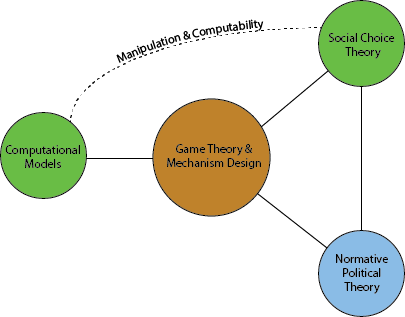
In the interest of parsimony I have drawn a picture of (at least some of) their connections. I have put game theory/mechanism design at the middle of the graph because, even if that’s not right, it instantiates the old adage that “the blogger draws the maps.”

This is a picture I drew...OF THE WORLD OF THE MIND.

This is a picture I drew…OF THE WORLD OF THE MIND.

Very quickly, why the distinctions between the four categories?  Well, I have been thinking about them—and I am comfortable describing myself as “actively” working in all four areas—and I thought it might be useful (if only for me) to work through a quick description of the lines in the picture.

Normative political theory is, by and large, completely concerned with internal consistency.[1] In this sense, it is linked with game theory and mechanism design and social choice theory: all three categories highly value what is known as a “fixed point,” which describes a solution to a problem that, when put forward as the solution to the problem as described by the theory, does not then lead to a different solution being produced.

Social choice theory is concerned with generality and, relatedly, agnosticism.  (There are important exceptions to this, such as in this article by Maggie Penn, Sean Gailmard, and myself.) That is, much of social choice theory tackles the tough questions of what can be achieved/guaranteed with as minimal restrictions on “who may show up” or “what people might want/believe” as possible.  The link between social choice theory and normative political theory is hopefully clear: much normative political theory either in essence argues for what one should want or believe or works out how one should act given what one wants or believes, while most social choice theory finds what can happen when we can’t or don’t want to restrict what people want or believe.[2]

Normative theory and social choice theory are each less concerned with the details of the specific situation: they are more general than game theory.[3]

On the other end of the generality spectrum is (the vast majority of) computational models. Most computational models require specification of the parameters of a particular situation to generate (often very precise) predictions.  If one has this specification at hand, (the right) computational models offer a direct path to the desired outcome: a prediction and the ability to start tinkering.

Part of the power of computational modeling is its deliberate setting aside of what I call epistemological concerns.  Put another way, a good computational model is not required to be internally consistent with respect to individual or group motivations.  That is, and this is often properly trumpeted as a strength of computational modeling but, in my opinion, for the wrong reasons, computational models do not necessarily yield what a game theorist would call “equilibrium outcomes.”  In other words, there is no reason to suspect that a computational model of a given political situation would remain accurate once the model was shown to one or more reflective agents involved in that situation.[4]

I’ll conclude now by restating my point bluntly: each of these are political theory. And, yes, game theory is at the middle: it requires specification of more details than social choice and normative theory (which I would argue, if pressed, truly differ only in their languages) and it requires “more of itself” in terms of internal consistency than is (appropriately) the norm in computational modeling.

Like I’ve said before about other analogous “comparisons,” asking which of these is the best is like asking whether a screwdriver is better than a hammer.  It depends on whether you want to screw someone or simply hit them over the head.

With that, I leave you with this.

____________

[1] There are lots of great normative arguments that encounter the dirty feet of reality, but that is to the field’s credit, as opposed to a defining quality, in my opinion.

[2] Note that this illustrates an important category of empirical implications of social choice theory: social choice results inform one about the degree to which one can infer anything about the preferences and/or beliefs of a group of individuals from the decisions and choices one observes the group make.

[3] Mechanism design is “in the middle,” as Austen-Smith and Banks make clear in their incredible treatises (volume 1 and volume 2).  That is, mechanism design asks, in essence, what general goals/outcomes can a group achieve through the proper design of a specific institution (i.e., “game”).

[4] I won’t discuss it here, but the dotted line in the figure connecting social choice and computational models reflects a very active area of research that asks when, how, and whether such reflective individuals might be able to change their behavior to make themselves better off.

MC Grammar Presents “U Shan’t Correct This”

It’s been too long since I wrote to you.  I apologize. Lots of the normal and delicious detritus of everyday life, combined with the singularly separate and complementary weight of “original thought,” has delayed me from my typical task of writing to you.

I write now, somewhat quixotically, to solve a variety of problems at once.  Luckily, Stephen Fry made a succinct contribution that clarifies at least a portion of my frazzled mindstream.

This video makes three points that I agree with, and draws an inference I disagree with quite strongly.

Language, what is it?  What should it be? The answer to the first question is ambiguous precisely (in my mind) because language that is clearly defined is less useful than one that is somewhat—per se and exactly, at least—undefinable.  The second one is pointless beyond the tautological answer “something used to communicate,” which presumes (fairly) that both speaker and listener have mutual knowledge of (at least most of) what the language “means.”

So, what do I agree with?  One, language evolves—not only does the world change, but expectations about what others think “we’re talking about” do as well—so there’s no reason to suppose for any reason other than the natural human desire for certainty that language (read: grammar, syntax, vocabulary, etc.should or is fixed in any sense.

Second, correcting others’ grammar is obtuse.  There’s a game theory point here: if you can correct the speaker’s grammar with anything approaching the requisite level of certainty for seizing such a teachable moment, you know what they mean to say.

I will set aside the question of “forum/medium” of the language that is being corrected.  Clearly, language that is deployed in an unambiguously colloquial/time-sensitive setting (facebook, twitter, when one needs to go to the bathroom) is properly thought of as, at best, an approximation of what the speaker would deploy in a setting where it was fair to presume that all parties should agree that language matters.

This brings me to the third point I agree with.  Fry makes another game theory point: when the expectation by the listener is that language should matter, then, well…to be blunt…it matters. Pushing this back and getting “game theoretic-plus” for a second, when the listener thinks that a sincere speaker thinks that the listener is likely to think that language matters and the listener has similar preferences to “the common listener,” then language matters.

Where I disagree is the (perhaps misinferred) implication that caring about the rules of language is a simple instantiation of pedantry.  Hell, I write in a calculatedly abstruse, enigmatic, and pedantic fashion.  I say calculatedly because I think words matter in a way that many more even-keeled individuals do not.  When I say that, though, it should be inferred that “matter” is properly interpreted by me as shorthand for “matter to me.”  In a nutshell, Fry can appropriately say, with me cheering alongside, that your language should not fit my constraints.  But, let’s be clear, I like word candy.  And, even less surprisingly, I like reading what I wrote…over and over and over. Conclusion? Don’t confuse caring about language with pedantry unless you are comfortable with equating pedantry with, ahem, “giving a shit.”  At the same time, any good (classical) liberal has to accept that the penumbras that one chooses to focus on need not attract anyone else’s gaze.

In other words, Fry is right: it is bad form to correct others’ grammer/syntax/vocabulary when the meaning is clear, but… language matters. If you have a point to make that language constrains, well, fuck language.  But, let’s be honest…this is pretty rare, so—if in doubt, honor language as best you can…and don’t be a douche correcting others’ language.

Hopefully I won’t be gone as long between this and the next post as I was between the previous post and this, but just in case, I leave you with this very apropos St. Louis shout-out.


Inside Baseball: Making Models of Minds, Making Models “Behave”

Most of my research starts with the presumption that individuals are rational.  By this, I mean that they know the rules of the game, and they also know that the other players are rational.[1]  Simple empirical observation indicates the inherent contestability of this presumption.  So, why do I continue to adopt it? Well, I have written before about this point in a number of posts, but (or, “accordingly”) I’ll say the presumption of rational behavior establishes the robustness of the phenomena that the model aims to “predict/explain/mimic.”  That is, presuming rationality makes my life harder as a theorist. If I did not have rationality as a stake for the tent I’m putting up, it would be pretty darn easy to place that tent wherever I want: as a theorist, I can explain anything if you let me bring irrational behavior to the table. Setting that to the side, however, there’s another point I’ve been thinking about lately that I wanted to drone on about a bit.  If we step away from presuming rationality, we need to put something in its place.  There is a huge and growing literature on deviations from rationality in social sciences.[2] In a quick form, my challenge to those who would have models incorporate these findings is as follows:

What are the “parameters” of irrationality?

A related version of this is “which varieties of irrationality should I put in my model?” There are various forms of irrational choice: those that deal with

  1. intertemporal choice (e.g., overconfidence in your own patience in the future),
  2. evaluating risk (e.g.is it a gamble over winnings or losses?),
  3. updating on information (e.g., favorable vs. unfavorable information?)

So, this leads to two questions.  First, which of these is more important to include?  Common sense (and the quest for causal identification, if that’s your cuppa tea) suggests that throwing them all in will yield something unmanageable.

Second, and more precisely, even if I choose one to include (for example, to see how the availability heuristic affects how voters evaluate incumbents and challengers, and how this affects campaign decisions), how do I parameterize/represent this bias?

Put another way, most (formal and informal) models of behavioral biases rely on at least an implicit notion of perception: in a nutshell, most biases in choice can be described as some “label” or “feature” of the decision problem that the decision-maker should not actually take into account actually bearing on the decision-maker’s ultimate choice(s).

The question, and conclusion of this post (in search of feedback), is how do we model the world of “features?”  That is, how does one make an even plausibly “general” theory of a phenomenon that includes behavioral biases?  After all, most models are designed to be generally applicable—where “generally” means across time, or space, or something.  Traditional models of choice/behavior presume that people have a “general” feature known as a preference ordering (or, essentially equivalently, a utility/payoff function).  But the (both formal and informal) “behavioral” models have been built largely on noting a series of deviations from the predictions of the classical choice model in a specific (often laboratory) setting.  This isn’t an objection that the findings aren’t externally valid—it’s an honest question as to how one extends the findings to general (i.e., external) settings.

So, what ingredients should I throw into the pot if I want to cook up a model of the mind to deploy in my models of political behavior and institutions?

With that, I call upon a favorite, and leave you with this.

___________

[1] There’s even more in here, as I wrote about here. I will set the issue of common knowledge of rationality aside for the purpose of this post, as it merely amplifies the point I am trying to make.

[2] I won’t bother to cite any of it, because it would be merely gratuitous and possibly lead to erroneous inferences about what I intend to be inferred by the inevitable omissions from such a list.  That concern, if you think about it, is meta. (What? Oh, okay… start here.)