Well, In a Worst Case Scenario, Your Treatment Works…

Three political scientists have recently attracted a great deal of attention because they sent mailers to 100,000 Montana voters.  The basics of the story are available elsewhere (see the link above), so I’ll move along to my points.  The researchers’ study is being criticized on at least three grounds, and I’ll respond to two of these, setting the third to the side because it isn’t that interesting.[1]

The two criticisms of the study I’ll discuss here share a common core, as each centers on whether it is okay to intervene in elections.  They are distinguished by specificity—whether it was okay to intervene in these elections vs. whether it is okay to intervene in any election.  My initial point deals with these elections, which aren’t as “pure” as one might infer from some of the narrative out there, and my second, more general point is that you can’t make an omelet without breaking some eggs.  Or, put another way, you usually can’t take measurements of an object without affecting the object itself.

400px-Montana-StateSeal.svg


“Non-Partisan” Doesn’t Mean What You Think It Means.  The Montana elections in question are nonpartisan judicial elections.  The mailers “placed” candidates on an ideological scale that was anchored by President Obama and Mitt Romney.  So, perhaps the mailers affected the electoral process by making it “partisan.”  I think this criticism is pretty shaky.  Non-partisan doesn’t mean non-ideological.  Rather, it means that parties play no official role in placing candidates on the ballot.  A principal argument for such elections is a “Progressive” concern with partisan “control” of the office in question.  I’ll note that Obama and Romney are partisans, of course, but candidates for non-partisan races can be partisans, too.  Indeed, candidates in non-partisan races can, and do, address issues that are clearly associated with partisan alignment (death penalty, abortion, drug policy, etc.)  In fact, prior to this, one of the races addressed in the mailers was already attracting attention for its “partisan tone.” So, while non-partisan politics might sound dreamy, expecting real electoral politics to play in concert with such a goal is indeed only that: a dream.

Intervention Is Necessary For Learning & Our Job Is To Learn. The most interesting criticism of the study rests on concerns that the study itself might have affected the election outcome.  The presumption in this criticism is that affecting the election outcome is bad.  I don’t accept that premise, but I don’t reject it either.  A key question in my mind is whether the intent of the research was to influence the election outcome and, if so, to what end.  I think it is fair to assume that the researchers didn’t have some ulterior motive in this case.  Period.

That said, along these lines, Chris Blattman makes a related point about whether it is permissible to want to affect the election outcome. I’ll take the argument a step farther and say that the field is supposed to generate work that might guide the choice of public policies, the design of institutions, and ultimately individual behavior itself.  Otherwise, why the heck are we in this business?

Even setting that aside, those who argue that this type of research (known as “field experiments”) should have no impact on real-world outcomes (e.g., see this excellent post by Melissa Michelson) kind of miss the point of doing the study at all.  This is because the point of the experiment is to identify the impact of some treatment/intervention on individual behavior.  There are three related points hidden in here.  First, the idea of a well-designed study is to measure an effect that we don’t already have precise knowledge of.[2]  So, one can never be certain that an experiment will have no effect: should ethics be judged ex ante or ex post?  (I have already implied that I think ex ante is the proper standpoint.)

Second, it is arguably impossible to obtain the desired measurement without affecting the outcomes, particularly if one views the outcome as being more than simply “who won the election?”    To guarantee that the outcome is not affected implies that one has to design the experiment to fail in a measurement sense.

Third, the question of whether the treatment had an effect can be gauged only imprecisely (e.g., by comparing treated individuals with untreated ones).  Knowing whether one had an effect requires measuring/estimating the counterfactual of what would have happened in the absence of the experiment.  I’ll set this aside, but note that there’s an even deeper question in where if one wanted to think about how one would fairly or democratically design an experiment on collective choice/action situations.

So, while protecting the democratic process is obviously of near-paramount importance, if you want to have gold standard quality information about how elections actually work—if you want to know things like

  1. whether non-partisan elections are better than partisan elections,
  2. what information voters pay attention to and what information they don’t, or
  3. what kind of information promotes responsiveness by incumbents,

then one needs to potentially affect election outcomes.  The analogy with drug trials is spot-on.  On the one hand, a drug trial should be designed to give as much quality of life to as many patients as possible.  But the question is, relative to what baseline?  A naive approach would be to say “well, minimize the number of people who are made worse off by having been in the drug trial.”  That’s easy: cancel the trial. But of course that comes with a cost—maybe the drug is helpful.  Similarly, one can’t just shuffle the problem aside by arguing for the “least invasive” treatment, because the logic unravels again to imply that the drug trial should be scrapped.

Experimental Design is an Aggregation Problem. In the end, the ethical design of field experiments requires making trade-offs between at least two desiderata:

  1. The value of the information to be learned and
  2. The invasiveness of the intervention.

Whenever one makes trade-offs, one is engaging in the aggregation of two or more goals or criteria.  Accordingly, evaluating the ethics of experimental design falls in the realm of social choice theory (see my new forthcoming paper with Maggie Penn, as well as our book, for more on these types of questions) and thus requires thinking in theoretical terms before running the experiment.  One should have taken the time to think about both the likely immediate effects of the experiment and also what will be affected by the information that is learned from the results.

This Ain’t That Different From What Many Others Do All The Time. My final point dovetails with Blattman’s argument in some ways.  Note that, aside from the matter of the Great Seal of the State of Montana, nothing that the researchers did would be inadmissible if they had just done it on their own as citizens.  Many groups do exactly this kind of thing, including non-partisan ones such as the League of Women Voters, ideological groups such as Americans for Democratic Action (ADA) and the American Conservative Union (ACU), and issue groups such as the National Rifle Association (NRA) and the Sierra Club.

Thus, the irony is that this experiment is susceptible to second-guessing precisely because it was carried out by academics working under the auspices of research universities.  The brouhaha over this experiment has the potential to lead to the next study of this form—and more will happen—being carried out outside of such institutional channels.  While one might not like this kind of research being conducted, it is ridiculous to claim that is better that it be performed outside of the academy by individuals and organizations cloaked in even more obscurity.  Indeed, such organizations are already doing it, at least this kind of academic research can provide us with some guess about what those other organizations are finding.[3][4]

With that, I leave you with this.

_____________

[1]One line of criticism centers on whether the mailer was deceptive, because it bore the official seal of the State of Montana. This was probably against the law. (There are apparently several other laws that the study might have violated as well, but this point travels to those as well.) While intriguing because we so rarely get to discuss the power of seals these days, this is a relatively simple matter: if it’s against the law to do it, then the researchers should not have done so.  Even if it is not against the law, I’d agree that it is deceptive.  Whether deception is a problem in social science experiments is itself somewhat controversial, but I’ll set that to the side.

[2] For example, while the reason we went to the moon was partly about “because it’s there,” aka the George Mallory theory of policymaking, it was also arguably about settling the “is it made of green cheese?” debate.  It turns out, no. 🙁

[3] I will point out quickly that this type of experimental work is done all the time by corporations.  This is often called “market research” or “market testing.”  People don’t like to think they are being treated like guinea pigs, but trust me…you are.  And you always will be.

[4] This excellent post by Thomas Leeper beat me to the irony of people getting upset at the policy relevance of political science research.
#Ferguson: The Racial Disconnect On Race

Yesterday, while actively following the events in Ferguson, I was asked the following by @GenXMedia: 

White Suburban America seems riddled with apathy, excuses and disconnect about #Ferguson. Any ideas why?

Upon further prompting, it became clear that @GenXMedia wanted a response to each of the three things that White Suburban America is riddled with: apathy, excuses, and disconnect.

It is important to note that, as many of you know, this important topic does not fall squarely in my “wheelhouse.”  I mostly think about institutions and strategic models of politics.  That said, and with the usual warning that you get what you pay for, here’s my promised response.


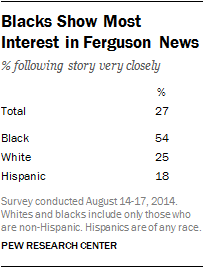
Apathy. If we define apathy as anything less than intense interest in the unfolding story in Ferguson then yes, unsurprisingly, it is clear that more white voters are apathetic toward the events in Ferguson, with 54% of black respondents saying they are following the story very closely, while only 25% of white respondents say the same thing:

8-18-2014_07

(Here is the full Pew survey and write-up.) It’s beyond my scope here but, to understand the intricate question of how race, civil rights, and Ferguson interact, it is important to note that only 18% of Hispanic respondents said they are following the story very closely.

Sadly, these numbers aren’t surprising to me.  Apathy is a “choice” only in the technical sense.  From a common sense standpoint, apathy is the absence of a choice to care/pay attention and “not choosing to pay attention” is a heck of a lot easier when the events seem less proximate to yourself.

I’m not saying that it’s rational to be apathetic, particularly about something as important and extreme as the events in Ferguson, but the results today are consistent with several decades of research into political attitudes in America, including the fact that the perception of “linked fate” is far more prevalent among black Americans than either whites or Latinos.[1]  Linked fate is a key concept in the study of race and politics.  A recent review of this literature describes linked fate as follows:

Linked fate is generally operationalized by an index formed by the combination of two questions. First, respondents are asked: “Do you think what happens generally to Black people in this country will have something to do with what happens in your life?” If there is an affirmative response, the respondent is then asked to evaluate the degree of connectedness: “Will it affect you a lot, some, or not very much?” [2]

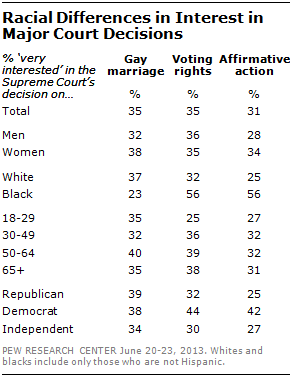
Moving beyond (and/or in addition to) linked fate, one can also argue that the incentives (or perhaps proximities) of black and white Americans differ with respect to law enforcement.  Setting aside a more detailed discussion of this, just note the similarity between the racial breakdown of people closely following the events in Ferguson with the analogous breakdown of interest across gay rights, voting rights, and affirmative action in 2013:

6.24.13.-2

Excuses. It’s well established that white Americans generally perceive racism to be less prevalent and less important than black Americans.   Discussing racial attitudes in the post-Civil Rights era, Brown, et al. write

In the new conventional wisdom about race, white racism is regarded as a remnant from the past because most whites no longer express bigoted attitudes or racial hatred.[3]

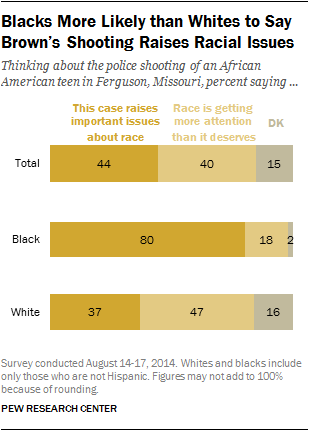
Simply put, the Pew survey does nothing to contradict this conclusion.  Specifically, 47% of white respondents said that “race is getting more attention than it deserves” in the coverage of the shooting of Michael Brown, while only 18% of black respondents, and only 25% of Hispanic respondents, agreed with that statement (see here for the full breakdown):

8-18-14_012

In the end, it’s important to note that the racial divide in attention being paid to Ferguson is in line with the racial differences in individuals’ beliefs that race is an important part of the narrative.  While it is impossible to gauge causality here—namely, are fewer white people paying attention to Ferguson because they think it’s not about race or are more white people saying Michael Brown’s shooting wasn’t about race because they’re not paying attention to Ferguson—both are consistent with avoidance: simply put, issues like homelessness, inequality, and discrimination are difficult to get many people to pay sustained attention to.  I’ve argued elsewhere that politics is about problem-solving, and people like to debate problems they think can be solved.  Race is arguably the most complicated problem to solve. While by no means admirable, avoidance of the issue by those who can (i.e., white people) is not surprising.[4]

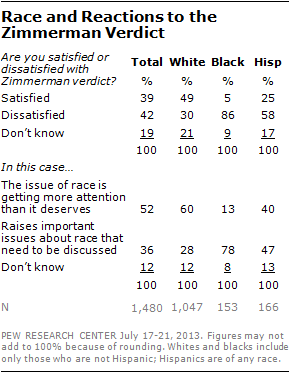
Disconnect. I’m not exactly sure how “disconnect” is different from both apathy and excuses, but I’ll take a stab and interpret this as “why do white people not seem to connect the events in Ferguson with race?”  My response here, sadly, is that they kind of do—at least insofar as the attitudes here are consistent with other similar racially charged events.  For example, following the acquittal of George Zimmerman in July 2013, Pew conducted a poll gauging reactions and attention to the case.  The racial breakdowns of responses to each are very similar to those just found in the case of Ferguson, with 60% of whites thinking the issue of race was getting more attention than it deserves, and only 13% of blacks feeling that way:

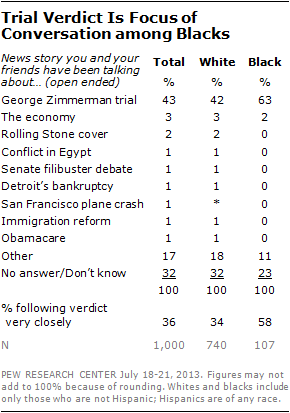
7-22-2013-1 Similarly, 63% of black respondents mentioned talking about the trial with friends, versus only 42% of white respondents:7-22-2013-2

Conclusion.  My own view on this is that Ferguson is most decidedly a racial issue.  This isn’t the same as saying that anyone involved is (or isn’t) racist.  Indeed, that issue, to me, misses the larger and more important point. In fact, while the racial realities of Michael Brown’s death—an unarmed black American killed by a white police officer—undoubtedly thrust race forward into the discussion, race should have been part of the discussion anyway.

That’s because any of the multiple dimensions of the context of Ferguson—the historical discrimination, the economic inequality, the political disparities, the unrepresentative political institutions, and the more general “special” features of local elections, to name just a few—make the issue of not only Michael Brown’s death, but also the largely and sadly ham-handed response a racial issue.

So, why don’t more white people see this?  A succinct (though definitely not exculpatory) answer is inertia: attitudes, like objects, tend to stay the same until acted upon an outside force. The reality of America is that white Americans are less likely to see their fates as being linked with those of black Americans and (perhaps because) they are less likely to face the everyday inequalities faced by far too many black Americans. In other words, and quite literally, most white Americans don’t often encounter an outside force with respect to race—definitely not like many black Americans do.  Whether they achieve this through apathy, excuses, and/or disconnect is a trickier question, but the correlation—the reality that race still divides Americans’ perceptions of politics and power—is sadly indisputable and robust, even in the 21st century.

____________

[1] See Dawson, Michael C. Behind the mule: Race and class in African-American politics. Princeton University Press, 1994.
[2] From Paula D. McClain, Jessica D. Johnson Carew, Eugene Walton, Jr., and Candis S. Watts. 2009. “Group Membership, Group Identity, and Group Consciousness: Measures of Racial Identity in American Politics?” Annual Review of Political Science (2009), p. 477.
[3] From Michael K. Brown, Martin Carnoy, Troy Duster, and David B. Oppenheimer. Whitewashing race: The myth of a color-blind society. University of California Press, 2003, p.36.
[4] Another, stronger, view of this is called “white privilege,” which describes the fact that issues that can be avoided are also deemed less important to others, without noticing that the ability to avoid these issues is not independent of race. (Thanks to Jessica Trounstine for adroitly directing me to this connection, as well as posting this telling graphic.)


Makes Us Stronger: The Math of Protest and Repression

Like many people, especially here in St. Louis, the ongoing events in Ferguson have consumed my attention and, frankly, really shaken me.  After much thought, I have possibly come up with a manageable take on one angle of “the math of” the situation.

It is important to distinguish protest from rebellion. Protest is distinguished from rebellion on the basis of intent.  Rebels intend to replace the government.  Protesters intend to change policy.

Protest, not rebellion, is what is happening in Ferguson.

In the end, this distinction is important because, in a nutshell, rebels don’t care what the government “thinks.”  In fact, rebellions are sometimes most successful when the government doesn’t notice them (until too late). Protesters, on the other hand, are directly attempting to change what the government (and/or other voters) “thinks.”[1]  In another nutshell, protest is about changing the government’s beliefs about who is upset about the policy in question, and how upset they are.

Protest is a form of costly signaling. Costly signaling describes any action that, because it is “expensive” or “unpleasant,” can convey something about oneself to others.[2]  Costly signaling is generally more informative than “cheap talk” signaling, in which one basically just says “hey, I am mad” but pays no cost to do so.

I’m not the first to make this point, of course.  But I wanted to bring it up again because thinking about the incentives to signal through protest can help us understand (some of) the events in Ferguson.  Below, I try to succinctly make a couple of points along these lines.

Protests are instrumentally rational only if they might work. As perhaps the canonical example of collective action, the problem for organizers is convincing citizens that participation will have some effect.[3]  The probability that a protest will have an effect is, generally speaking, an increasing function of the number of protesters.  This highlights one incentive for anyone trying to prevent the desired change: namely, clear the streets. By keeping protesters off the street, the government eliminates the possibility of the protesters sending (one type of) costly signal to those citizens “on the sidelines.”  This is really effective if the government can simply keep the streets clear from the beginning.[4] However, once protesters are “on the streets,” clearing the streets can have unintended consequences that become clear in a costly signaling framework.  Specifically:

Putting down a protest increases protest’s signaling value. Think about it this way: suppose that the government started giving money to those who showed up at the protest.  The “protest” would probably grow in size, right?  It would also become less informative about “who is upset about the policy in question, and how upset they are.”  This is because some of the people there are presumably there only for the money.  Indeed, some people who are really upset about the policy but were (for example) missing work for the protest might leave when the government starts giving away money, because their individual presence at the “protest” would have a smaller ultimate effect on the policy.

The converse of this logic can hold, too: by tear-gassing and shooting rubber bullets at citizens, the government amplifies the content/credibility of the message the protesters are trying to send.[5]

Conclusion: Two Reasons to Not Clear The Streets.  There’s more that can be said within the costly signaling conception of protest, of course, but I’ll keep this short and simply point out that clearing the streets is not only fundamentally undemocratic and counter to fundamental American values—it can easily lead to ironic results.  Understanding the proper response to protest (even if based on cynical motives) requires thinking about why the protesters are there.  They aren’t just upset—they’re trying to show others how upset they are.[6]

Good governments don’t threaten their citizens because it’s wrong to do so.
Smart governments don’t threaten their citizens because it’s stupid to do so.

Given the events of the past 10 days, I’ll take either type.

With that, I leave you with this.

_______________

[1] This is a blog post, so I will simply note the sloppiness of ascribing “thought” to a deceptively simple collective such as “the government.” Apologies to Ken Arrow, as appropriate.

[2] I make a lot of costly signaling arguments on this blog (e.g., here, here, here). This is itself a costly signal of how useful I believe the concept to be. KAPOW!

[3] And, to complicate things, this cuts both ways: the successful organizer must convince his or her followers that the outcome can be achieved, but only with the followers’ help.

[4] Arguably not too different from the policy that is being attempted today in Ferguson (8/18)

[5] This is particularly true now that there are so many excellent livestreams of protests.

[6] I thought about discussing the incentives of the government to portray its actions as being “not about the protest” (i.e., protecting property, responding to gunshots/fireworks?) but I’ll leave that for another post.

If Keyser Söze Ruled America, Would We Know?

In this post on Mischiefs of Faction, Seth Masket discusses the recent debate about whether (super-)rich are overly influential in American politics.  I’ve already said a bit about the recent Gilens and Page piece that provides evidence that rich interests might have more pull than those of the average American.  In a nutshell, I don’t believe that the (nonetheless impressive) evidence presented by Gilens and Page demonstrates that the rich are actually driving, as opposed to responding to, politics.[1]

Seth’s post echoes my skepticism in some respects.  First, the rich and “super rich” donors are less polarized than are “small” donors.  Second, and perhaps even more importantly, admittedly casual inspection of REALLY large donors suggests that they are backing losing causes.  As Seth writes,

…the very wealthy aren’t necessarily getting what they’re paying for. Note that Sheldon Adelson appears in the above graph. He’s pretty conservative, according to these figures, and he memorably spent about $20 million in 2012 to buy Newt Gingrich the Republican presidential nomination, which kind of didn’t happen […] he definitely didn’t get what he paid for. (Okay, yeah, he sent a signal that he’s a rich guy who will spend money on politics, but people knew that already.)

While most donations aren’t quite at this level, they nonetheless follow a similar path, with a lot of them not really buying anything at all. To some extent, the money gives them access to politicians, which isn’t nothing.“[2]

The Adelson point raises another problem we need to confront when looking for the influence of money in American politics.  Since the 1970s, most federal campaign contribution data has been public.  Furthermore, even the ways in which one can spend money that are less transparent (e.g., independent expenditures) can be credibly revealed to the public if the donor(s) want to do so.

Thus, a rich donor with strong, public opinions could achieve influence on candidates—even or especially those he or she does not contribute to—by donating a bunch of money to long-shot, extreme/fringe candidates.  This is a costly signal of how much the donor cares about the issue(s) he or she is raising, and might lead to other candidates “etch-a-sketching” their positions closer to the goals of the donor.  Indeed, these candidates need not expect to ever receive a dime from the donor in question: they might just want to “turn off the spigot” and move on with the other dimensions of the campaign.

Furthermore, such candidates might actually prefer to not receive donations/explicit support from these donors.  After all, a candidate might not want to be either associated with the donor from a personal or policy stance (do you think anyone is courting Donald Sterling for endorsements right now?) or, even more ironically, the candidate might worry about being seen as “in the donor’s pocket.” Finally, there are a lot of rich donors, and they don’t espouse identical views on every topic.  As Seth notes,

“politicians are wary of boldly adopting a wealthy donor’s views, and … they hear from a lot of wealthy donors across the political spectrum, who probably have conflicting ideas”

Overall, tracing political influence through known-to-be-observable actions such as donations, press releases, and endorsements is perilous.  A truly influential individual sometimes wants to minimize the public’s awareness of his or her influence, particularly when that influence is being exercised through others.  It is useful to always remember Kevin Spacey’s line from The Usual Suspects:

The greatest trick the Devil ever pulled was convincing the world he didn’t exist.”[3][4]

From an empirical standpoint, I think the current debate about influence in American politics is interesting: for example, it is motivating people to think about both what data can be collected and innovative ways to manipulate and visualize it.  But I caution against the temptation to jump from it to wholesale normative judgments about the state of American politics.  Specifically, there’s another Kevin Spacey line in The Usual Suspects that is useful to remember as politicos and pundits debate who truly “controls” American politics:

To a cop, the explanation is never that complicated. It’s always simple. There’s no mystery to the street, no arch criminal behind it all. If you got a dead body and you think his brother did it, you’re gonna find out you’re right.


_____________

[1] This is what is known as an “endogeneity problem.”  While some people roll their eyes at such claims, I provided a theory (and could provide more than couple of additional ones) that support the claim that such a problem might exist.  Hence, I humbly assert that the burden of proving that this is not a problem rests on those who claim that the evidence is indeed “causal” in nature.

[2] As a side note, I’ve also argued that donors should be expected to have more access to politicians than non-donors, and that this need not represent a failing of our (or any) democratic system.

[3] Verifying my memory of this quote, I found out that it is a restatement of a line by Baudelaire: “La plus belle des ruses du diable est de vous persuader qu’il n’existe pas.I have no idea what this has to do with anything, but I feel marginally more erudite after copy-and-pasting French into my post.

[4] I will simply note in passing the link between this and the entirety of the first two seasons of the US version of House of Cards.


It’s Better To Fight When You Can Win, Or At Least Look Like You Did

In this post, Larry Bartels provocatively claims that Rich People Rule! In a nutshell, Bartels argues (correctly) that more and more political scientists are producing multiple and smart independent analyses of the determinants of public policy, one of which, by Kalla and Broockman, I have already opined on (“Donation Discrimination Denotes Deliverance of Democracy“).

Bartel’s motivation for bringing this up is essentially this quote from this forthcoming article by Martin Gilens & Benjamin Page:

economic elites and organized groups representing business interests have substantial independent impacts on U.S. government policy, while mass-based interest groups and average citizens have little or no independent influence.

The Gilens and Page is an interesting read, if only because the data on which it is based is very impressive.

Unfortunately, the theory behind the work is not nearly as strong.  In particular, the study is based on comparing observed position-taking by interest groups with (solicited) individual feedback on various surveys.[1]  So what?  Well, there is at least one potential problem, containing two sub-points, the combination of which I’ll call the Pick Your Battles Hypothesis.

Pick your battles.  Interest groups do not randomly announce positions on public issues.  Rather, any interest group of political interest presumably attempts to influence public policy through strategic choices of not only what to say, but when to bother saying anything at all.  While the mass public opinion data was presumably gathered by pollsters in ways to at least somewhat minimize individuals’ costs of providing their opinions, the interest groups had to pay the direct and indirect costs of getting their message(s) out. There’s two sub-points here, one more theoretical interesting than the other and the other presumably more empirically relevant.

Sub-point 1: Pick a winner. The theoretically interesting sub-point is that an organized “interest group” is/are the agents of donors and supporters.  To the degree that donations and support are conditioned on the perceived effectiveness of the interest group, (the leaders/decision-makers of) an interest group will—ala standard principal-agent theory—have a greater incentive to pay the costs of taking a public position when they perceive that they are likely to “win.”  If there is such a selection effect at work, then the measured correlation between policy and interest groups’ positions will be overestimated.

Sub-point 2: Only Fight The Fights That Can Be Won. The more empirically relevant sub-point is that, even if one thinks that interest groups don’t fear being on the losing side of a public debate, the simple and cold reality of instrumental rationality is that, if making an announcement is costly, any interest group should make an announcement only when the announcement can actually affect something.  Moving quickly here, this suggests that interest groups should be taking positions when they believe decision-makers might be persuaded.  To the degree that these decision-makers are presumably at least somewhat responsive to public opinion (however measured), instrumentally rational (and probably asymmetrically informed) interest groups will be more likely to make announcements that run against relative strong public opinion than to join the chorus.[2]  If this is happening, the question of whether interest groups have too much influence depends on whether you think they have better or worse information and on the types of policies that their views are influential on.

Conclusion. As political scientists know, observational data is tricky.  This is particularly true when it is the result of costly individual effort in pursuit of policy (and other) goals.  I really like Gilens and Page’s paper—the realistic point of scholarly inquiry is not to be right, it’s to get ever closer to being right, and this is even more true with directly policy-relevant work.  I just think that great data should be combined with at least a modicum of (micro-founded, individualistic) theoretical argument.  Without that, we might think umbrellas cause rain, hiring a lawyer causes you to go to jail, or chemotherapy causes death from cancer.  In other words, the analyst has simultaneously more data and less information than those he or she studies.

_______________

[1] Gilens and Page also compare responsiveness to mass opinions of economic elites (i.e., those in the 90th percentile in income) versus those of the median earner.  While I have some issues with this comparison (for example, I imagine getting a representative sample of the 90th income percentile is a bit different than getting one of the median income earner and, as Gilens and Page acknowledge, the information held by and incentives of the rich are plausibly very different from those of median earners), I will focus on the interest group component of the analysis in this post.

[2]  That this is not just hypothetical crazy talk is indicated by the relatively strong negative correlation (-.10***) between the positions of business interest groups and the average citizen’s preferences.


Donation Discrimination Denotes Deliverance of Democracy

A recent paper by Joshua Kalla & David Broockman has attracted some attention (for example, in this Washington Post storyMonkey Cage post, and this excellent, reflective post on Mischiefs of Faction by Jennifer Victor).  In a nutshell, the paper reports the results of a well-designed field experiment that provides evidence that donations to a Member of Congress “open doors” in the sense that being a donor promotes access to more high ranking officials in the Member’s staff, including possibly the Member of Congress himself or herself.

I am not going to critique the study. Jennifer does that well in several ways.  Unrelatedly, I am also not going to doubt (or cast doubt upon) the results.  Rather, doing what I do, I am going to make a quick point about the question at hand.

We have a situation in which a (quasi-)monopolist (the Member) has a “good” to sell (access/face time).  Simply put, let’s suppose this good is valuable to some people and, similarly, that donations are valuable to the Member.  Then, it follows from a classic corner of social science known as price discrimination that the Member (in self-interested terms) should privilege those who are willing to pay for it.  That is, those who want access most will be willing to pay more than those want access less, and an efficient means to allocate the scarce/costly resource of access is to give to those who are most willing to pay.  Is this normatively disturbing?  Hell, yes.  Is it troubling even in everyman’s language?  Oh, for sure.  Is it inevitable?  Well, yes, that too.

Here’s another, more methods-meets-theory take on it.  Suppose that a Member imposed a policy where donations did not offer an advantage in obtaining access.   Now, think about your position as a constituent/citizen seeking access.

What would you do?

Let’s suppose that you like money. We’ve already supposed you seek access.  Now, finally, put those two together in the face of the hypothetical Member who does not reward donations with preferential access. … You should be very happy as you realize that you can have your cake and eat it, too, as you keep your money and waltz into the Member’s office, swilling sherry and talking Grand Strategy into the wee hours.

The summary of this hypothetical is this: if you believe that is plausible (1) that members don’t reward donations with preferential access and (2) that potential donors like money, then the predicted level of donations to any members is zero.[1]

We know that people give money to campaigns.  We also know or at least strongly believe that people expect something for their money.  Putting these together, I will simply say that the conjunction of these makes me feel better, not worse, about our democratic system.

Paraphrasing at least an apocryphal version of Churchill, democracy is better than every system we’ve ever tried, but it’s still only capable of delivering second-best…at best.  The Kalla & Broockman results, as clean as a whistle, further confirm my belief in this.


_________

[1] This is a blog post, and I’ve been away for a while for many reasons, including that these take me a lot of time.  Accordingly, I’ll simply note that other motivations for giving (e.g., financing reelection campaigns in a purely instrumental fashion) can be accomplished by other routes in the Federal campaign finance system (party committees, other PACs, etc., and unless you are really focused on a given Member’s reelection (but why, except for access?), these routes have transaction costs/flexibility advantages over direct giving to a single Member’s campaign).

I’ll Show You…By Not Showing Up

All is not well in Thaliand, where the opposition Democrat Party is calling for its supporters (some of whom have been actively protesting for months now) to boycott today’s parliamentary elections.

Boycotting elections is not uncommon: indeed, opposition parties have recently boycotted elections in Bangladesh and the main Islamist opposition party is calling for a boycott of upcoming elections in Algeria. The point of this post is, from a strategic standpoint, why would a party call for its supporters to not only not vote for it, but to not vote at all? [1]

I will discuss two theories that can justify election boycotts.  The first concerns the opposition party’s strength, and the second concerns the ramifications of an election result being overturned.  In general, the two are distinguished by whether the boycotting party expects to “win” the election or not.

In both cases, to make the stories succinct, suppose that some proposed “reform” is the main political issue and, without any loss of generality, let’s suppose that the ruling party is proposing the reform and the boycotting party opposes it. (This labeling doesn’t matter, but keeps the language simple.)  I’ll start with “opposition party strength” explanation.

I’m So Popular…Nobody Showed Up.  For the first explanation, suppose that the opposition party expects that it will lose the election—it suspects its supporters are outnumbered by the other party, and suppose that the ruling party will press ahead with the reform if it believes that (say) 60% of the citizens support the reform.

If the opposition party does not boycott, and the ruling party wins with (say) 62% of the vote, then the ruling party will proceed with the reform.  The opposition party loses both electorally and in policy terms.

If the opposition party does boycott, then, while the ruling party will still win, the election result is less informative about the true latent support for the reform.  In particular, as opposed to the baseline case—where abstention by a voter is more than likely due to indifference about (say) the reform—each “non-vote” might represent opposition to the reform.  Thus, boycotting the election can lead to the ruling party being less certain about the underlying support for the reform and either modifying, or demurring from, the reform. [2]

Notice that this justification is based on signaling, and the logic is clearest when there is essentially no hope for the opposition party to win the election.  If the opposition party might win (i.e., it has nearly the same number of supporters as the ruling party), then it must trade-off the potential increased probability of stymieing the reform (in the case of a loss) against the reduced probability of both winning office and stymieing reform.  The second justification is more applicable when the opposition party suspects that the election won’t matter in any event.

It Didn’t Have to Play Out This Way. Sadly, election results are not sacrosanct.  Suppose that the opposition party suspects that, if it wins the election, the ruling party might disregard the election result and impose the reform anyway.  Such an undemocratic move might lead to various ancillary “bad” things unrest and/or a coup.  To keep it simple just suppose that the opposition party prefers the reform to be implemented after being “ratified” (even in a boycotted election) rather than implemented against a contrary election result.  In this case, because voting is costly, voting for the ruling party is otherwise distasteful, or for the purpose of recording an implicit score of (non-)support for the reform, the opposition might benefit from boycotting precisely when it suspects it might “win” the election. [3]

Elections Aren’t Just About Winning. Each of the arguments sketched out above rely on a key characteristic of elections: they aren’t the end of the game.  Rather, an election results is always to some degree a signal about the electorate’s preferences about the issues being confronted at that time.  Of course, the arguments also highlight how the proper interpretation of the “signal sent” by an election result need not be straightforward: as is usual, the fact that something might serve as a signal can infect the incentives of those sending it (in this case the opposition party) in counterinitutive ways (for example, see this point here).

More generally, the arguments provide two alternate routes to understand the legitimating power of participation.  That is, many people understandably say that free, open, and active elections are a foundation of a healthy and legitimate government.  This argument is often (to me, at least) based on the idea that people don’t want to participate in something that they don’t feel connected to and/or “served well by.”  This isn’t a silly argument—it does have a self-enforcing quality that is reminiscent of equilibrium.  But even if one is happy to accept that logic as “just so,” the next step is to examine incentives that logic provides to political actors in pursuit of policy and office.

With that, I leave you with this.

_______________

[1] Especially in multiparty systems (especially with nontrivial electoral “thresholds” for representation and/or public financing), there are clear reasons for a party to call for it supporters to vote for a different party.  This phenomenon, known colloquially as strategic voting, is about coordination, and I will note it and set it to the side: strategic voting does not justify abstention unless there is some type of quorum/participation requirement.

[2] I’ll keep moving, but a moment’s thought suggests that, in some circumstances, this argument also suggests an incentive for the boycotting party to call for a boycott but send some of its supporters to the polls anyway.  The details are a bit complicated, and such an incentive (or, “comparative static of the ruling party’s beliefs as a function of the actual turnout”) might not work out in equilibrium, because the ruling party’s inferences get complicated and depend upon what it knows/believes about the opposition party’s gambit in this regard.  Nonetheless, it is a neat possibility.  TO ME.

[3] One could embellish this argument quite easily (to account for smaller parties also subscribing to its logic) by having the opposition party increasingly dislike the reform being implemented over larger proportions of votes “against” the reform.

Going Down in Flames…To Rise Like A Phoenix (in the Primary)

So, the Federal Government is once again approaching the debt ceiling.  Senate Minority Leader Mitch McConnell has said that he thinks that

“…for the president to ask for a clean debt ceiling, when we have a debt the size of our economy is irresponsible. So, we ought to discuss adding something to his request to raise the debt ceiling that does something about the debt or produces at least something positive for our country…”

What McConnell and his colleagues will discuss adding is a bit unclear at this point (though approval of the Keystone pipeline might be part of it), but Democrats are repeating President Obama’s earlier stance that there will be no negotiations based on the debt limit.

This seems like a stand-off in the making…or does it?

Setting aside the popular conception (with which I concur) that Congressional Republicans “lost” the previous fight on the debt ceiling, McConnell followed the above quote with the following statement:

“We’re never gonna default. The Speaker and I made that clear,”

Um, maybe this isn’t a stand-off in the making.  Maybe a “stand up, just to sit down?”  That’s not catchy, but it brings us to my point in this post.

I could argue that McConnell is pursuing a strategy of either looking “crazy” or trying to imply that he is “hemmed in” by his colleagues, as I have argued before regarding Boehner and his factious caucus.   But, I don’t think this is that.  Rather, McConnell’s unusual comments might be best understood as an attempt to send a costly signal to his constituents, as he is facing and already fighting a right-wing primary challenge by Matt Bevin.  I’ll quickly detail this argument.

Let’s suppose that McConnell is facing a primary challenge because some believe his conservative bona fides are lacking.  McConnell can scream as loud as he wants that he is as conservative, but Glenn Beck doesn’t think he’s good enough.

How can McConnell convince voters that he is a true conservative? Well, he can’t just say it—the voters he wants to convince with such a statement will understand that this is cheap talk.  He has to make the statement that he is “one of them” costly—it has to “pin him down” in some way.  This is tough to do with policy, given that he is the minority leader and his party does not control the White House.

So, my argument goes, he can publicly stonewall what is (hopefully) in the end a fait accompli—the debt ceiling increase—and take his lumps along the way.  This type of position will work only if it hurts McConnell in some verifiable way.  My too-clever-by-half argument is that he is setting exactly such a situation up for the voters who care to see that, at the least, he is willing to bleed for them.

His two statements above make it clear that (1) he is simply being difficult, and (2) he is willing to acknowledge that he will lose unless Obama is willing for some reason to compromise.  (Not saying Obama won’t—he might—but McConnell probably doesn’t know that Obama will.)

Arguably, by saying that he is going to try to drive a hard bargain on the debt ceiling while at the same time admitting he’ll ultimately support a clean debt ceiling increase,  McConnell has adopted a position of “I’m so conservative, I’m willing to fight A KNOWINGLY UNWINNABLE FIGHT FOR CONSERVATIVE `PRINCIPLES.'”[1]

To revisit the argument again before concluding, my point here is that McConnell was probably not speaking off-the-cuff: he is no idiot, and I believe he realizes that his position is internally inconsistent.  Most voters won’t care, but those who pay attention might, and the distinction between his statements and simply saying “awww, heck no—we aren’t going to give a clean debt ceiling increase” is that he purposely made clear that not only was he against default—he and Speaker Boehner have “made it clear” that “we’re never gonna default.”  That is, he explicitly pointed out that the GOP is very unlikely to get anything from this—and yet he’s willing to lose trying.

Because that’s just how flamboyantly conservative he is.

With that, I leave you with this.

___________________

[1] I apologize if my distaste for this narrative offends you, dear reader, but I will not accept that even flirting with violating the full faith and credit of the Federal Government is consistent with any reasonable rendition of conservative principles.  Trust, reliability, sanctity of contract—hell, even the facile analogy between running the government and the responsible financial management of a family or small business—-all run squarely against using the debt ceiling as a bargaining chip. Full stop.  That said, as a political scientist, I do not think McConnell is playing dirty—procedural stopgaps are rightly the fitting and necessary last bastion of the minority party.  (See what I did there?  I can link filibusters and debt ceilings, because that’s the way I’m wired: namely, short-circuited.)

Believe Me When I Say That I Want To Believe That I Can’t Believe In You.

A recurring apparent conundrum is the mismatch between Congressional approval (about 14% approval and 78% disapproval) and reelection rates (about 91% in 2012).  If Americans disapprove of their legislators at such a high rate, why do they reelect them at an even higher rate?  PEOPLE BE CRAZY…AMIRITE?

Maybe.  A traditional explanation is that people don’t like Congress but like THEIR representatives.  Again, maybe.  Indeed, probably.  But, in the contrarian spirit of mathofpolitics, I wish to forward another explanation.  This explanation is undoubtedly wrong, but raises an interesting welfare point that could still hold even if the microfoundations of the explanation are amiss.

The heart of the explanation is that a cynical belief along the lines of “all politicians are crooks” can help voters get better/more faithful representation from their representatives.  Thus, ironically, a deep suspicion among voters about the accountability of legislators can aid one in keeping those legislators behaving in accord with the voters’ wishes.  (PEOPLE BE CRAZY LIKE A FOX…AMIRITE?)

Now, let’s get to the argument/the model.

Theoretically, elections might help achieve accountability (i.e., make incumbents do what voters want) through their potential ability to solve two important problems: moral hazard and adverse selection. The essence of moral hazard is “hidden action”: I want my representatives to work smart AND hard, but I can’t actually observe them working.  Instead, I observe noisy real-world indicators of how hard they’re working: unemployment, budget deficits, health care costs, Olympic medals, and Eurovision.  To the degree that these are correlated with legislative effort and I condition my vote choice on these observables, I can provide an incentive for a reelection-motivated incumbent to work smart and hard.

The essence of adverse selection is hidden information: I want my legislator to take actions on my behalf when they present themselves.  The best way to “get this” is to have a legislator who shares my preferences.  (Think Fenno’s Home Style.) But, practically speaking, every aspiring representative will tell me that he or she shares my preferences.  So, regardless of how I discern whether my incumbent shares my preferences, the reality is that I will have a strict incentive to reelect an incumbent who expect shares my preferences…because, after all, I generally have little information about his or her challenger’s preferences.

So, in a nutshell, you’d like to solve both of these problems simultaneously: you want your incumbent to share your preferences and work both smart and hard.  In the immortal words of Bachman Turner Overdrive, you want them to be taking care of business and working overtime. Every day. Every way.

Unfortunately, solving both of these problems is frequently impossible.  The details of why can be summed up with the old saying that “a bird in the hand is better than two in the bush.” You see, once you believe that your legislator truly has your interests at heart, you will (and, in a certain way, should) be more likely to forgive/reelect him or her if he or she is a little lazy.

This fact ends up making it harder for a voter to discipline his or her representatives: in particular, think of the following simple world.  Assume there are faithful and faithless politicians (this is fixed for any given politician) and that every politician can either work hard or be lazy. And, for simplicity, suppose that the faithful type always works hard. (This is not important, it just simplifies the exposition.)

Furthermore, let p \in (0,1) denote the probability that a random incumbent is faithful.

Here’s the rub: you don’t observe the politician’s type (faithful or faithless) or how hard he or she worked.  Rather, you observe one of three outcomes: Great, OK, or Bad.  Finally, suppose that the probabilities of observing these outcomes are

P[Great | work hard & faithful] = 0.35
P[OK | work hard & faithful] = 0.55
P[Bad | work hard & faithful] = 0.1

P[Great | work hard & faithless] = 0.3
P[OK | work hard & faithless] = 0.5
P[Bad | work hard & faithless] = 0.2

P[Great | be lazy & faithless] = 0.1
P[OK | be lazy & faithless] = 0.5
P[Bad | be lazy & faithless] = 0.4

(If you take a moment, you’ll realize that outcomes are more likely to be better for faithful types regardless of how they work and for those who work hard, regardless of their type (i.e., ceteris paribus). …JUST AS IN LIFE.)

To illustrate the problem at hand here:

Suppose that the voter observes an “OK” outcome.  what is the voter’s posterior probability that the politician is a faithful type?

\Pr[\text{faithful}|\text{outcome=OK}] = \frac{0.55p}{0.55p + (1-p)(0.5 x + 0.5 (1-x))}=\frac{0.55p}{0.5+0.05p}>p,

where x denotes the probability that a faithless politician works hard.  (Note that my judicious choice of probabilities obviates the need to worry about what this is.  YOU’RE WELCOME.)

The key point is that the probability that the politician is the faithful type, conditional on seeing only an “OK” outcome, is greater than p, the probability that a random challenger will be a faithful type.

This means that, upon seeing an “OK” outcome, you should reelect your incumbent.  He or she is a (probabilistic) bird in the hand.

So what?  Well, this all goes away if you believe that there are no faithful politicians.  That is, if you’re a hard-core cynic (as many of my FB friends purport to be), and you believe p=0, then upon observing an “OK” outcome you can credibly (and, concomitantly, “should”) throw the bum out.  If p=0, then (assuming that working hard is not too costly to the incumbent) the optimal reelection rule in this setting is to reelect if and only if the outcome is “Great.”  Furthermore, imposing such a rule in such cases will yield a higher expected outcome for you (the voter) than you can obtain in equilibrium when p>0.

In summary, it’s a lot easier to “throw the bums out” if you actually think they’re all bums. This, ironically, will both make you better off and lead to you throwing fewer out, because the “bums” will know what you think of them.

Tying this back to real-world politics, the mathofpolitics/logic of adverse selection and moral hazard suggest a somewhat subtle value of cynicism in politics.  (Which, perhaps seemingly oddly for a game theorist, is something I detest.)  What is also kind of neat about this logic is that it provides an interesting argument in favor of primaries: the whole logic of why adverse selection undermines the solution to the moral hazard problem is that the voter can not select a replacement who is “just/almost as likely as the incumbent” to have the same innate interests as the voter.  To the degree that we believe that this type of alignment between incumbents and voters is correlated with the incumbent’s partisanship, primaries offer the voters a (more) credible tool to discipline their incumbent’s moral hazard problem.

And with that, I am left thinking of Arlen Specter and accordingly want to leave you with this.

Have Gun, Will Vote

Yesterday, the Senate—in line with expectations—rejected the most basic of gun control proposals.  In light of the Newtown massacre—an event that shook all of us—this might seem shocking.  For example, even leaving aside the emotional pull that perhaps we can as a nation call that horrible day back and make it right, the proposal arguably had/has 90% support among the public.

Does this demonstrate a problem with the Senate or, perhaps, democracy itself? Simply put, no.

Let me be clear: I have many family and friends who own and use guns for hunting and sport, and I do not believe that the debate about “taking away guns” is worth the breath or typing it takes to describe such a practically ludicrous concept. However, in the interest of full disclosure, I do not own a gun, and do not think that a gun is appropriate to keep in my house. Okay…that said…now I’m going to blow your mind. WITH SOCIAL SCIENCE.

First, the Senate ain’t done.  I’ll just note that and then spare you (for now) yet another installment of my “votes matter for signaling to constituents” argument (which would imply we might see the background checks come in through another, presumably bundled, amendment).

Second, and the “math of politics” part of this post, this vote demonstrates the not-so-gentle implications of the subtle interaction of psychology, indirect democracy, and multi-issue politics.

Before I continue, let me apologize for my shortcuts, I am about to unfairly but succinctly imply that gun rights advocates are all gun owners.  This supposition is demonstrably false in the general context, of course, because plenty of people cheer for teams representing colleges that they not only didn’t attend, but couldn’t have if they wanted to.  (You know who I’m talking about, right?)  That said, here we go…

A realist/game theoretic interpretation of democracy implies that it “works” (if it does) only because voters hold incumbents accountable for their decisions.  Taking this logic on its own and pairing it with the overwhelming empirical support for background checks, the intuitive conclusion is that democracy must be failing: clearly a few Senators at least must be ignoring the demands of their constituents.  Right? (Don’t worry, I’m not about to make an argument based on the (mal)apportionment of the Senate or sampling error.)

Umm, yes, perhaps…until you realize that Senate elections choose Senators, not positions. Once you realize this, you “think down the game tree” a bit as an incumbent and you think…

“Well, I vote on lots of different issues.  Each voter comes into the voting booth and does something like a weighted sum over the various positions I am seen as favorable/reliable on and then compares me with the challenger.”

In a nutshell, this means that every incumbent—when faced with a vote on any issue—considers the weight (or, in the terminology of political science, salience) of that issue with his or her electorate. (I’m abstracting from individual-voter-level differences for simplicity.)

Thus, the impact of an incumbent’s gun control vote on any given voter i‘s “approval/support” for the incumbent is basically something like

w_{i}^{\text{gun}} L_{i}^{\text{gun}},

where w_{i}^{\text{gun}}>0 is the importance of gun control (larger values imply gun control is more important to i) and L_{i}^{\text{gun}} is “+1” if i agrees with the incumbent’s vote on gun control and “-1” otherwise.

Note that this is just one issue among many.  The total approval/support of the voter for the incumbent is something like

A_{i} = w_{i}^{\text{gun}} L_{i}^{\text{gun}} + w_{i}^{\text{health care}} L_{i}^{\text{health care}} + w_{i}^{\text{deficit}} L_{i}^{\text{deficit}}.

Okay, that’s voting.  Now let’s think about psychology. In a nutshell, who cares most strongly about background checks? This is sort of a OlsonianTversky&Kahneman effect:

Those who encounter the policy most often care the most about it.

Gun owners (or people who think/fear they might want to buy a gun someday) will generally have (or be believed by incumbents to have) larger values of w_{i}^{\text{gun}}. And, to cut to the chase, many of them will not prefer to submit to (say) background checks.  (After all, most these voters are, indeed, good Americans.)

So, while 90% of the voters might prefer a vote for background checks (i.e., L_{i}^{\text{gun}}=+1 for a vote for yesterday’s amendment), few if any of them assign nearly as large a value of w_{i}^{\text{gun}} as the 10% of the voters who oppose background checks.

This matters because an incumbent—in the spirit of democratic responsiveness—is responsive to a voter on any given single issue only to the degree that the voter’s vote is responsive to the incumbent’s vote/stance on that issue. Congress deals with many issues. For better or worse, my argument here is that “gun control/gun rights” votes are generally more important/dispositive for voters who refer to the issue as “gun rights.”

Here’s a picture suggesting this, from Pew:

Revealed Differential Importance of Gun Rights/Control

In spite of that picture, note that, according to my argument, this is not about polarization in the classical sense (the two sides don’t necessarily have wildly different policy goals). While gun control is a fairly partisan issue, it is not actually a strongly partisan one. Rather, background checks represent an issue that (in line with the Olson shout-out above) present “concentrated costs” to an arguably much-less-than-majority group and “dispersed benefits” to a larger-than-majority group. If we had a referendum on the background checks amendment (and everybody had to turnout and vote), then I have no doubt that the Manchin-Toomey amendment would win in a landslide. But that’s not the way indirect democracy works. (And, for another day, thank goodness for that. AMIRITE, CALIFORNIANS WITH SCHOOL-AGE CHILDREN?)

So, I am sad that our nation tears and blows itself apart over both the issue and its instantiation. I cried (a lot) watching the coverage of Newtown and for a few days afterwards. That said, the institutional and psychological/preference realities of the issue mean that at least I sleep well at night confident in the notion that this strife does not imply anything untoward about our politicians or voters. To put it another way, as hard as it is to accept sometimes, democracy is about choices—the logic above is a convoluted (but more precise) way of saying “pro-gun rights voters will “throw the bum out” for a pro-gun-control vote…and a pro-gun-control voter probably won’t do the same to his or her incumbent for a pro-gun-rights vote.” As I disclosed above, I am more than happy to be proven wrong on this in 2014. And with that, I put my money where my mouth is and leave you with this.

________________________________________________________________________

PS.  According to this article, Sen. Toomey (R-PA) “argued that `the Second Amendment does not apply equally to every single American…'”  I can’t resist the opportunity to suggest that this is wrong headed on arguably two counts.  First, it is distinctly poor taste and shortsighted to get into an Orwellian “some people have more rights than others” interpretation of the Constitution. Second, and more controversially, the Second Amendment is actually a guarantee of a collective (read: State) right, rather than an individual one.  I mean, one is the loneliest number even for militias?  (Also, are “poor taste” and “shortsightedness” synonymous in equilibrium?)