The IRS Is Here to Help. So Is ICE.

It’s been almost ten years since I’ve written here. The last time I posted, Donald Trump had just clinched the GOP nomination, his Banzhaf power index had hit 1.0, and I was calculating the proportion of his campaign contributions that were unitemized.1 That was June 2016. I stopped writing because the general election demanded a firehose of commentary I didn’t have the time or the stomach for, and the opportunity cost of blogging versus finishing actual research was getting untenable.

A lot has happened. Some of the people who used to read this blog — colleagues, friends, people I admired — aren’t here anymore. I won’t make a list, because that isn’t what this space is for, but I’ll say that their absence is felt, and that part of what brings me back is the sense that the kind of work this blog tries to do — taking the math seriously, taking the politics seriously, and refusing to pretend you can do one without the other — matters more now than it did when I left.

For those who are new: this is a blog about the math of politics, which is a thing that exists whether or not anyone writes about it. The tagline is three implies chaos, which is a reference to the fact that collective decision-making with three or more alternatives is, under very general conditions, a mess.2 I’m a political scientist at Emory. I use formal models — game theory, mechanism design, social choice — to study how institutions shape behavior. And I write here when something in the news is so perfectly illuminated by the theory that I can’t not.

Today a federal judge ruled that the IRS violated federal law approximately 42,695 times, and I have a model for that. Let’s go.


NA NA

Last April, Treasury Secretary Bessent and DHS Secretary Noem signed a memorandum of understanding allowing ICE to submit names and addresses to the IRS for cross-verification against tax records. ICE submitted 1.28 million names. The IRS returned roughly 47,000 matches. The acting IRS commissioner resigned over the agreement. And Judge Colleen Kollar-Kotelly, reviewing the IRS’s own chief risk officer’s declaration, found that in the vast majority of those 47,000 cases, ICE hadn’t even provided a valid address for the person it was looking for — as required by the Internal Revenue Code. The address fields contained entries like “Failed to Provide,” “Unknown Address,” or simply “NA NA.”3

NA NA.

That’s what ICE typed into the field that was supposed to ensure the government could only access tax records for individuals it had already specifically identified. And the IRS said: close enough.

Now, the obvious story here — the one you’ll get from the news — is about a legal violation and an institutional failure. And that story is correct. But there’s a deeper story, one that requires thinking about what classification systems do to the populations they classify. Because the address field in the §6103 request wasn’t just a data element. It was a constraint — a design specification that determined what kind of system the IRS-ICE pipeline would be. With the address requirement enforced, the system is a targeted lookup: you ask about a specific person you’ve already identified, and the IRS confirms or denies. With the address requirement collapsed — with “NA NA” treated as a valid input — the system becomes a dragnet. Same code, same database, same agencies. But a fundamentally different machine, operating under fundamentally different logic, with fundamentally different consequences for the people inside it.

I want to talk about those consequences. Specifically, I want to talk about what happens to the population being classified when the classifier changes.


Filing Taxes as a Strategic Choice

Here’s the setup. If you’ve read the work Maggie Penn and I have been doing on classification algorithms, this will look familiar.4

Undocumented immigrants in the United States pay taxes. They do this using Individual Taxpayer Identification Numbers (ITINs), which the IRS issues specifically to people who have tax obligations but aren’t eligible for Social Security numbers. Filing is not optional — the legal obligation exists regardless of immigration status. But the compliance rate — how many people actually file — has historically been sustained by a critical institutional feature: a firewall between tax data and immigration enforcement. Section 6103 of the Internal Revenue Code strictly prohibits the IRS from sharing taxpayer information with other agencies except under narrow, court-supervised conditions.

The firewall is what made tax filing a safe act. Filing carried a compliance benefit — potential refunds, building a record for future status adjustment, staying on the right side of the IRS — and essentially zero enforcement cost. The tax system observed you, but the immigration system couldn’t see what the tax system saw.5 To put it in terms we’ll use throughout: the classifier’s expected responsiveness was zero.6 When the classifier is null, people make their filing decision based solely on the intrinsic costs and benefits of compliance. Call that sincere behavior.

The MOU blew a hole in that firewall. After the MOU, filing generates a signal — the tax record, including your address — that feeds directly into an enforcement match. Before the breach, the only classifier that mattered was the IRS’s own enforcement system, and that system rewarded filing: if you complied, you reduced your probability of audit, penalty, and all the administrative misery that follows from the IRS noticing you didn’t file. The reward was real, the classifier was responsive to compliance, and the equilibrium worked.

The MOU layered a second classifier on top — the ICE match — and this one runs in the opposite direction. Filing still reduces your IRS enforcement risk, but it now increases your immigration enforcement risk, because filing is what generates the data that feeds the match. For citizens and legal residents, the second classifier is irrelevant — they face no immigration enforcement cost, so the net calculus doesn’t change. For undocumented immigrants, the second classifier dominates. The expected cost of filing went up, and for many people it went up enough to swamp the expected benefit.

The equilibrium compliance rate in the model is

$$\pi_F(\delta, \phi, r) = F(r \cdot \rho(\delta, \phi))$$

where $r$ captures the net stakes of being classified and $\rho$ captures how much the classifier’s decision depends on the individual’s behavior.6 When the firewall was intact, the net reward to filing was positive — the IRS classifier rewarded compliance, and the immigration system couldn’t see you. When the firewall broke, the net reward dropped, in some cases below zero, and the filing rate dropped with it. Not because the legal obligation changed. Not because the refund got smaller. Because the classifier changed, and people responded.

This is a point that’s worth pausing on, because it’s general and it’s important: classification systems do not passively observe the world. They reshape it. A credit-scoring algorithm changes how people use credit. An auditing algorithm changes how people report income. A policing algorithm changes where people walk. The instrument and the thing being measured are not independent of each other, and any analysis that treats them as independent will be wrong in a specific, predictable direction: it will overestimate the accuracy of the system and underestimate its behavioral effects.

Think of two cities, each with a system for issuing speeding tickets. One city’s algorithm is designed to ticket speeders — it cares about accuracy. The other city’s algorithm is designed to generate revenue — it tickets indiscriminately. Drivers in the accuracy-motivated city slow down, because compliance is rewarded. Drivers in the revenue-motivated city don’t bother, because ticketing has nothing to do with their behavior. Same roads, same drivers, same speed limits. Different classifiers, different equilibria. The classifier doesn’t just measure the city — it makes the city.7


The Death Spiral

This is where it gets interesting. And by “interesting” I mean “bad.”

The people most likely to be correctly identified by the IRS-ICE match are those with stable addresses who file consistently and accurately. These are, almost by definition, the most compliant members of the undocumented population — the ones who’ve been following the rules, building a paper trail, doing exactly what the system told them to do. They’re also the ones with the most to lose from enforcement, because they’ve given the system the most data about themselves.

These are the first people who stop filing.

Judge Talwani flagged this directly. Community organizations that provide tax assistance to immigrants can’t advise their members to stop filing — that would be encouraging illegal behavior. But they also can’t encourage filing, because filing now triggers enforcement risk. The organizations reported decreased revenue and participation. The chilling effect isn’t hypothetical. It’s in the court record.

Now here’s the feedback loop. When the most identifiable filers exit the system, the quality of the remaining data degrades. The match rate goes down. The false positive rate — the probability that a match incorrectly targets a citizen or legal resident — goes up, both because the denominator of correctly matched records shrinks and because ICE is submitting garbage inputs (“NA NA”) that the IRS is accepting anyway. The classifier gets worse at its stated objective precisely because it’s operating.

The system doesn’t just get unfair. It gets worse at its own stated purpose — identifying specific individuals — because the individuals it could most easily identify are exactly the ones who stop showing up.

This is a general property of classification systems with endogenous behavior, and it’s one I think about a lot. When the population being classified can respond to the classifier, the classifier doesn’t observe a fixed distribution. It selects the distribution that’s willing to be observed. And that selection runs in exactly the wrong direction if your goal is accurate identification: the easy cases exit, the hard cases remain, and accuracy deteriorates as a function of the classifier’s own operation. The system eats its own inputs.8


What the Designer Wants Matters

One of the results Maggie and I are most insistent about is that the objectives of the entity doing the classifying shape the equilibrium in ways that aren’t obvious from the classifier’s structure alone. Two cities with identical data, identical populations, and identical infrastructure but different objectives will design different classifiers, induce different behavior, and produce different social outcomes. The objectives live inside the algorithm, not alongside it.

So: what is DHS trying to do?

The official framing is accuracy-aligned. DHS says the goal is to “identify who is in our country.” That sounds like accuracy maximization: correctly match individuals to their immigration status.

But the implementation tells a different story. An accuracy-maximizing designer needs good inputs — the whole point of the §6103 requirement that ICE provide a valid address is to ensure the system operates on pre-identified individuals, which is a precondition for accurate matching. ICE submitted “NA NA.” They submitted jail addresses without street locations. They submitted 1.28 million names and got 47,000 matches, meaning a 96.3% non-match rate before you even get to the question of whether the matches were accurate.

This doesn’t look like accuracy maximization. It looks like a fishing expedition — a bulk data pull designed to maximize the reach of the enforcement system rather than the precision of individual identifications. In the language of the paper, it looks more like compliance maximization (or its dark inverse: maximizing the chilling effect on a target population) or outright predatory objectives — a system that benefits from inducing non-compliance, because non-compliance makes the targets more vulnerable, not less.9

And the distinction between objectives matters formally, because the two produce different classifiers with different welfare properties. An accuracy-maximizing classifier, we show, will push some groups toward compliance and others away — exacerbating behavioral differences between groups even when the data quality is identical across groups. A compliance-maximizing classifier, by contrast, always satisfies what we call aligned incentives: it pushes all groups in the same behavioral direction.

Here, the groups aren’t abstract. They’re citizens, legal residents, and undocumented immigrants, all of whom file taxes, all of whom had their data swept into the same match, and all of whom face different enforcement costs from being identified. The classifier doesn’t distinguish between them at the input stage — it just matches names and addresses. But the behavioral response to the classifier differs radically across groups, because the stakes of being classified differ radically. Citizens face essentially zero enforcement cost from a match. Undocumented immigrants face deportation. The same classifier, applied to the same data, produces wildly different equilibrium behavior in different populations.

That’s not a bug in the implementation. That’s a structural property of classification systems with heterogeneous stakes. And it’s a property that accuracy maximization makes worse, not better.


The Commitment Problem

There’s one more piece of the model that’s eerily relevant. We distinguish between designers who can commit to a classification algorithm and designers who are subject to audit — who must classify consistently with Bayes’s rule and their stated objectives. The commitment case is more powerful: a designer who can commit can deliberately misclassify some individuals to manipulate aggregate behavior. The no-commitment case, which we interpret as the effect of auditing or judicial review, strips away this power.

Judge Kollar-Kotelly’s ruling is an audit. She looked at what the IRS actually did — accepted “NA NA” as a valid address, disclosed 42,695 records in violation of the statutory requirement — and said: this doesn’t satisfy the constraints. Judge Talwani’s injunction goes further, blocking enforcement use of the data entirely.

These rulings function exactly as the no-commitment constraint does in the model. They force the classifier to satisfy sequential rationality — to justify each classification decision on its own terms, rather than as part of a bulk strategy to influence population behavior. And the paper tells us what happens when you impose that constraint: the resulting equilibrium satisfies aligned incentives. The designer can no longer push different groups in different behavioral directions.

That’s the fairness argument for judicial review of classification systems, stated formally. It’s not that judges know better than agencies how to design algorithms. It’s that the constraint of having to justify individual decisions prevents the designer from using the algorithm to strategically manipulate aggregate behavior. The cost is accuracy — the no-commitment equilibrium is always weakly less accurate than what the designer could achieve with commitment power. But the benefit is behavioral neutrality across groups, which is a fairness property that accuracy maximization cannot guarantee.10


Where This Goes

The D.C. Circuit will rule on the Kollar-Kotelly injunction. If they uphold it, the no-commitment constraint holds and the data-sharing agreement is dead in its current form. If they reverse — and the Edwards panel’s reasoning from two days ago suggests this is possible — the commitment case reasserts itself, and the behavioral distortions I’ve described become the operating equilibrium.

Meanwhile, the chilling effect is already in motion. People have already stopped filing. Community organizations have already seen decreased participation. The equilibrium is shifting in real time, and it won’t shift back quickly even if the courts ultimately block the agreement, because trust in the firewall is not a switch you can flip. It’s a belief about institutional behavior, and beliefs update slowly after violations — especially violations that occurred 42,695 times.

The tax system was designed as a compliance mechanism: file your returns, pay what you owe, and we won’t use your data against you. That design was a choice. The firewall was a choice. The address requirement in §6103 was a choice. Every one of those choices encoded a judgment about what the system should be for — not just what it should measure, but what kind of behavior it should sustain. The MOU didn’t just breach a legal firewall. It changed the classifier, which changed the equilibrium, which is changing the population, which will change the data, which will change what the classifier can do. The whole thing is a loop, and it’s spinning in exactly the direction the model predicts.

I said I’d be back when something in the news was so perfectly illuminated by the theory that I couldn’t not write about it. This is that. There will be more.11

With that, I leave you with this.


1. 72.9%, for those keeping score.

2. The phrase is from Li and Yorke’s 1975 paper “Period Three Implies Chaos,” which proved that a continuous map with a periodic point of period 3 has periodic points of every period — plus an uncountable mess of aperiodic orbits. But the tagline does triple duty: Arrow’s theorem, the Gibbard-Satterthwaite theorem, and the McKelvey-Schofield chaos theorem all say that with three or more alternatives, the relationship between individual preferences and collective outcomes becomes fundamentally unstable. Norman Schofield, who proved the general form of the chaos result with Richard McKelvey, was a mentor and colleague to both Maggie Penn and me at Washington University. It was Norman, in a bar in Barcelona, who suggested that Maggie and I write our first book, Social Choice and Legitimacy: The Possibilities of Impossibility, which we dedicated in part to McKelvey. He died in 2018, and he is one of the people I miss when I write here. Three implies chaos. It’s not a bug. It is the central fact of democratic life.

3. The legal landscape is, to use a technical term, a mess. Kollar-Kotelly’s injunction from November is still in effect but under appeal in the D.C. Circuit. Judge Talwani in Massachusetts issued a separate injunction in early February blocking enforcement use of the data. And two days ago, a D.C. Circuit panel declined to enjoin the agreement, reasoning that “last known address” isn’t protected return information under §6103. So you have district courts saying it’s illegal and an appellate panel suggesting it might not be. Three courts, three bins for the same data. If that doesn’t sound like a social choice problem to you, you haven’t been reading this blog long enough.

4. Penn and Patty, “Classification Algorithms and Social Outcomes,” American Journal of Political Science (forthcoming). The formal model and all the results I’m drawing on here are in that paper. What follows is a blog-post-grade application of the framework, not a formal extension of it. But the shoe fits disturbingly well.

5. The firewall wasn’t just a policy preference — it was constitutional load-bearing infrastructure. The government’s power to tax illegal income was established in United States v. Sullivan (1927) and famously applied to convict Al Capone in 1931. But requiring people to report illegal income creates an obvious Fifth Amendment problem: filing becomes compelled self-incrimination. Section 6103 resolved the tension by ensuring tax data stayed behind the wall. With the firewall intact, you could — in principle — write “narco drug lord” in the occupation field of a 1040 and nothing would happen, because the IRS couldn’t share it. The MOU reopened that wound. If filing now feeds ICE, then filing is self-incrimination for undocumented immigrants, and the constitutional bargain that made the whole system work since Sullivan is back in play. Whether anyone is litigating this yet is a question I leave open, but the logical structure is Gödelian: the system simultaneously compels disclosure and punishes the act of disclosing.

6. In the model, expected responsiveness is $\rho(\delta, \phi) = (\delta_1 + \delta_0 – 1)(2\phi – 1)$, where $\delta_1$ and $\delta_0$ are the probabilities that the classifier’s decision matches the signal for compliers and non-compliers respectively, and $\phi$ is signal accuracy. A null classifier has $\rho = 0$: the probability of being targeted is the same regardless of whether you file. The §6103 firewall enforced nullity by severing the link between the signal (tax record) and the decision (enforcement action).

7. This example is from the paper, but it’s the kind of thing that should be folklore by now. It isn’t, largely because the computer science literature on algorithmic fairness has mostly treated the classified population as fixed. That’s starting to change — see Perdomo et al. (2020) on performative prediction and Hardt et al. (2016) on equality of opportunity — but the political science framing, where the designer has objectives and the population has strategic responses, is still underdeveloped. Maggie and I are trying to fix that.

8. There’s also a revenue dimension that shouldn’t be ignored. The IRS estimates that undocumented immigrants pay billions in federal taxes annually. If the filing rate drops — which it will, and which the court record suggests it already is — that’s tax revenue the government doesn’t collect. The classifier was supposed to serve immigration enforcement, but its equilibrium effect includes degrading the tax base. Whether anyone in the administration has done this calculation is an exercise I leave to the reader.

9. Predatory preferences in the model are characterized by a designer whose most-preferred outcome is to not reward an individual who didn’t comply. Think predatory lending: the lender benefits most when the borrower defaults, because the default triggers fees, repossession, or refinancing at worse terms. A designer with predatory preferences over immigration enforcement would want undocumented immigrants to stop filing taxes, because non-filers are more legally precarious, have weaker paper trails, and are easier to deport. Whether this is what DHS actually wants is a question I can’t answer from the model. But the model can tell you what the observable signatures of predatory preferences look like, and “submit NA NA as an address for 1.28 million people” is consistent with the signature.

10. Whether you think that tradeoff is worth it depends on what you think “fairness” means in this context, and reasonable people disagree. But the point is that it is a tradeoff, with formal properties that can be characterized — not a vague gesture at competing values. I have more to say about this, and about how it connects to a set of problems that go well beyond tax data. But that will have to wait for another post. Or, you know, the book.

11. Next up: the Supreme Court just handed us a game-theoretic goldmine, and three implies chaos. Stay tuned.

The Patriots Are Commonly Uncommon

This is math, but it isn’t politics.  This is serious business.  This is the NFL.

The New England Patriots won the coin toss to begin today’s AFC championship game against the Denver Broncos. With that, the Patriots have won 28 out of their last 38 coin tosses. To flip a fair coin 38 times and have (say) “Heads” come up 28 or more times is an astonishingly rare event. Formally, the probability of winning 28 or more times out of 38 tries when using a fair coin is 0.00254882, or a little better than “1 in 400” odds.

But the occurrence of something this unusual is not actually that unusual. This is because of selective attention: we (or, in this case, sports journalists like the Boston Globe‘s Jim McBride) look for unusual things to comment and reflect upon. I decided to see how frequently in a run of 320 coin flips a “window” of 38 coin flips would come up “Heads” 28 or more times. I simulated 10,000 runs of 320 coin flips and then calculated how many of the 283 “windows of 38” in each run contained at least 28 occurrences of “Heads.” (For a similar analysis following McBride’s article, considering 25 game windows, see this nice post by Harrison Chase.)

The result? 441 runs: 4.41%, or a little better than “1 in 25” odds. (Also, note that the result would be doubled if one thinks that we would also be just as quick to notice that the Patriots had lost 28 out of the last 38 coin tosses.)

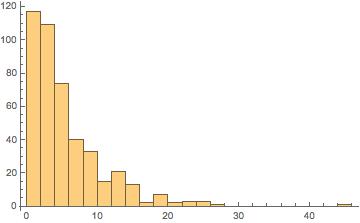
The distribution of “how many windows of 38” had at least 28 Heads, among those that contained at least one such window, is displayed in the figure below. (I omitted the 9,559 runs in which no such window occurred in order to make the figure more readable.)

CoinTossFig1

Figure 1: How Many Windows of 38 Had At Least 28 Heads


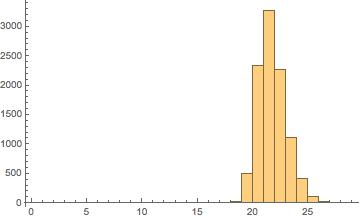
Accounting for correlation. Inspired partly by Harrison Chase’s post linked to above, I ran a simulation in which 32 teams each “flipped against each other” exactly once (so each team flips 31 times), and looked at the maximum number of flips won by any team. This relaxes the assumption of independence used in both the first simulation and, as noted by Chase, the Harvard Sports Analysis Collective analysis linked to above. I ran this simulation 10,000 times as well. I counted how many times the maximum number of flips won equaled or exceeded 23, which is the number of times the Patriots won in their first 31 games of the current 38 game window (i.e., through their December 6th, 2015 game against the Eagles).

The result? In 1,641 trials (16.41%), at least one team won the coin flip at least 23 times.

The Effect of Dependence. Intuition suggests that accounting for the lack of independence between teams’ totals decreases the probability of observing runs like the Patriots’. To see the intuition, consider the probability two teams both win their independent coin flips: 25%, and then consider the probability both teams “win” a single coin flip: 0%.

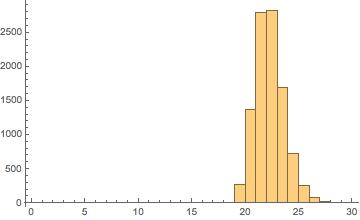
My simulations bear out this intuition, but the effect is bigger than I suspected it would be. Running the same 10,000 simulations assuming independence, at least one team won the coin flip at least 23 times in 2,763 trials (27.63%).

The histograms for the maximum number of wins in each of the 10,000 simulations, first for the “team versus team dependent” case and the second for the “independent across teams” case, are displayed below.

CoinTossFig2

Figure 2: Maximum Number of Coin Flip Wins by A Team in Round-Robin 32 Team League Season


CoinTossFig3

Figure 3: Maximum Number of Wins Among 32 Teams Flipping A Coin 31 Times

Takeaway Message.  Of course, anything that occurs around 5% of the time is not an incredibly common occurrence, but it illustrates that, it’s not that unusual for something unusual to occur. For example, note that the NFC once won the Super Bowl coin toss 14 times in a row (Super Bowls XXXII to XLV), an event that occurs with probability 0.00012207, or a little worse than “1 in 8000” odds. And, of course, we recently saw a coin flip in which the coin didn’t flip.

An empirical matter: somebody should go collect the coin flip data for all teams.  One point here is that looking at one team probably makes this seem more unusual, and the first intuition about the math might suggest that we can simply gaze in awe at how weird this is.  But, upon reflection, we should remember that we often stop to look at weird things without noting exactly how weird they are.

____________________________

Notes.

  1. The probability 0.00254882 in the introduction is obtained by calculating the CDF of the Binomial[38,0.5] distribution at 27, and then subtracting this number from 1.  A common mistake (or, at least, made by me at first) is to calculate the Binomial[38,0.5] distribution at 28 and subtract this number from 1. Because the Binomial is an integer valued distribution, that actually gives the probability that a coin would come up Heads at least 29 times. The difference is small, but not negligible, particularly for the point of this post (considering the probability of a pretty rare event occurring in multiple trials).
  2. 320 flips is 20 years of regular season games. Not that the streak is constrained to regular season games. I like Chase Harrison’s number (247, the number of games Belichick had coached the Patriots at the time of his post) better, but I didn’t want to re-run the simulations.
  3. The probability of this “notable” event is even higher if one thinks that the we would be paying attention to the event even if the Patriots had won only (say) 27 of the last 38 flips.
  4. I did the simulations in Mathematica, and the code is available here.

In Comes Volatility, Nonplussing Both Fairness & Inequality

You know where you are?
You’re down in the jungle baby, you’re gonna die…
In the jungle…welcome to the jungle….
Watch it bring you to your knees, knees…
                             – Guns N’ Roses, “Welcome to the Jungle”

It’s a jungle out there, and even though you think you’ve made it today, you just wait…poverty is more than likely in your future…BEFORE YOU TURN 65!  Or at least that’s what some would have you believe (for example, here, here, and here).

In a study recently published on PLoS ONE, Mark R. Rank and Thomas A. Hirschl examine how individuals tended to traverse the income hierarchy in the United States between 1968 and 2011. Rank and Hirschl specifically and notably focus on relative income levels, considering in particular the likelihood of an individual falling into relative poverty (defined as being in bottom 20% of incomes in a given year) or extreme relative poverty (the bottom 10% of incomes in a given year) at any point between the ages of 25 and 60.  To give an idea of what these levels entail in terms of actual incomes the 20th percentile of incomes in 2011 was $25,368 and the 10th percentile in 2011 was $14,447. (p.4)

A key finding of the study is as follows:

Between the ages of 25 to 60, “61.8 percent of the American population will have experienced a year of poverty” (p.4), and “42.1 percent of the population will have encountered a year in which their household income fell into extreme poverty.” (p.5)

I wanted to make two points about this admirably simple and fascinating study.  The first is that it is unclear what to make of this study with respect to the dynamic determinants of income in the United States.  Specifically, I will argue that the statistics are consistent with a simple (and silly) model of dynamic incomes.  I then consider, with that model as a backdrop, what the findings really say about income inequality in the United States.

A Simple, Silly Dynamic Model of Income.  Suppose that society has 100 people (there’s no need for more people, given our focus on percentiles) and, at the beginning of time, we give everybody a unique ID number between 1 and 100, which we then use as their Base Income, or BI. Then, at the beginning of each year and for each person i, we draw an (independent) random number uniformly distributed between 0 and 1 and multiply it by the Volatility Factor,  which is some positive and fixed number.  This is the Income Fluctuation, or IF, for that person in that year: that person’s income in that year is then

\text{Income}_i^t = \text{BI}_i^t + \text{IF}_i^t.

In this model, each person’s income path is simply a random walk (with maximum distance equal to the Volatility Factor) “above” their Baseline Income.  If we run this for 35 years, we can then score, for each person i, where their income in that year ranked relative to the other 99 individuals’ incomes in that year.

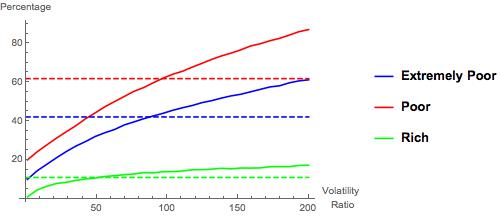
I simulated this model with a range of Volatility Factors ranging from 1 to 200. [1]  I then plotted out percentages analogous to those reported by Rank and Hirschl for each Volatility Factor, as well as the percentage of people who spent at least one year out of the 35 years in the top 1% (i.e., as the richest person out of the 100).  The results are shown in Figure 1, below.[2]  In the figure, the red solid line graphs the simulated percentage of individuals who experienced at least one year of poverty (out of 35 years total), the blue solid line does the same for extreme poverty, and the green solid line does this for visiting the top 1%.  The dotted lines indicate the empirical estimates from Rank and Hirschl—the poverty line is at 61.8%, the extreme poverty line at 42.1% and the “rich” line at 11%.[3]

Figure 1. Simulation Results

Intuition indicates that each of these percentages should be increasing in the Volatility Factor (referred to equivalently as the Volatility Ratio in the figure)—this is because volatility is independent across time and people in this model: more volatility, the less one’s Base Income matters in determining one’s relative standing.

What is interesting about Figure 1 is that the simulated Poor and Extremely Poor occurrence percentages intersect Rank and Hirschl’s estimated percentages at almost exactly the same place—a volatility factor around 90 leads to simulated “visits to poverty and extreme poverty” that mimic those found by Rank and Hirschl.  Also interesting is that this volatility factor leads to slightly higher frequency of visiting the top 1% than Rank and Hirschl found in their study.

Summing that up in a concise but slightly sloppy way: comparing my simple and silly model with real-world data suggests that (relative) income volatility is higher among poorer people than it is among richer people.  … Why does it suggest this, you ask?

Well, in my simple and silly model, and even at a volatility factor as high as 90, the bottom 10% of individuals in terms of Base Income can never enter the top 1%.  At volatility factors greater than 80, however, the top 1% of individuals in Base Income can enter the bottom 20% at some point in their life (though it is really, really rare).  Individuals who are not entering relative poverty at all are disproportionately those with higher Base Incomes (and conversely for those who are not entering the top 1% at all).  Thus, to get the “churn” high enough to pull those individuals “down” into relative poverty, one has to drive the overall volatility of incomes to a level at which “too many” of the individuals with lower Base Incomes are appearing in the rich at some point in their life.  Thus, a simplistic take from the simulations is that (relative) volatility of incomes is around 85-90 for average and poor households, and a little lower for the really rich households. (I will simply note at this point that the federal tax structure differentially privileges income streams typically drawn from pre-existing wealth. See here for a quick read on this.)

Stepping back, I think the most interesting aspect of the silly model/simulation exercise—indeed, the reason I wrote this code—is that it demonstrates the difficulty of inferring anything about income inequality or truly interesting issues from the (very good) data that Rank and Hirschl are using.  The reason for this is that the data is simply an outcome.  I discuss below some of the even more interesting aspects of their analysis, which goes beyond the click-bait “you’ll probably be poor sometime in your life” catchline, but it is worth pointing out that this level of their analysis is arguably interesting only because it has to do with incomes, and that might be what makes it so dangerous.  It is unclear (and Rank and Hirschl are admirably noncommittal when it comes to this) what one should–or can—infer from this level of analysis about the nature of the economy, opportunity, inequalities, or so forth.  Simply put, it would seem lots of models would be consistent with these estimates—I came up with a very silly and highly abstract one in about 20 minutes.

Is Randomness Fair? While the model I explored above is not a very compelling one from a verisimilitude perspective, it is a useful benchmark for considering what Rank and Hirschl’s findings say about income inequality in the US.  Setting aside the question of whether (or, rather, for what purposes) “relative poverty” is a useful benchmark, the fact that many people will at some point be relatively poor during their lifetime at first seems disturbing.  But, for someone interested in fairness, it shouldn’t necessarily be.  This is because relative poverty is ineradicable: at any point in time, exactly 20% of people will be “poor” under Rank and Hirschl’s benchmark.[4]  In other words, somebody has to be the poorest person, two people have to compose the set of the poorest two people, and so forth.

Given that somebody has to be relatively poor at any given point in time, it immediately follows that it might be fair for everybody to have to be relatively poor at some point in their life: in simple terms, maybe everybody ought to share the burden of doing poorly for a year. Note that, in my silly model, the distribution of incomes is not completely fair.  Even though shocks to incomes—the Income Fluctuations—are independently and randomly (i.e., fairly) distributed across individuals, the baseline incomes establish a preexisting hierarchy that may or may not be fair.[5] For simplicity, I will simply refer to my model as being “random and pretty fair.”

Of course, under a strong and neutral sense of fairness, this sharing would be truly random and unrelated to (at least immutable, value neutral) characteristics of individuals, such as gender and race.  Note that, in my “random and pretty fair” model, the heterogeneity of Base Incomes implies that the sharing would be truly random or fair only in the limit as the Volatility Factor diverges to \infty.

Rank and Hirschl’s analysis probes whether the “sharing” observed in the real world is actually fair in this strong sense and, unsurprisingly, finds that it is not independent:

Those who are younger, nonwhite, female, not married, with 12 years or less of education, and who have a work disability, are significantly more likely to
encounter a year of poverty or extreme poverty. 
(pp.7-8)

This, in my mind, is the more telling takeaway from Rank and Hirschl’s piece—many of the standard determinants of absolute poverty remain significant predictors of relative poverty.  The reason I think this is the more telling takeaway follows on the analysis of my silly model: a high frequency of experiencing relative poverty is not inconsistent with a “pretty fair” model of incomes, but the frequency of experiencing poverty being predicted by factors such as gender and race does raise at least the question of fairness.

With that, and for my best friend, co-conspirator, and partner in crime, I leave you with this.


______________

[1]Note that, when the Volatility Factor is less than or equal to 1, individuals’ ranks are fixed across time: the top earner is always the same, as are the bottom 20%, the bottom 10%, and so forth.  It’s a very boring world.

[2]Also, as always when I do this sort of thing, I am very happy to share the Mathematica code for the simulations if you want to play with them—simply email me. Maybe we can write a real paper together.

[3] The top 1% percentage is taken from this PLoS ONE article by Rank and Hirschl.

[4] I leave aside the knife-edge case of multiple households having the exact same income.

[5] Whether such preexisting distinctions are fair or not is a much deeper issue than I wish to address in this post.  That said, my simple argument here would imply that such distinctions, because they persist, are at least “dynamically unfair.”

#Ferguson: The Racial Disconnect On Race

Yesterday, while actively following the events in Ferguson, I was asked the following by @GenXMedia: 

White Suburban America seems riddled with apathy, excuses and disconnect about #Ferguson. Any ideas why?

Upon further prompting, it became clear that @GenXMedia wanted a response to each of the three things that White Suburban America is riddled with: apathy, excuses, and disconnect.

It is important to note that, as many of you know, this important topic does not fall squarely in my “wheelhouse.”  I mostly think about institutions and strategic models of politics.  That said, and with the usual warning that you get what you pay for, here’s my promised response.


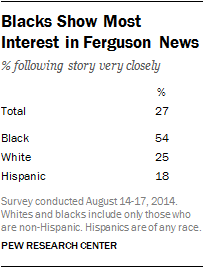
Apathy. If we define apathy as anything less than intense interest in the unfolding story in Ferguson then yes, unsurprisingly, it is clear that more white voters are apathetic toward the events in Ferguson, with 54% of black respondents saying they are following the story very closely, while only 25% of white respondents say the same thing:

8-18-2014_07

(Here is the full Pew survey and write-up.) It’s beyond my scope here but, to understand the intricate question of how race, civil rights, and Ferguson interact, it is important to note that only 18% of Hispanic respondents said they are following the story very closely.

Sadly, these numbers aren’t surprising to me.  Apathy is a “choice” only in the technical sense.  From a common sense standpoint, apathy is the absence of a choice to care/pay attention and “not choosing to pay attention” is a heck of a lot easier when the events seem less proximate to yourself.

I’m not saying that it’s rational to be apathetic, particularly about something as important and extreme as the events in Ferguson, but the results today are consistent with several decades of research into political attitudes in America, including the fact that the perception of “linked fate” is far more prevalent among black Americans than either whites or Latinos.[1]  Linked fate is a key concept in the study of race and politics.  A recent review of this literature describes linked fate as follows:

Linked fate is generally operationalized by an index formed by the combination of two questions. First, respondents are asked: “Do you think what happens generally to Black people in this country will have something to do with what happens in your life?” If there is an affirmative response, the respondent is then asked to evaluate the degree of connectedness: “Will it affect you a lot, some, or not very much?” [2]

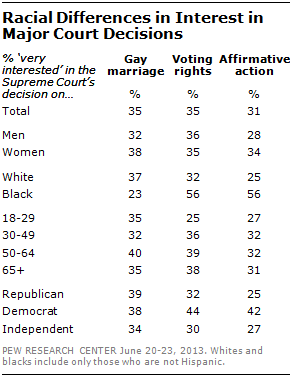
Moving beyond (and/or in addition to) linked fate, one can also argue that the incentives (or perhaps proximities) of black and white Americans differ with respect to law enforcement.  Setting aside a more detailed discussion of this, just note the similarity between the racial breakdown of people closely following the events in Ferguson with the analogous breakdown of interest across gay rights, voting rights, and affirmative action in 2013:

6.24.13.-2

Excuses. It’s well established that white Americans generally perceive racism to be less prevalent and less important than black Americans.   Discussing racial attitudes in the post-Civil Rights era, Brown, et al. write

In the new conventional wisdom about race, white racism is regarded as a remnant from the past because most whites no longer express bigoted attitudes or racial hatred.[3]

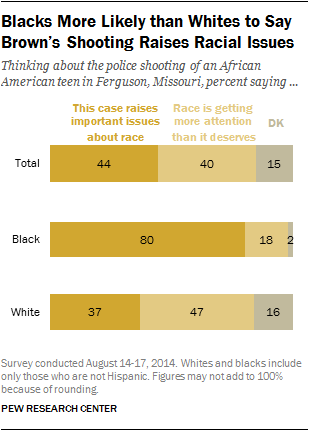
Simply put, the Pew survey does nothing to contradict this conclusion.  Specifically, 47% of white respondents said that “race is getting more attention than it deserves” in the coverage of the shooting of Michael Brown, while only 18% of black respondents, and only 25% of Hispanic respondents, agreed with that statement (see here for the full breakdown):

8-18-14_012

In the end, it’s important to note that the racial divide in attention being paid to Ferguson is in line with the racial differences in individuals’ beliefs that race is an important part of the narrative.  While it is impossible to gauge causality here—namely, are fewer white people paying attention to Ferguson because they think it’s not about race or are more white people saying Michael Brown’s shooting wasn’t about race because they’re not paying attention to Ferguson—both are consistent with avoidance: simply put, issues like homelessness, inequality, and discrimination are difficult to get many people to pay sustained attention to.  I’ve argued elsewhere that politics is about problem-solving, and people like to debate problems they think can be solved.  Race is arguably the most complicated problem to solve. While by no means admirable, avoidance of the issue by those who can (i.e., white people) is not surprising.[4]

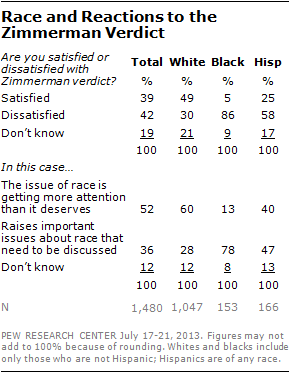
Disconnect. I’m not exactly sure how “disconnect” is different from both apathy and excuses, but I’ll take a stab and interpret this as “why do white people not seem to connect the events in Ferguson with race?”  My response here, sadly, is that they kind of do—at least insofar as the attitudes here are consistent with other similar racially charged events.  For example, following the acquittal of George Zimmerman in July 2013, Pew conducted a poll gauging reactions and attention to the case.  The racial breakdowns of responses to each are very similar to those just found in the case of Ferguson, with 60% of whites thinking the issue of race was getting more attention than it deserves, and only 13% of blacks feeling that way:

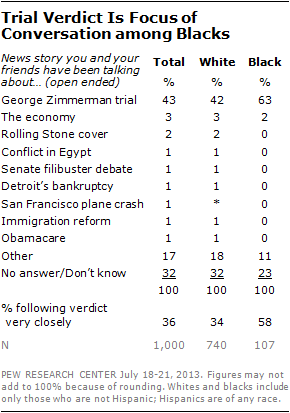
7-22-2013-1 Similarly, 63% of black respondents mentioned talking about the trial with friends, versus only 42% of white respondents:7-22-2013-2

Conclusion.  My own view on this is that Ferguson is most decidedly a racial issue.  This isn’t the same as saying that anyone involved is (or isn’t) racist.  Indeed, that issue, to me, misses the larger and more important point. In fact, while the racial realities of Michael Brown’s death—an unarmed black American killed by a white police officer—undoubtedly thrust race forward into the discussion, race should have been part of the discussion anyway.

That’s because any of the multiple dimensions of the context of Ferguson—the historical discrimination, the economic inequality, the political disparities, the unrepresentative political institutions, and the more general “special” features of local elections, to name just a few—make the issue of not only Michael Brown’s death, but also the largely and sadly ham-handed response a racial issue.

So, why don’t more white people see this?  A succinct (though definitely not exculpatory) answer is inertia: attitudes, like objects, tend to stay the same until acted upon an outside force. The reality of America is that white Americans are less likely to see their fates as being linked with those of black Americans and (perhaps because) they are less likely to face the everyday inequalities faced by far too many black Americans. In other words, and quite literally, most white Americans don’t often encounter an outside force with respect to race—definitely not like many black Americans do.  Whether they achieve this through apathy, excuses, and/or disconnect is a trickier question, but the correlation—the reality that race still divides Americans’ perceptions of politics and power—is sadly indisputable and robust, even in the 21st century.

____________

[1] See Dawson, Michael C. Behind the mule: Race and class in African-American politics. Princeton University Press, 1994.
[2] From Paula D. McClain, Jessica D. Johnson Carew, Eugene Walton, Jr., and Candis S. Watts. 2009. “Group Membership, Group Identity, and Group Consciousness: Measures of Racial Identity in American Politics?” Annual Review of Political Science (2009), p. 477.
[3] From Michael K. Brown, Martin Carnoy, Troy Duster, and David B. Oppenheimer. Whitewashing race: The myth of a color-blind society. University of California Press, 2003, p.36.
[4] Another, stronger, view of this is called “white privilege,” which describes the fact that issues that can be avoided are also deemed less important to others, without noticing that the ability to avoid these issues is not independent of race. (Thanks to Jessica Trounstine for adroitly directing me to this connection, as well as posting this telling graphic.)


How Political Science Makes Politics Make Us Less Stupid

This post by Ezra Klein discusses this study, entitled “Motivated Numeracy and Enlightened Self-Government,” by Dan M. Kahan, Erica Cantrell Dawson, Ellen Peters, and Paul Slovic.  The gist of the post and the study is that people are less mathematically sophisticated when considering statistical evidence regarding a political issue.

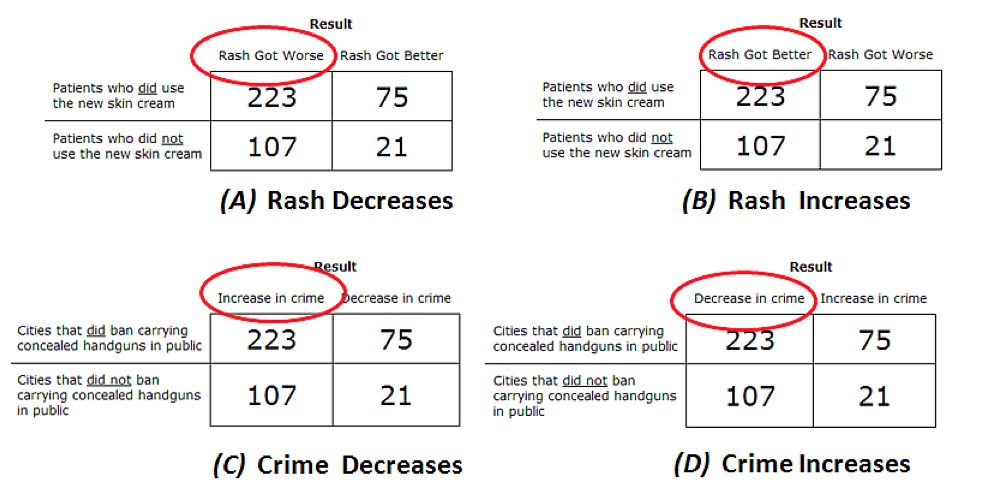
The study presented people with “data” from a (fake) experiment about the effect of a hand cream on rashes.  There were two treatment groups: one group used the cream and the other did not.  The group that used the skin cream had more subjects reported (i.e.a higher response rate), but a lower success rate.[1] Mathematically/scientifically sophisticated individuals should realize that the key statistics are the ratios of successes to failures within each treatment, not the absolute number of successes.

This was the baseline comparison, as it considered a nonpolitical issue (whether to use the skin cream).  The researchers then conducted the same study with a change in labeling. Rather than reporting on the effectiveness of skin cream, the same results were labeled as reporting the effectiveness of gun-control laws. All four treatments of the study are pictured below.

Gunning for Mathematical Literacy

Gunning for Mathematical Literacy

I want to make one methodological point about this study: the gun control treatments were not apples-to-apples comparisons with the skin cream treatment and, furthermore, the difference between them is an important distinction between well-done science and the messy realities of real-world (political/economic) policy evaluation/comparison.

Quoting from page 10 of the study,

Subjects were instructed that a “city government was trying to decide whether to pass a law banning private citizens from carrying concealed handguns in public.” Government officials, subjects were told, were “unsure whether the law will be more likely to decrease crime by reducing the number of people carrying weapons or increase crime by making it harder for law-abiding citizens to defend themselves from violent criminals.” To address this question, researchers had divided cities into two groups: one consisting of cities that had recently enacted bans on concealed weapons and another that had no such bans. They then observed the number of cities that experienced “decreases in crime” and those that experienced “increases in crime” in the next year. Supplied that information once more in a 2×2 contingency table, subjects were instructed to indicate whether “cities that enacted a ban on carrying concealed handguns were more likely to have a decrease in crime” or instead “more likely to have an increase in crime than cities without bans.” 

The sentence highlighted in bold (by me) is the core of my main point here.  It was not even suggested to the subjects that the data was experimental.  Rather, the description is that the data is observational.  In other words, it wasn’t the case in the hypothetical example that cities were randomly selected to implement gun-control laws.

While this might seem like a small point, it is a big deal.  This is because, to be direct about it, gun-control laws are adopted because they are perceived to be possibly effective in reducing gun crime,[2] they are controversial,[3] and accordingly will be more likely to be adopted in cities where gun crime is perceived to be bad and/or getting worse.

Without randomization, one needs to control for the cities’ situations to gain some leverage on what the true counterfactual in each case would have been.  That is, what would have happened in each city that passed a gun-control law if they had not passed a gun-control law, and vice-versa?

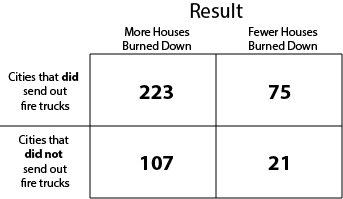
To make this point even more clearly, consider the following hypothetical.  Suppose that instead of gun-control laws and crime prevention, we compared the observed use of fire trucks in a city and then evaluated how many houses ultimately burned down?  Such a treatment is displayed below.

FireTrucks

From this hypothetical, the logic of the study implies that a sophisticated subject is one who says “sending out fire trucks causes more houses to burn down.”  Of course, a basic understanding of fires and fire trucks strongly suggests that such a conclusion is absolutely ridiculous.

What’s the point?  After all, the study shows that partisan subjects were more likely to say that the treatment their partisanship would tend to support (gun-control for Democrats, no gun-control for Republicans) was the more effective.   This is where the importance of counterfactuals comes in.  Let’s reasonably presume for simplicity that “Republicans don’t support gun-control” because they believe it is insufficiently effective at crime prevention to warrant the intrusion on personal liberties and that “Democrats support gun-control” because they believe conversely that it is sufficiently effective.[4] Then, these individuals, given that the hypothetical data was not collected experimentally, could arguably look at the hypothetical data in the following ways:

  • A Republican, when presented with hypothetical evidence of gun-control laws being effective, could argue that, because towns adopt gun control laws during a crime wave, regression to the mean might lead the evidence to overestimate the effectiveness of gun control laws on crime reduction.  That is, gun-control laws are ineffective and they are implemented as responses to transient bumps in crime.
  • A Democrat, when presented with hypothetical evidence of gun-control laws being ineffective, might reason along the lines of the fire truck example: cities that adopted gun control laws were/are experiencing increasing crime and that the proper comparison is not increase of crime, but increase of crime relative to the unobserved counterfactual.  That is, cities that implement gun-control laws are less crime-ridden than they would have been if they had not implemented the measures, but the measures themselves can not ensure a net reduction of crime during times in which other factors are driving crime rates.

Conclusion. The mathofpolitics points of this post are two.  First, it is completely reasonable that partisans have more well-developed (“tighter”) priors about the effectiveness/desirability of various political policy choices.  When we think about adoption of policies in the real world, it is also reasonable that these beliefs will drive the observed adoption of policies.  Finally, for almost every policy of any importance it is the case that the proper choice depends on the “facts on the ground.”  Different times, places, circumstances, and people typically call for different choices.  To forget this will lead one to naively conclude that chemotherapy causes people to die from cancer.

Second, it’s really time to stop picking on voters. Politics does not make you “dumb.” People have limited time, use shortcuts, take cues from elites, etc., in every walk of life.  Traffic-drawing headlines and pithy summaries like “How politics makes us stupid” are elitist and ironically anti-intellectual.  The Kahan, Dawson, Peters, and Slovic study is really cool in a lot of ways.  My methodological criticism is in a sense a virtue: it highlights the unique way in which science must be conducted in real-world political and economic settings.  Some policy changes can not be implemented experimentally for normative, ethical, and/or practical reasons, but it is nonetheless important to attempt to gauge their effectiveness in various ways.  Thinking about this and, more broadly, how such evidence is and should be interpreted by voters is arguably one of the central purposes of political science.

With that, I leave you with this.

Note: I neglected to mention this study—“Partisan Bias in Factual Beliefs about Politics (by John G. BullockAlan S. GerberSeth J. Hill, and Gregory A. Huber)–which shows that some of the “partisan bias” can be removed by offering subjects tiny monetary rewards for being correct. Thanks to Keith Schnakenberg for reminding me of this study.

____________

[1] The study manipulated whether the cream was effective or not, but I’ll frame my discuss ion with respect to the manipulation in which the cream was not effective.

[2] Note that this is not saying that all “cities” perceive that gun-control laws are effective at reducing gun crime.  Just that only those cities in which they are perceived to possibly be effective will adopt them.

[3] Again, in cities where such a law is not controversial, one might infer something about the level of crime (and/or gun ownership) in that city.

[4] I am also leaving aside the possibility that Republicans like crime or that Democrats just don’t like guns.

My Ignorance Provokes Me: I know Where Ukraine is and I Still Want to Fight

It’s been too long since I prattled into cyberspace.  This Monkey Cage post by Kyle Dropp  Joshua D. Kertzer & Thomas Zeitzoff caught my contrarian attention.  In a nutshell, it says that those who are less informed about the location of Ukraine are more likely to support US military intervention.  This is an intriguing and policy-relevant finding from a smart design.  That said, the post’s conclusion is summarized as: “the further our respondents thought that Ukraine was from its actual location, the more they wanted the U.S. to intervene militarily.”  The implication from the post (inferred by me, but also by several others, I aver) is that this is an indication of irrationality.  I hate to spoil the surprise, but I am going to offer a rationalization for this apparent disconnect.

First, however, the study’s methodology—very cool in many ways—caught my eye, only because (in my eyes) the post’s authors imbue the measure with too much validity with respect to the subjects’ “knowledge.”  Specifically, the study asked people to click on a map where they think Ukraine is located.  The study then measures the distance between the click and Ukraine.[1]  Then Dropp, Kertzer, & Zeitzoff state that this

…distance enables us to measure accuracy continuously: People who believe Ukraine is in Eastern Europe clearly are more informed than those who believe it is in Brazil or in the Indian Ocean.

I disagree with the strongest interpretation of this statement.  While I agree that people who believe Ukraine is in Eastern Europe are probably (not clearly, because some might guess/click randomly on Eastern Europe, too) more informed than those who “believe it is in Brazil or in the Indian Ocean,” I would actually say that the example chosen by the authors suggests that distance is not the right metric.  For example, someone who thinks Ukraine is Brazil is clearly wrong about political geography, but someone who thinks that Ukraine is located in the middle of an ocean is clearly wrong about plain-ole geography.

More subtly, it’s not clear that the “distance away from Ukraine” is a good measure of lack of knowledge.  In a nutshell, I aver that there are two types of people in the world: those who know where Ukraine is and those who do not.  Distinguishing between those who do not by the distance of their “miss” is just introducing measurement error, because (by supposition/definition) they are guessing.  That is, the true distance of miss is not necessarily indicative of knowledge or lack thereof.  Rather, if you don’t know where Ukraine is, then you don’t know where it is.

Moving on quickly, I will say the following.  It is not clear at all that not knowing where a conflict is should (in the sense of rationality) make one less likely to favor intervention. The key point is that if anyone is aware of the Crimea/Ukraine crisis, they probably know[2] that there is military action.  This isn’t Sochi, after all.

So, I put two thought experiments out there, and then off to the rest of the night go I.

First, suppose someone comes up to you and says, “there’s a fire in your house,” and then rudely runs off, leaving you ignorant of where the fire is.  What would you do…call the fire department, or run through the house looking for the fire?  I assert that either response is rational, depending on other covariates (such as how much you are insured for, whether you live in an igloo, and if you have a special room you typically freebase in).  The principal determinant in this case in many situations is the IMPORTANCE OF PUTTING OUT THE FIRE, not the cost of accidentally dowsing one too many rooms with water.

Second, the Ukraine is not quite on the opposite side of the world from the US, but it’s pretty darn close (Google Maps tells me it is a 15 hour flight from St. Louis).  So, let’s think about what “clicking far from Ukraine when guessing where Ukraine is” implies about the (at least in the post) unaddressed correlation of “clicking close to the United States when guessing where Ukraine is”?  This picture demonstrates where each US survey respondent clicked when asked to locate Ukraine.  Focus on the misses, because these are the ones that will drive any correlation between “distance of inaccuracy and support for foreign intervention” correlation. (Because distances are bounded below by zero and a lot of people got Ukraine basically right.)

There are a lot of clicks in Greenland, Canada, and Alaska. I am going to leave now, but the general rule is that the elliptic geometry of the globe (and the fact that the Ukraine is not inside the United States[3]) implies that clicking farther away from Ukraine means that you are, with some positive (and in this case, significant) probability clicking closer to the United States.

So, suppose that the study said “those who think the Ukraine is located close to the US are more likely to support military intervention to stem Russian expansion?”  Would that be surprising?  Would that make you think voters are irrational?

Look, people have limited time and aren’t asked to make foreign policy decisions very often (i.e., ever).  So, let’s stop picking on them.  It is elitist, and it offers nothing other than a headline/tweet that draws elitists (yes, like me) to your webpage.

Also, let’s not forget that, as far as I know, there is no chance in the current situation of the United States government intervening in the Ukraine. So, even if voters are irrational, maybe that’s meta: we have an indirect democracy for a reason, perhaps?

_______________

[1] If I was going to get really in the weeds, I would raise the question of which metric is used to measure distance between a point and a convex shape with nonempty interior.  There are a lot of sensible ones. And, indeed, the fact that there isn’t an unambiguously correct one is actually an instantiation of Arrow’s theorem.  Think about that for a second.  And then thank me for not prattling on more about that.  [That’s called constructing the counterfactual. –Ed.]

[2] And, as the authors state, “two-thirds of Americans have reported following the situation at least “somewhat closely,

[3] Just think about conducting this same survey with a conflict in Georgia.  Far-fetched, right?  HAHAHAHA

Poor Work Counting the Working Poor

This Op-Ed in Forbes, “Almost Everything You Have Been Told About The Minimum Wage Is False,” by Jeffrey Dorfman, argues that increasing the federal minimum wage (1) would not affect as many people as you might think and (2) would not help the working poor as much as (say) teenagers.

The first half of Dorfman’s Op-Ed is misleading in important and ironic ways.[1]  I will detail three significant logical failures in it, and then provide a more transparent accounting of how many people’s wages would be directly increased by an increase of the federal minimum wage to $10.10/hr.

Three Failures. First, Dorfman either misunderstands or misrepresents the difference between necessary and sufficient conditions when he writes:

First, people should acknowledge that this rather heated policy discussion is over a very small group of people. According to the Bureau of Labor Statistics there are about 3.6 million workers at or below the minimum wage (you can be below legally under certain conditions). 

Dorfman should acknowledge that raising the federal minimum wage would affect not only those who earn a wage less than or equal to the current minimum wage.  The data that Dorfman is discussing excludes anybody who receives $7.26/hr or more.  Thus, Dorfman should acknowledge that the “small” group of 3.6 million people he is considering compose the relevant basis of discussion if we are considering a one cent increase in the federal minimum wage.[2]

Second, Dorfman starts comparing apples and oranges, writing

Within that tiny group, most of these workers are not poor and are not trying to support a family on only their earnings. In fact, according to a recent study, 63 percent of workers who earn less than $9.50 per hour (well over the minimum wage of $7.25) are the second or third earner in their family and 43 percent of these workers live in households that earn over $50,000 per year.

This is apples to oranges because the data in the (linked) study is from 2003-2007, before the Great Recession, but the BLS data is from 2012. Furthermore, Dorfman doesn’t take the time to actually report what the study does say (on page 593):

Of those who will gain, 63.2% are second or third earners living in households with incomes twice the poverty line, and 42.3% live in households with incomes three times the poverty line, well above $50,233, the income of the median household in 2007.

Let’s think about this for a second: ~20% of those who made less than $9.50/hr in 2007 lived in a household with an annual income (it turns out) of somewhere between $41,300 and $61,950.  I mean, seriously, helping this kind of household—you know, hard-working and distinctly middle class—that would be a ridiculous outcome.

In addition, I’m going to be quick about Dorfman’s faulty (and, I think, disingenuous) logic in his implication that people poorly paid job “… are not trying to support a family on only their earnings” just because others in the household are working, too.

Namely, if you are the second or third earner in a family, that does not imply that you don’t need the money.  In fact, I am going to blatantly assert that it’s probably the case that the number of “voluntarily non-working” 16+ year-olds in an American household is positively correlated with the household’s income.  After all, many people work a job for, you know, the money.  But, of course, some people might take near-minimum-wage jobs just to keep themselves busy.

Next, Dorfman starts making descriptive statements out of the blue:

...Thus, minimum wage earners are not a uniformly poor and struggling group; many are teenagers from middle class families and many more are sharing the burden of providing for their families, not carrying the load all by themselves.

The closest thing Dorfman putatively offers as evidence for the conclusion that these are teenagers (there is no evidence from what kind of families these teenagers come in the BLS data) is the BLS data, which again is constrained only to those earning no more than the minimum wage of $7.25/hr.

Finally, Dorfman says

This group of workers is also shrinking. In 1980, 15 percent of hourly workers earned the minimum wage. Today that share is down to only 4.7 percent. Further, almost two-thirds of today’s minimum wage workers are in the service industry and nearly half work in food service. 

But again, the point is that raising the minimum wage to (say) $10.10/hr, as President Obama has called for, would help more than only those who earn the minimum wage.

I’m not just going to point out Dorfman’s mistakes.  I have done a little digging (it took me about 15 minutes, to be clear, to get real numbers), and I’ll give a better estimate of how big that “very small group of people” really is.[3]

The Occupational Employment Statistics Query System, provided by the U.S. Bureau of Labor Statistics, provides a different picture of how many people would be impacted by a change in the federal minimum wage to $10.10/hr.

The most recent data, from May 2012, is displayed at the end of this post.  The points I’d like to quickly point out are as follows:

  • In Food Preparation and Serving Related Occupations, 50% of 11,546,880 workers receive less than $9.10/hr, and 75% receive less than $11.11/hr.  Thus, somewhere around 62.5% of these workers, or about 5.75 million people would receive a higher wage.
  • In Sales and Related Occupations, 25% of 13,835,090 workers receive less than $9.12/hr, and 50% receive less than $12.08/hr.  So, conservatively, about 3.5 million people would receive a higher wage.
  • In Transportation and Material Moving Occupations, 25% of 8,771,690 workers receive less than $10.06/hr.  Thus, over 2.1 million people would receive a higher wage.
  • In Healthcare Support Occupations, 25% of 3,915,460 workers receive less than $10.03/hr.  That’s nearly a million people who would receive a higher wage.
  • Overall, 10% of all workers (across all industries) receive an hourly wage lower than $8.70/hr, and 25% of all workers receive an hourly wage lower than $10.81/hr.  A rough estimate, then, is that at least one out of every six workers would receive a higher hourly wage if the federal minimum wage were raised to $10.10/hr. To put that in absolute terms:

Over 21,500,000 Americans would receive a higher wage.

…or, about 6 times as many as Dorfman implied.


With that, I leave you with this.

___________________

[1] I will not address the second part of Dorfman’s piece about productivity shifts in the food service industry, and the “ironic” aspect of the mistakes in the piece is the conclusion of the first paragraph, where Dorfman informs the reader that “much of what you hear about the minimum wage is completely untrue.”

[2] I am setting aside the question of how many people who currently earn less than minimum wage would be affected by an increase in the level of the wage.  This is a complicated matter for a variety of reasons.

[3] I, like Dorfman, will leave aside the question of overall impact of a minimum wage hike on employment.  I am not advocating for or against a minimum wage hike—rather, I am advocating against those who argue that very few workers make very low wages.

___________________


BLS Data:


Occupation (SOC code) Employment(1) Hourly mean wage Hourly 10th percentile wage Hourly 25th percentile wage Hourly median wage Hourly 75th percentile wage Hourly 90th percentile wage Annual 10th percentile wage(2) Annual 25th percentile wage(2) Annual median wage(2)
All Occupations(000000) 130287700 22.01 8.70 10.81 16.71 27.02 41.74 18090 22480 34750
Management Occupations(110000) 6390430 52.20 22.12 31.56 45.15 65.20 (5)- 46000 65650 93910
Business and Financial Operations Occupations(130000) 6419370 33.44 16.88 22.28 30.05 40.61 53.50 35110 46340 62500
Computer and Mathematical Occupations(150000) 3578220 38.55 19.39 26.55 36.67 48.40 60.55 40330 55220 76270
Architecture and Engineering Occupations(170000) 2356530 37.98 19.45 26.16 35.35 46.81 59.52 40450 54420 73540
Life, Physical, and Social Science Occupations(190000) 1104100 32.87 15.06 20.35 28.89 41.18 55.38 31320 42330 60100
Community and Social Service Occupations(210000) 1882080 21.27 11.21 14.57 19.42 26.52 34.36 23310 30310 40400
Legal Occupations(230000) 1023020 47.39 16.80 23.15 36.19 62.57 (5)- 34940 48150 75270
Education, Training, and Library Occupations(250000) 8374910 24.62 9.94 14.66 22.13 30.85 41.54 20670 30490 46020
Arts, Design, Entertainment, Sports, and Media Occupations(270000) 1750130 26.20 9.42 13.76 21.12 32.16 46.12 19600 28630 43930
Healthcare Practitioners and Technical Occupations(290000) 7649930 35.35 14.84 20.56 28.94 40.69 61.54 30870 42760 60200
Healthcare Support Occupations(310000) 3915460 13.36 8.62 10.03 12.28 15.64 19.51 17920 20850 25550
Protective Service Occupations(330000) 3207790 20.70 9.09 11.71 17.60 26.89 37.35 18910 24370 36620
Food Preparation and Serving Related Occupations(350000) 11546880 10.28 7.84 8.38 9.10 11.11 14.60 16310 17430 18930
Building and Grounds Cleaning and Maintenance Occupations(370000) 4246260 12.34 8.12 8.95 10.91 14.44 18.93 16890 18630 22690
Personal Care and Service Occupations(390000) 3810750 11.80 7.96 8.66 10.02 13.10 18.21 16560 18010 20840
Sales and Related Occupations(410000) 13835090 18.26 8.25 9.12 12.08 20.88 35.60 17170 18970 25120
Office and Administrative Support Occupations(430000) 21355350 16.54 9.17 11.51 15.15 20.18 26.13 19070 23940 31510
Farming, Fishing, and Forestry Occupations(450000) 427670 11.65 8.23 8.65 9.31 12.97 18.64 17130 18000 19370
Construction and Extraction Occupations(470000) 4978290 21.61 11.15 14.37 19.29 27.19 35.61 23190 29900 40120
Installation, Maintenance, and Repair Occupations(490000) 5069590 21.09 10.92 14.56 19.72 26.63 33.69 22720 30290 41020
Production Occupations(510000) 8594170 16.59 9.02 11.05 14.87 20.26 27.11 18760 22990 30920
Transportation and Material Moving Occupations(530000) 8771690 16.15 8.56 10.06 13.92 19.41 26.83 17800 20930 28960
Footnotes:
(1) Estimates for detailed occupations do not sum to the totals because the totals include occupations not shown separately. Estimates do not include self-employed workers.
(2) Annual wages have been calculated by multiplying the hourly mean wage by 2,080 hours; where an hourly mean wage is not published, the annual wage has been directly calculated from the reported survey data.
(5) This wage is equal to or greater than $90.00 per hour or $187,199 per year.
SOC code: Standard Occupational Classification code — see http://www.bls.gov/soc/home.htm

Data extracted on January 30, 2014


The Noted Is Always Notable

…but the notable is frequently unnoted.

This post, along with the always thought-provoking repartee with my friend Chris Bonneau, inspires me to write a  post about selection effects and their ability to magically turn a mountain into a molehill.  The short version of the story is that a brouhaha was breaking out at the University of Colorado-Boulder regarding Patricia Adler, a Professor of Sociology whose course in “Deviance in US Society” (which looks fascinating) attracted unwelcome attention.  I will dispense with the details of the case, but note that Adler was ultimately not formally punished. As a faculty member myself, I rightly and consciously adopt a default position of “the critics generally know less about how to do it than the faculty member and, accordingly, often have even worse motives when they attempt to intervene.”

But, to be clear, this post is not about Adler’s case, per se. Rather, and I think more fairly, this post is about the argument advanced by  in the post linked at the beginning.  In a nutshell, Schuman—or her copyeditors—argues in the subtitle:

How would you like it if a bunch of online randos could get you fired? That’s life for professors.

Well, I wouldn’t like it. Indeed, you could omit the “online” qualification.  Or, for that matter, substitute “anyone” for “a bunch of online randos.”  But, more to the point—and I feel bad picking on Schuman, because it’s a common mistake in this kind of crisis post mortem and I believe the intentions are (very) good—Schuman’s argument is prone to a classic selection effect.

Specifically, the article presents no evidence that “online randos” (i.e., some sort of viral flame against Adler) had provoked the CU-Boulder administration’s initial actions.  In some searching, it seems that what did provoke it is still unclear.  The remarkable thing about viral anti-intellectual vitriol is it tends to be VERY CLEAR.  (Doubt it?  Just click here.) So, let’s suppose that some soon-forgotten wave of outrage from the “internet review board” did not actually bring upon the Adler brouhaha.

No, the viral storm started after Adler (understandably) went public about the burgeoning brouhaha.  And, to repeat myself, Adler was ultimately inconvenienced, but not otherwise punished. Yes, I am sure that the ensuing viral maelstrom attracted vitriolic detractors.  But, to be honest, if you’re in the middle of a brouhaha and you surf the blogosphere, it’s not really reasonable to expect not to find a deluge of derogatory detritus.

Caveat surfor, as the Roman kids say.

In fact, in spite of the anti-Adler/anti-Sociology/armchair-intellectual/professional-anti-intellectual invective that followed the initial splash of Adler’s tribulations, again…she was ultimately not formally punished.  So, this isn’t about the internet (even potentially) getting a professor fired.  Rather, it’s more likely reflective of the reality that a tenured professor at a nationally prominent university being investigated/harassed by her administration is/was per se notable.  (Let’s hope it stays that way.)

Before concluding, let me provide a simple, three-pronged analogy to this:

  1. Internet criticism of President Bush caused his inept performance during and following Hurricane Katrina,
  2. Internet criticism of President Obama caused his inept performance with respect to Benghazi and/or the Affordable Care Act rollout, and
  3. Internet criticism of Governor Christie caused his inept handling of traffic leading to George Washington Bridge.

Of course, none of those causal stories seems plausible.  As much as I am suspicious of those who spend precious time pestering faculty, I really doubt that the ex post ranting of “online randos” was somehow the ex ante cause/inducement of her troubles and travail.

With that, I leave you with this.


Let Me Confirm Your Belief That Your Irrationality Is Rational

This opinion piece in the New York Times, entitled “Why We Make Bad Decisions,” by Noreena Hertz, explores the implications of a well-established psychological/behavioral phenomenon known as confirmation bias.  In a nutshell, confirmation bias describes the general tendency to overweigh information in line with one’s prior beliefs and/or give too little weight to information contradicting those beliefs or attitudes.

This phenomena is clearly relevant to politics in a wide array of settings.  Voters may ignore “negative” information about their own favored party or give too much credence to “negative” information about other parties.  Individuals may selectively pay more attention to positive information about the policies they favor or ignore information that reflects poorly upon those policies.

Well, as is my usual approach, I wanted to briefly point out that observing such a bias may not be irrational.  I have two explanations for this behavior. The first demonstrates why positive and negative information should be evaluated differently in certain (common) contexts.  The second explanation demonstrates why individuals should stop exerting effort on updating their beliefs (i.e., paying attention to information) in certain (again, common) choice situations.

Both explanations rely on a simple presumption about beliefs: I will presume, as typical, that an individual’s beliefs are important only insofar as they affect the individual’s behavior. This is an important presumption, and it is definitely contestable, albeit not in standard social science models.  I will touch upon it again in the conclusion of the post.

Before continuing, note that I am not arguing that Hertz is “wrong.”  To the degree that one is confronted with “pure and costless information” in a single decision-maker situation, there is absolutely no reason to do anything other than faithfully revise your beliefs as far as possible according to Bayes’s Rule.  This is a mathematical fact.  That said, situations in which information is pure and costless and one’s decisions and incentives are in no way contaminated by strategic considerations are pretty few and far between.

That said, let’s move on to the explanations.

The first explanation is demonstrated by the following example. Suppose you have decided to get your yard reseeded: the bare spots have gotten unbearable, and something must be done.  Now suppose that you head down to the local nursery to get some seed and, while jawing with the sales person, he or she says “you know, buying sod is a much faster way to get a beautiful lawn.”  Should you believe this statement? Yes.

Should you change your beliefs about the effectiveness of seed and sod? Well, that’s not clear. In particular, you need to consider the source of the information and his or her motivations.  Sod is much more expensive than seed, and the sales person is presumably motivated to increase the amount of money you spend.  Accordingly, you should give less weight to the information—particularly in terms of whether you should put the seed back and buy sod instead.  Furthermore, once you realize that you should probably not act upon the information in terms of changing your choice, it is not even clear that you should process/pay attention to anything that the sales person says about the relative value of sod over seed.[1]

The second explanation is based on the following example.  Suppose that you have spent many months studying (say) two different houses, and you will buy one and exactly one.  Eventually, you have enough evidence to conclude with near-certainty that house A is the best one to buy.  At some point, your belief about the relative values of the two houses (if you are good Bayesian decision theorist) will be sufficiently certain that you would not pay any nontrivial cost for additional information.  Incorporating and processing information is costly insofar as it requires mental effort.  Even if it doesn’t, belief revision is important only to the degree that it will affect your decision.  But rarely is decision revision costless.  That is, most decisions about (say) personal health and finances are ongoing: changing one’s habits and diet, rearranging one’s asset allocation and consumption—these all require effort.  Put these two together, and it is clear that in some cases, ignoring information that is contrary to one’s beliefs may actually be rational.[2]

Finally, before concluding, I want to quickly mention that beliefs can be directly valuable in a “psychological” sense.  To be quick about it, suppose that you enjoy believing that your future will be bright.  Say you took an exam yesterday and will find out the results in 2 weeks.  You enjoy thinking that you did well, and you dislike negative disappointment.  In such cases, it is often optimal for you to have beliefs of the following form:

1. Walk out of the exam thinking you did INCREDIBLY WELL.
2. Keep thinking this.  No reason to find out anything about it, even if you can, until the end.
3. In the moments before you find out, recalibrate those beliefs downward.[3]

The same logic applies in situations in which the decision is a fait accompli for other reasons.  That is, suppose you have to buy a given house.  If you enjoy thinking that “the future is bright” even a little bit, then you have no immediate incentive to update upon/pay attention to information that disconfirms your “apparent prior beliefs” (i.e., the beliefs that would justify buying the house if you had a choice).

The link between this and the apparently pathological belief revision by (say) smokers/drinkers/drug users/UNC football fans and others “addicted” to arguably unhealthy lifestyles is clear: if you know—for whatever reason—that your decision is invariant to your beliefs, there is no reason to hold rational ones.  Indeed, there is probably a clear argument on “psychological” grounds that you should update in ways consistent with confirmation bias.

With that, I leave you with this and this.

__________________

[1] Of course, the opposite is true if the sales person tells you, “oh, you are definitely doing the right thing not buying sod.” In this case, the information is more credible because of the source’s motivations, so that this would rationally be given at least as much credence as if it were provided by a “neutral” source, and would therefore similarly look like confirmation bias.  In politics, this is known as the “it takes a Nixon to go to China” logic.

[2] You could call this a “tune in, update, and drop out” kind of logic.  And, it is beyond the scope of this post, but it is also a justification for apparent overconfidence in some strategic situations.  In particular, committing to not updating on the viability of a joint venture can bolster members’ incentives to contribute individually to the team production components of the venture.  In other words, if I am less worried that you might be listening to evidence that could make you doubt the value of the venture, I am in some situations less worried about my own individual effort being in vain because of you happening to have heard, on your own, that the venture might be less profitable than we all believed when we started out.  There is a link to NFL quarterbacks and head coaches in here somewhere.

[3] Years ago, I wrote a paper with George Loewenstein and Niklas Karlsson, on exactly this behavioral optimization problem.  The basic idea is that irrational beliefs (and irrational belief revision) is even “more easily made optimal/rational” if one allows for beliefs to matter on their own, which I rule out in the two explanations, but clearly is descriptively realistic.

Believe Me When I Say That I Want To Believe That I Can’t Believe In You.

A recurring apparent conundrum is the mismatch between Congressional approval (about 14% approval and 78% disapproval) and reelection rates (about 91% in 2012).  If Americans disapprove of their legislators at such a high rate, why do they reelect them at an even higher rate?  PEOPLE BE CRAZY…AMIRITE?

Maybe.  A traditional explanation is that people don’t like Congress but like THEIR representatives.  Again, maybe.  Indeed, probably.  But, in the contrarian spirit of mathofpolitics, I wish to forward another explanation.  This explanation is undoubtedly wrong, but raises an interesting welfare point that could still hold even if the microfoundations of the explanation are amiss.

The heart of the explanation is that a cynical belief along the lines of “all politicians are crooks” can help voters get better/more faithful representation from their representatives.  Thus, ironically, a deep suspicion among voters about the accountability of legislators can aid one in keeping those legislators behaving in accord with the voters’ wishes.  (PEOPLE BE CRAZY LIKE A FOX…AMIRITE?)

Now, let’s get to the argument/the model.

Theoretically, elections might help achieve accountability (i.e., make incumbents do what voters want) through their potential ability to solve two important problems: moral hazard and adverse selection. The essence of moral hazard is “hidden action”: I want my representatives to work smart AND hard, but I can’t actually observe them working.  Instead, I observe noisy real-world indicators of how hard they’re working: unemployment, budget deficits, health care costs, Olympic medals, and Eurovision.  To the degree that these are correlated with legislative effort and I condition my vote choice on these observables, I can provide an incentive for a reelection-motivated incumbent to work smart and hard.

The essence of adverse selection is hidden information: I want my legislator to take actions on my behalf when they present themselves.  The best way to “get this” is to have a legislator who shares my preferences.  (Think Fenno’s Home Style.) But, practically speaking, every aspiring representative will tell me that he or she shares my preferences.  So, regardless of how I discern whether my incumbent shares my preferences, the reality is that I will have a strict incentive to reelect an incumbent who expect shares my preferences…because, after all, I generally have little information about his or her challenger’s preferences.

So, in a nutshell, you’d like to solve both of these problems simultaneously: you want your incumbent to share your preferences and work both smart and hard.  In the immortal words of Bachman Turner Overdrive, you want them to be taking care of business and working overtime. Every day. Every way.

Unfortunately, solving both of these problems is frequently impossible.  The details of why can be summed up with the old saying that “a bird in the hand is better than two in the bush.” You see, once you believe that your legislator truly has your interests at heart, you will (and, in a certain way, should) be more likely to forgive/reelect him or her if he or she is a little lazy.

This fact ends up making it harder for a voter to discipline his or her representatives: in particular, think of the following simple world.  Assume there are faithful and faithless politicians (this is fixed for any given politician) and that every politician can either work hard or be lazy. And, for simplicity, suppose that the faithful type always works hard. (This is not important, it just simplifies the exposition.)

Furthermore, let p \in (0,1) denote the probability that a random incumbent is faithful.

Here’s the rub: you don’t observe the politician’s type (faithful or faithless) or how hard he or she worked.  Rather, you observe one of three outcomes: Great, OK, or Bad.  Finally, suppose that the probabilities of observing these outcomes are

P[Great | work hard & faithful] = 0.35
P[OK | work hard & faithful] = 0.55
P[Bad | work hard & faithful] = 0.1

P[Great | work hard & faithless] = 0.3
P[OK | work hard & faithless] = 0.5
P[Bad | work hard & faithless] = 0.2

P[Great | be lazy & faithless] = 0.1
P[OK | be lazy & faithless] = 0.5
P[Bad | be lazy & faithless] = 0.4

(If you take a moment, you’ll realize that outcomes are more likely to be better for faithful types regardless of how they work and for those who work hard, regardless of their type (i.e., ceteris paribus). …JUST AS IN LIFE.)

To illustrate the problem at hand here:

Suppose that the voter observes an “OK” outcome.  what is the voter’s posterior probability that the politician is a faithful type?

\Pr[\text{faithful}|\text{outcome=OK}] = \frac{0.55p}{0.55p + (1-p)(0.5 x + 0.5 (1-x))}=\frac{0.55p}{0.5+0.05p}>p,

where x denotes the probability that a faithless politician works hard.  (Note that my judicious choice of probabilities obviates the need to worry about what this is.  YOU’RE WELCOME.)

The key point is that the probability that the politician is the faithful type, conditional on seeing only an “OK” outcome, is greater than p, the probability that a random challenger will be a faithful type.

This means that, upon seeing an “OK” outcome, you should reelect your incumbent.  He or she is a (probabilistic) bird in the hand.

So what?  Well, this all goes away if you believe that there are no faithful politicians.  That is, if you’re a hard-core cynic (as many of my FB friends purport to be), and you believe p=0, then upon observing an “OK” outcome you can credibly (and, concomitantly, “should”) throw the bum out.  If p=0, then (assuming that working hard is not too costly to the incumbent) the optimal reelection rule in this setting is to reelect if and only if the outcome is “Great.”  Furthermore, imposing such a rule in such cases will yield a higher expected outcome for you (the voter) than you can obtain in equilibrium when p>0.

In summary, it’s a lot easier to “throw the bums out” if you actually think they’re all bums. This, ironically, will both make you better off and lead to you throwing fewer out, because the “bums” will know what you think of them.

Tying this back to real-world politics, the mathofpolitics/logic of adverse selection and moral hazard suggest a somewhat subtle value of cynicism in politics.  (Which, perhaps seemingly oddly for a game theorist, is something I detest.)  What is also kind of neat about this logic is that it provides an interesting argument in favor of primaries: the whole logic of why adverse selection undermines the solution to the moral hazard problem is that the voter can not select a replacement who is “just/almost as likely as the incumbent” to have the same innate interests as the voter.  To the degree that we believe that this type of alignment between incumbents and voters is correlated with the incumbent’s partisanship, primaries offer the voters a (more) credible tool to discipline their incumbent’s moral hazard problem.

And with that, I am left thinking of Arlen Specter and accordingly want to leave you with this.