Extreme and Unpredictable: Is Ideology Collapsing in the Senate GOP?

The Republican Party is in crisis. This year’s presidential campaign is arguably evidence enough for this conclusion, but it is important to remember that there are really (at least) two “Republican Parties”: one composed of voters and another composed of Members of Congress.

A split in the broader GOP is troublesome for Republican elites because, among other things, it complicates the quest for the White House, which might also cause significant problems for Republican Members seeking reelection. But splits in the broader party do not necessarily affect governing. A split in the “party in Congress,” however, can greatly complicate governing. Indeed, one might argue that the beginnings of such a split caused the downfall of former Speaker Boehner, the government shutdown of 2013, and the near-shutdown of 2015.

As Keith Poole eloquently notes, the potential split in the GOP appears eerily similar to the collapse of the Whig Party in the early 1850s (the last time a major party split occurred in the United States). A key difference between the current Congress and those in the 1850s is the lack of a “second dimension” of roll call voting. Without going into the weeds too much, what this means is that there is no systematic splitting of the Republican party on a repeatedly revisited issue. In the 1850s, that issue was slavery (specifically how it would be dealt with as the nation admitted new states).

Because of this, our roll call-based estimates of Members’ ideologies essentially place all members on a single, left-right dimension. This implies that, for most contested roll call votes, most of the Republicans vote one way and most of the Democrats vote the other. The figure below, which displays the proportion of roll call votes in each Congress and chamber that pitted a majority of one party against a majority of the other, illustrates how this has become increasingly the case.

PartyLineVotes

Of note in the figure are two things. The first is the overall increase in party line voting since the civil rights era. Party line voting was rare during this era in part because the Republican party controlled relatively few seats in either chamber and, relatedly, because the Democratic party often split on civil rights legislation, with Southern Democrats relatively frequently voting with Republicans. As the South “realigned,” beginning in earnest with the 1980 election, the parties became more clearly sorted and party line voting became more common: with civil rights legislation largely off the table, fewer and fewer votes split either party.

The second thing to note is that party line voting dropped precipitously in 1997 (the first Congress of Bill Clinton’s second term), rose during George W Bush’s presidency, and unevenly surged during Obama’s first 3 Congresses. Thus, “partisan voting” is definitely not on the decline in recent years.  This is important for many reasons, but for our purposes it is important because it implies that the nature of “partisan warfare” has not qualitatively changed in terms of the structure of roll call voting, writ large.

Unpredictability and Ideology

Given a Member’s estimated ideology (“ideal point”), we can predict how that member should have voted on each roll call vote. (I am omitting some details.) Using this and the actual votes, we can calculate how many times each Member’s vote was “mispredicted” by the estimated ideal point.

In a nutshell, these are situations in which most of the other Members who have similar ideological voting records voted (say) “Yea,” members on the other side of the ideological spectrum voted “Nay” and the member in question voted “Nay.” For example, if all of the Democrats voted “Nay” on some roll call, and all of the Republicans other than Ted Cruz voted Yea, then Senator Cruz’s vote would be mispredicted by Cruz’s estimated ideal point (which is the most conservative among the current Senate).

Typically, this misprediction, or “error” rate is higher for Members who are (estimated to be) ideological moderates. This is for several reasons. First, if a member is simply voting randomly, then he or she would be estimated to be a moderate. Second, and more substantively, if a member is actually moderate, then his or her vote is more likely to be determined by non-ideological factors because his or her ideological preferences are relatively weaker than for someone who is ideologically extreme.

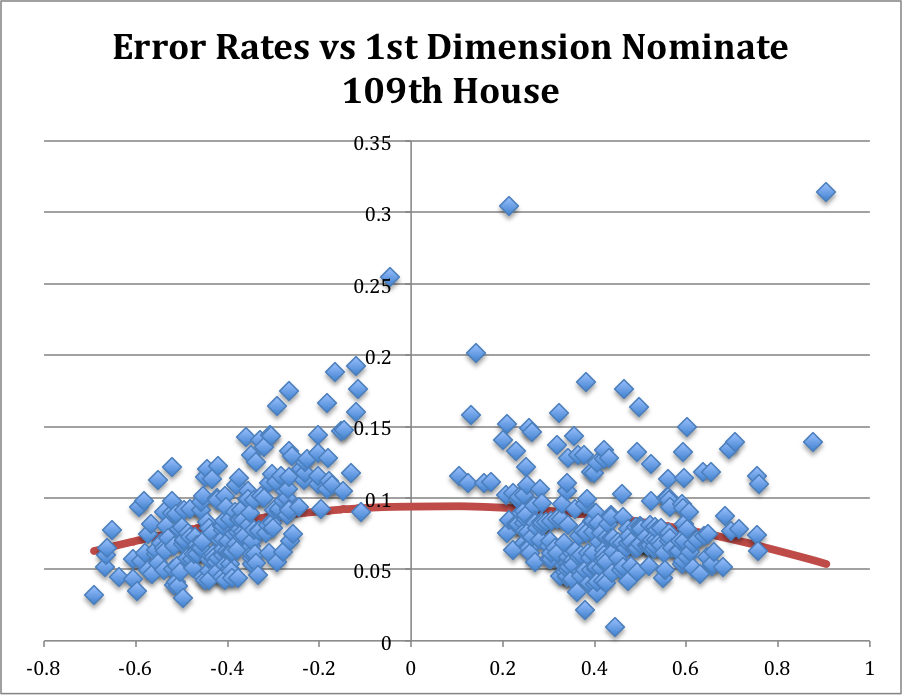
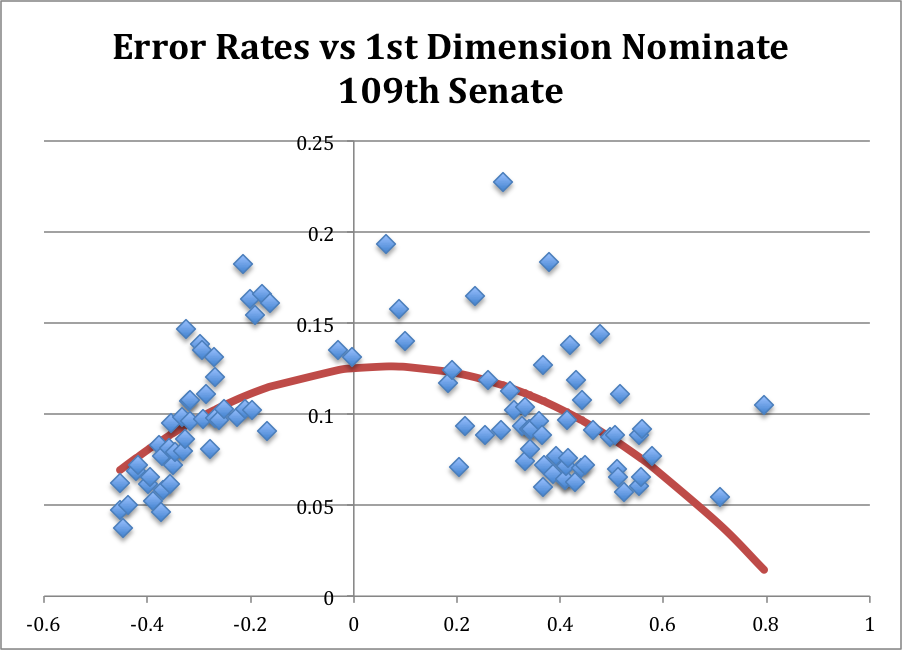
In any event, the figures below illustrate the House and Senate for a “typical” recent Congress, the 109th Congress (2005-6). In the 109th both chambers of Congress were controlled by the Republican Party, following the reelection of George W. Bush. In both figures, the horizontal axis is the estimated ideology so dots on the left represent liberals and dots on the right represent conservative), and the vertical axis is the proportion of votes cast by that member that were mispredicted by his or her estimated ideology. Each figure includes an estimated quadratic equation for “expected error rate.”[1]
 

109th-House 109th-Senate

In both figures, with one notable exception in the 109th House (Ron Paul (R, TX), Senator Rand Paul’s father), bear out the general tendency for moderates to have higher error rates than “strong” liberals and conservatives. [2]

What About Today? Let’s turn to the 114th Congress (through March 2016). Looking first at the House, the pattern from the 109th is still present.[3] Moderates are characterized by higher error rates than strong liberals or conservatives.
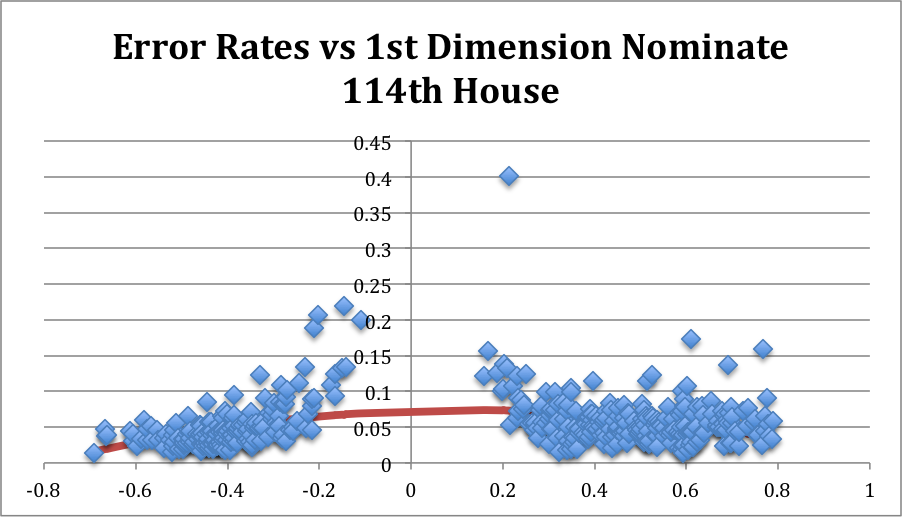
114th-HouseIn the 114th Senate (through March 2016), however, the picture is qualitatively and statistically different:
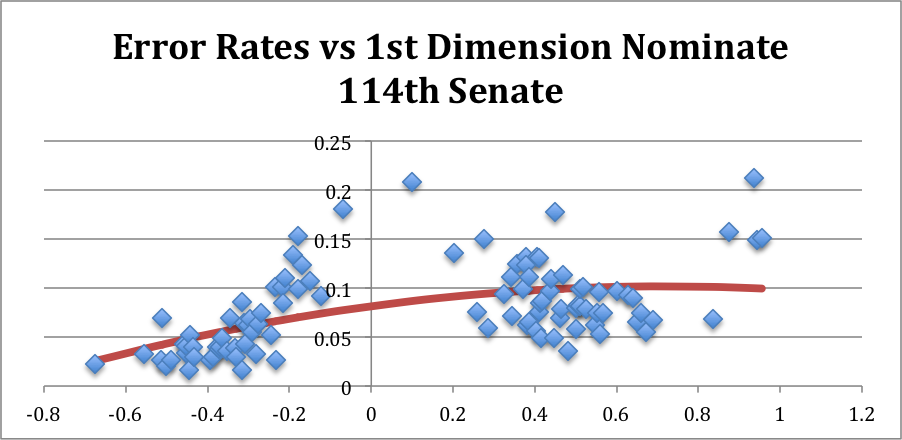
114th-SenateIn particular, the Republican party has generally higher error rates than does the Democratic party.[5] This indicates that Republican Senators have been more likely to vote against their party than have been Democratic Senators or, more substantively, the internal ideological structure of the Republican party in the Senate has played a smaller role in determining how GOP Senators have voted in this Congress.

Who’s Being Unpredictable?

Consider the list of the 15 Senators with the highest error rates:

Name State Error Rate Party Conservative Rank
PAUL Kentucky 21.2% GOP 3rd
COLLINS Maine 20.8% GOP 54th
MANCHIN West Virginia 18.1% Dem 55th
HELLER Nevada 17.7% GOP 29th
FLAKE Arizona 15.7% GOP 4th
KING Maine 15.3% Independent 60th
CRUZ Texas 15.1% GOP 1st
KIRK Illinois 15.0% GOP 51st
LEE Utah 14.9% GOP 2nd
MURKOWSKI Alaska 13.6% GOP 53rd
NELSON Florida 13.4% Dem 61st
PORTMAN Ohio 13.2% GOP 44th
MORAN Kansas 13.1% GOP 38th
MCCONNELL Kentucky 13.0% GOP 37th
AYOTTE New Hampshire 12.4% GOP 46th
HEITKAMP North Dakota 12.4% Dem 58th
MCCAIN Arizona 12.4% GOP 43rd
GARDNER Colorado 11.3% GOP 26th
GRASSLEY Iowa 11.1% GOP 48th
CORKER Tennessee 11.1% GOP 41st

Tellingly, the four most conservative Senators have incredibly high error rates (and two of these (Paul and Cruz) made serious runs for the GOP presidential nomination). The rest of the list is dominated by Republicans. The four non-GOP Senators are in fairly conservative states (with Maine being an unusual case).[6]

Hindsight and looking back… I don’t have time to get into the weeds even more with this at this moment. For now, I just wanted to point out that voting in the current Senate is unusual: Republicans are breaking with their party more often than are Democrats, and a handful of “extreme” conservatives are breaking with the party at incredibly (indeed, historically) high rates. To quickly see the recent past, consider the 113th Congress:
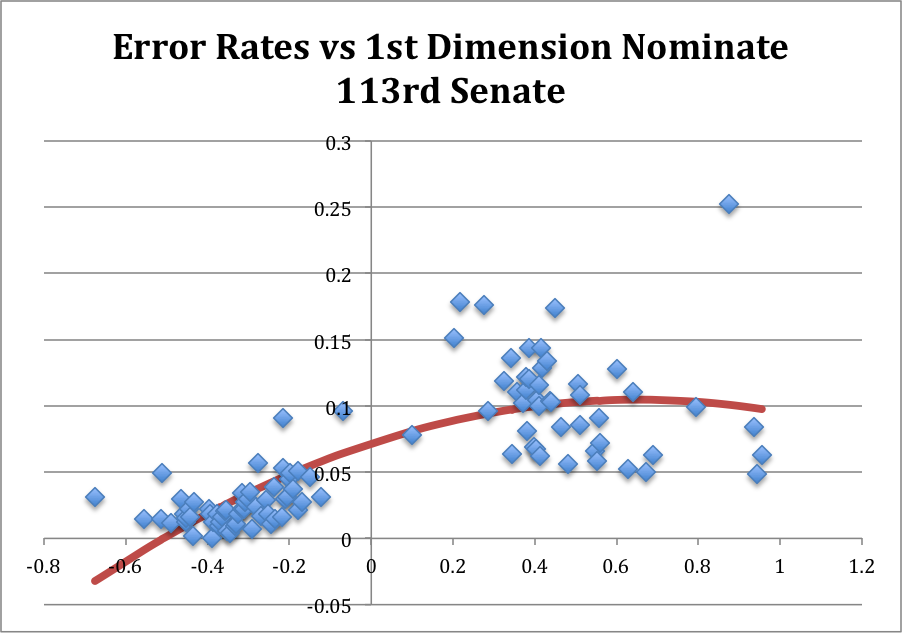
113th-Senate

In the last Congress, Republicans were already breaking with their party at qualitatively higher rates than were their Democratic counterparts, but there was no real analogue to the cluster of 4 extremely conservative Senators who have been mispredicted so strongly in the 114th Congress. One of those 4—Senator Flake (R, AZ) was a newly-arrived freshman Senator in the 113th Congress and has continued to be difficult to predict in his second Congress.

What does it mean? 

In line with both Keith Poole’s conclusion that the GOP shows significant signs of breaking up and the recent revolt among the GOP members in the House (where agenda setting is much more tightly centralized), I think what is happening is that (some of) the “estimated as conservative” wing of the GOP in the Senate is increasingly breaking party lines in pursuit of issues that are not being addressed by the chamber. Qualitative examples of such behavior are seen in the recurrent obstructionism among the “Tea Party wing” of the Republican party. (For example, see my theoretical work on this type of behavior and its electoral origins.) This rhetoric has also flared in the race for (both parties’) presidential nominations.

In line with this, of course, is the fact that the GOP has a disproportionately large number of Senators up for reelection in 2016. I haven’t had time to go through and compare the list of highly mispredicted Senators (please feel free to do so and email me about it!), but my hunch is that a bunch of “in-cycle” Senators are on that list.

For now, though, I leave you with this and this.

________________


[1] The quadratic term is significant (and obviously negative) in both chambers, as typical.

[2] The other Members with similarly high error rates in the House are Gene Taylor (D, MS), who would go on to be defeated 4 years later in the 2010 election, and Walter Jones (R, NC), who will show up again below: both were considered “mavericks” and were, as a result, estimated as being relatively moderate in ideological terms. In the Senate, the three highest error rates were (in order) Senator Mike DeWine (R, OH), who would be defeated in the 2006 midterm election by Sherrod Brown, Senator Arlen Specter (R, PA), a moderate Republican, and Senator John McCain (R, AZ).

[3] The quadratic term for the estimation of the relationship between estimated ideal point and error rate is again significant and of course negative.

[4] The quadratic term in this case is still negative, but no longer statistically significant. The linear term is positive, of course, and statistically significant.

[5] As is common in recent Congresses, there is no overlap between the parties’ ideological estimates so far this Congress: Senator Joe Manchin (D, WV) is the most conservative Democratic Senator, and Senator Susan Collins (R, ME) is the most liberal Republican Senator, but Senator Collins is estimated as being more conservative than Senator Manchin.

[6] Mitch McConnell is on this list for procedural reasons: he frequently votes “with” the Democrats on cloture motions when it is clear that cloture will fail, so as to reserve the right to motion to reconsider the vote in the future.


 

Cotton Pickin’?

[This is the first ever guest post on Math Of Politics. If you’re interested in posting on Math Of Politics, drop me an email.]

By Scott Ainsworth.

To understand the Cotton letter, we need to think about the operation of treaties. Treaties are like contracts, designed to solidify current behaviors or constrain future behaviors for some period of time. Treaties fail when the prescribed behaviors are no longer individually rational for at least one of the parties to maintain. Failures can occur almost instantly – consider some of the recent treaties regarding Ukraine. Alternatively, treaties can teeter on the verge of failure (or success) for quite some time.[1] Of course, individual rationality is best understood in the eyes of the beholders, and holders of political office come and go (as Cotton reminded everyone). Is political succession problematic for treaties? Elections are known, but who will win the next presidential election is unknown. In the words of a former defense secretary, these are known unknowns. But there are also unknown unknowns. What the hell is happening in this world? Summing up, some exogenous shocks are more exogenous than others. Treaties are not automatically vulnerable (or invulnerable) to exogenous shocks, but it is easier to brace for the known unknowns than the unknown unknowns.

So, why did Cotton remind the Iranian leaders that the U.S. has regular elections and that treaties can fail?

Ostensibly, Cotton was worried about the sort of treaty being negotiated. To what type of treaty will leaders submit? A desperate leader might agree to a treaty with very little lasting power. Consider 24 or 48-hour ceasefires. Does the success or failure of Obama’s last two years depend on securing any sort of agreement with Iran? I think it’s reasonable to suggest that Obama secures few immediate brownie points for his negotiations with Iran, so the possibility of long-term gains likely play the dominant role. But if Obama is not focused on short-term political gains, he needs a treaty with some lasting power.[2]

Of course, a treaty with lasting power must be somewhat invulnerable to regular electoral shocks – our known unknowns. To think that Obama would agree to a treaty that will be undone as soon as he leaves office is to suggest that Obama has only short-term gains in mind. Long-term gains would be impossible because political succession would ensure the renegotiation and demise of Obama’s treaty. Unless presidents cannot imagine the world after they leave office, some subgame calculations seem warranted. My guess is that the president and the Iranian leaders were both comfortable assessing the implications of elections and other known unknowns.

So, why did Cotton write the letter? I can see two possibilities.

Possibility 1. Cotton et al. truly do presume that the Iranian leaders are unaware of the role of executive agreements in U.S. international affairs. This is possible, but unlikely. Newcomers to chess might like to think “he won’t see this,” but chess is a game of complete information. Everything is upright, literally above board. Similarly, executive agreements do not hide in the nether reaches of constitutional authority.

Possibility 2. Cotton et al. do believe that Iranian leaders are aware of the role of executive agreements. Cotton simply wants to emphasize that any agreement would be tied to a particular Democratic president and not a succeeding president. This could make sense if Cotton were to believe that the negotiators are not employing subgame perfection. Suppose Cotton does manage to convince the Iranian leadership that the agreement is designed for failure. If Cotton were convincing, the Iranians could heavily discount long-term costs and implications.[3] Reluctant or hardline Iranians might be more willing to accede to a treaty that is projected by the political cognoscente to collapse in two years. Agreeing to a ten-year treaty is trickier. Thanks, Senator Cotton.

In the end, perhaps Cotton et al. did not use any subgame thinking of their own. That is, the authors of this infamous letter are complaining about a path of the game tree, but they are unaware that the offending path is well removed from the equilibrium path.[4] It is reasonable to consider and debate possible equilibrium paths. Different equilibria typically treat parties very differently. Not all equilibria are worthy of our support. But to debate something off the equilibrium path seems to be a waste of everyone’s time – unless it is meant for crass political consumption. That the Iranian leadership failed to bite is telling. That 47 senators are still running a “Nobama” campaign is also telling. That a newly minted senator can secure 46 Republican signatures for a letter of questionable value bodes ill for the Grand Ol’ Party. There are few gains from debating the merits of non-equilibrium paths.

With that, I leave you with this.

_______________________

Scott Ainsworth is Professor of Political Science at The School of Public and International Affairs at The University of Georgia

[1] By some measures, negotiations with Iran have been ongoing for over a decade.

[2] The Iranians, who have their own concerns about political succession, are also likely focusing on long-term gains.

[3] As an analogy, consider a bank note. Suppose a large 30-year bank loan is problematic for a borrower. If mysteriously the bank were to dissolve with 50% likelihood after two years, the borrower’s long-term situation is less problematic. If mysteriously the bank itself were to dissolve entirely, the borrower’s situation is not problematic at all.

[4] This is not the time to consider trembling hand perfection or other equilibrium refinements that might allow one to imagine being off the equilibrium path.

Ceiling the Deal: Quid Pro Keystone

The debt ceiling drama is inexorably drawing to its next installment, and the question remains: when and, more importantly, how will a deal get done?  To keep matters simple, President Obama and Congressional Democrats have stood by the long-standing pledge to not negotiate on the debt ceiling, but some Congressional Republicans have been pushing for concessions in return for a debt ceiling increase—in particular, approval of the Keystone XL pipeline.

The State Department released its final report on the environmental impact of the proposed Keystone XL pipeline (fact sheet here) last week.  In a nutshell, the report is a “win” for pipeline supporters.  The idea of a “Keystone approval in return for debt ceiling increase” deal is not new, of course.  What I want to discuss briefly is the procedural details of the deal and their strategic (electoral) implications.

A key question in this game is whether Congress explicitly attaches Keystone XL approval to the debt ceiling increase or not.  Congress could pass a combined bill, or perhaps an implicit deal will be struck: President Obama approves Keystone XL and Congressional Republicans approve a “clean” debt ceiling increase, without (too loudly) claiming a quid pro quo.

I have reason to suspect that President Obama is trying to set up exactly such a deal: he said in June that the criterion for approving the pipeline is that is “not significantly exacerbate the problem of carbon pollution.”  The State Department report provides an argument that it won’t.  Furthermore, President Obama said that “the net effects of the pipeline’s impact on our climate will be absolutely critical to determining whether this project is allowed to go forward.

However, White House press secretary Jay Carney said today that Obama’s decision on the pipeline would be free from “ideological or political influence.” And the current spin regarding Secretary of State Kerry is that (1) Obama has asked him for a recommendation on the project and (2) that Kerry may be conflicted regarding his principles and partisan motivations.

The strategic question here for my purposes today is

Does Obama value “not bargaining” over the debt ceiling—a signaling of resolve, etc. that I have touched upon in various other posts (such as here)—more than the potential gain from allowing moderate Democratic Senators to vote for a bill (perhaps with a debt ceiling increase too) mandating approval of the project? [1] [2]

With respect to the first point, I think all three sides (Democrats, Republicans, and Canadians) are playing a bit of a game of chicken: nobody wants to be seen as “giving in” if they don’t have to.  I won’t work this through in detail, but the basics of “chicken” as pretty simple: each player would prefer to look tough (not give in) and have one or both of the others give in.[3]  At the same time, each player would prefer to give in if they knew that neither of the others were going to give in.  The best case scenario in this situation, it seems, is the “win-win” scenario of (1) Obama looking “presidential” and “job-creating” by solemnly approving the Keystone project at the same time as (2) Congress passing a “dirty” debt ceiling increase that mandates approval of the pipeline.

The devil, of course, is in the details: the timing has to be managed appropriately so that neither side is “clearly” trying to save face.  I think this can be accomplished by having the Senate vote for a Keystone approval and clean debt ceiling increase separately, then have the House vote under a special rule to approve both and send them to the President, during which time the President would unilaterally approve the pipeline, so that he could explain that he was essentially signing a clean debt ceiling increase.

Will it work out this way?  Oh, I’m sure it will be different.  But with the benefit of being “up close” in temporal terms, I would be somewhat surprised if we don’t see action on both the debt ceiling and the Keystone project in the next week.

With that, I leave you with this.

_____________

[1] In 2012, a majority of the Senate voted in favor of such an approval, though it failed to get the 60 votes required to move forward.

[2] I thought about discussing why Obama might want a visible and positive Kerry recommendation, versus why he might want a negative and visible one.  The basics of one such argument are provided by my colleague Randy Calvert’s seminal article from 1985, entitled “The Value of Biased Information.”  I’ll come back to this argument at another time, I’m sure.  (And, to be honest, I have already stood on Randy’s shoulders elsewhere.)

[3] Usually, “Chicken” is described as a two-player game.  With more than 2 players, it becomes clear that Chicken is really just “private provision of a public good,” or the “who takes the trash out game.”  This is not the same as the Who Let The Dogs Out? game, which has no pure strategy equilibria (Baha Men (2000)).

Going Down in Flames…To Rise Like A Phoenix (in the Primary)

So, the Federal Government is once again approaching the debt ceiling.  Senate Minority Leader Mitch McConnell has said that he thinks that

“…for the president to ask for a clean debt ceiling, when we have a debt the size of our economy is irresponsible. So, we ought to discuss adding something to his request to raise the debt ceiling that does something about the debt or produces at least something positive for our country…”

What McConnell and his colleagues will discuss adding is a bit unclear at this point (though approval of the Keystone pipeline might be part of it), but Democrats are repeating President Obama’s earlier stance that there will be no negotiations based on the debt limit.

This seems like a stand-off in the making…or does it?

Setting aside the popular conception (with which I concur) that Congressional Republicans “lost” the previous fight on the debt ceiling, McConnell followed the above quote with the following statement:

“We’re never gonna default. The Speaker and I made that clear,”

Um, maybe this isn’t a stand-off in the making.  Maybe a “stand up, just to sit down?”  That’s not catchy, but it brings us to my point in this post.

I could argue that McConnell is pursuing a strategy of either looking “crazy” or trying to imply that he is “hemmed in” by his colleagues, as I have argued before regarding Boehner and his factious caucus.   But, I don’t think this is that.  Rather, McConnell’s unusual comments might be best understood as an attempt to send a costly signal to his constituents, as he is facing and already fighting a right-wing primary challenge by Matt Bevin.  I’ll quickly detail this argument.

Let’s suppose that McConnell is facing a primary challenge because some believe his conservative bona fides are lacking.  McConnell can scream as loud as he wants that he is as conservative, but Glenn Beck doesn’t think he’s good enough.

How can McConnell convince voters that he is a true conservative? Well, he can’t just say it—the voters he wants to convince with such a statement will understand that this is cheap talk.  He has to make the statement that he is “one of them” costly—it has to “pin him down” in some way.  This is tough to do with policy, given that he is the minority leader and his party does not control the White House.

So, my argument goes, he can publicly stonewall what is (hopefully) in the end a fait accompli—the debt ceiling increase—and take his lumps along the way.  This type of position will work only if it hurts McConnell in some verifiable way.  My too-clever-by-half argument is that he is setting exactly such a situation up for the voters who care to see that, at the least, he is willing to bleed for them.

His two statements above make it clear that (1) he is simply being difficult, and (2) he is willing to acknowledge that he will lose unless Obama is willing for some reason to compromise.  (Not saying Obama won’t—he might—but McConnell probably doesn’t know that Obama will.)

Arguably, by saying that he is going to try to drive a hard bargain on the debt ceiling while at the same time admitting he’ll ultimately support a clean debt ceiling increase,  McConnell has adopted a position of “I’m so conservative, I’m willing to fight A KNOWINGLY UNWINNABLE FIGHT FOR CONSERVATIVE `PRINCIPLES.'”[1]

To revisit the argument again before concluding, my point here is that McConnell was probably not speaking off-the-cuff: he is no idiot, and I believe he realizes that his position is internally inconsistent.  Most voters won’t care, but those who pay attention might, and the distinction between his statements and simply saying “awww, heck no—we aren’t going to give a clean debt ceiling increase” is that he purposely made clear that not only was he against default—he and Speaker Boehner have “made it clear” that “we’re never gonna default.”  That is, he explicitly pointed out that the GOP is very unlikely to get anything from this—and yet he’s willing to lose trying.

Because that’s just how flamboyantly conservative he is.

With that, I leave you with this.

___________________

[1] I apologize if my distaste for this narrative offends you, dear reader, but I will not accept that even flirting with violating the full faith and credit of the Federal Government is consistent with any reasonable rendition of conservative principles.  Trust, reliability, sanctity of contract—hell, even the facile analogy between running the government and the responsible financial management of a family or small business—-all run squarely against using the debt ceiling as a bargaining chip. Full stop.  That said, as a political scientist, I do not think McConnell is playing dirty—procedural stopgaps are rightly the fitting and necessary last bastion of the minority party.  (See what I did there?  I can link filibusters and debt ceilings, because that’s the way I’m wired: namely, short-circuited.)

No, Seriously, That Was Such A Bad Idea, WE MUST DO IT AGAIN

Another quote in this (still) excellent piece in the New York Times by Jeremy W. Peters, describing the resolution to the debt ceiling and funding showdown, stuck out at me:

The question so crucial to the Republican Party’s viability now, heading into the 2014 Congressional elections and beyond, is whether it has been so stung by the fallout that the conservatives who insisted on leading this fight will shy away in the months ahead when the government runs out of money and exhausts its borrowing authority yet again.

A key point in the compromise reached to resolve the current crisis regards the timing of the “two crises.”  The government is funded through January 15th, 2014, and the debt ceiling is extended through February 7th, 2014. Note that this compromise does two related things on this dimension:

  1. It does not put the “funding crises” on the same day, and
  2. It puts the less important one (federal government appropriations) first.

Peters appropriately asks whether the “next round” of this dynamic will be occasioned by different behavior by (say) the House Republicans.  But I want to focus on a logically prior question:

Why didn’t Congress pass something that delayed both of these past the 2014 elections?  That is, why did they simply kick the can a short way down the road?

On this question, my main argument/explanation for the delay/obstruction over the 16 days of the shutdown was one of signaling: members of the GOP (and arguably some Democrats) had an incentive to demonstrate their ideological commitments through costly (in)action.  The debt ceiling/default deadline represented arguably a Rubicon of sorts, one that allowed all members—or, at least, Boehner & Cantor—break the impasse by allowing a floor vote.  This is because the (perceived) true costs of obstructing any longer were sufficiently large that they even “true conservatives” would rather get kicked out of office than pay them, and accordingly, many stripes of conservatives (some more faithful, some less) could and would “pool” at this point and vote to end the impasse.  (This explains/is consistent with the push by some to claim that default was either not going to happen on October 17th or, even more amusingly, that default is not that big of a deal.)

To the degree that this signaling argument holds water, it also predicts that the last-minute resolution would involve just a small “kick of the can down the road,” as happened.  That is, to the degree that “the fight” was potentially a useful signal of legislators’ true ideological stances, “signing up for another one” must also be a useful signal.  This would change only if some other event intervenes to explain why ideologically pure individuals would shy away from the fight, allowing heterogeneous members to once again “pool” on agreeing to resolve the fight “permanently.”[1]

The delicious irony here is that the incentive to fight over fiscal responsibility, the latest round of which appears to have been a public approval loss for the GOP, is arguably part of the cause of the fiscal responsibility problem (at least with respect to debt ceiling and shutdown inefficiencies) itself.  This is in line with the frequently noted historical frequency with which, in spite of the fact that Congress can at any time stop having to take such “tough votes,” the debt ceiling has been increased over 90 times since World War II: these votes provide opportunities for members of various factions to attempt to “signal their true colors” by standing fast for a little while in the face of a “must pass vote.”

There’s more here, but it’s Friday.  So, I’ll signal my true type by grabbing a beer and leaving you with this.

_______________

[1] I will leave aside for now the issue of plausible such events: one example, of course, would be a “grand bargain” that (say) cuts/controls entitlement spending in the future.

Dis-Spence-ing with the Debt Debacle

There is an excellent piece in the New York Times by Jeremy W. Peters describing the outcome of last night’s (temporary) resolution to the debt ceiling and funding showdown. A quote stuck out at me:

Others could not explain why it took so much damage, to their party and the millions of people inconvenienced and worse by the shutdown, to end up right where so many of them expected.

Well, there is a simple MathOfPolitics explanation for this.  In a nutshell, it’s called a “pooling equilibrium” in game theory.  The classic example of this behavior is the “job market signaling model,” due to 2001 Nobel Laureate Michael Spence. The basic idea is that there are two types of workers/applicants: “low” type and “high” type, and employers would prefer to hire high type workers.  The type of a worker, however, is asymmetrically known: the worker knows his or her type, and the potential employer does not.  Rather, the employer can observe whether the applicant (say) went to college, and — here’s “the rabbit” — high types find college more enjoyable/less costly than low types.[1]  Employers see an applicant’s education (college or no college) and hire based on that information alone.  In the model, and this is key for the analogy, education is in and of itself inefficient—it does not make a worker better.  Rather, it is obtained in equilibrium only to the degree that it helps the worker in question procure employment.[2]

In every equilibrium of such a situation, the low type of worker does not obtain a degree unless the high type obtains one, too.  This leads, when the value of employment is sufficiently high, to both types of workers getting a degree, and thus the degree is observationally unimportant: some people with degrees get jobs, some don’t—degrees seem (observationally) to be unimportant.[3]

In other words, at the “beginning of the game” in such situations, everybody knows that getting a degree is “pointless,” and yet everybody knows that everybody will get it. In the end, applicants are hired with the same probability that they would have been if the option to get a degree were prohibited/taken off the table, and yet every applicant pays a positive cost to get the degree nonetheless.  Rephrasing:

The model explains why workers will get degrees to “get a job,” only to end up right where they started.

Here, the analogy is that “the Republicans” (it’s easy language, but see here) were trying to signal their “ideological purity/conservatism/belief in small government/hatred for the Affordable Care Act.”  In the end, the stakes for signaling this—say, successful circumvention of a primary challenge from a right-wing candidate—were perceived to be so large, relative to the costs of temporary shutdown and some briefly rattled markets that all (House) Republicans, regardless of their true beliefs/purity, were willing to go along with the gambit.  Note that this story is in line with the party line vote behind such procedural undergirdings of unity as discussed in this post, and, more math/less politics, is based on the counterfactual reasoning that drives signaling models discussed in this post.

So, to summarize: a simple signaling model not only explains what happened over the past 17+ days, it also offers an explanation for why what happened was foreseeable.  Thus, rephrasing one more time:

Game theory already explained and arguably predicted that it would take so much damage … to end up right where so many of them expected.

With that, I leave you with this.

__________

[1] When I say “the rabbit,” I mean (in layman’s terms) the causal mechanism: the thing that makes the model work, that explains the phenomenon that the model is aimed at, that makes the audience ultimately say “ahhhh!”

[2] And, no, I won’t admit that this is essentially a model of getting a PhD in the social sciences.  BECAUSE I (RE)LEARNED ABOUT POOLING EQUILIBRIA GETTING MY PhD.

[3] In a nontrivial set of cases (when employment is less valuable relative than the low type of worker’s net marginal cost of obtaining a degree relative to that experienced by the high type of worker), degrees are obtained only by high types, all applicants with degrees—and only those applicants—are employed, and degrees “look” valuable, even though they generate no inherent value on their own.  This is the first of many (empirically) important conclusions obtained by this deceptively simple model.

Boehner in a Manger? The Entitativity Scene in DC

The SHUTDOWN-CEILING SHOWDOWN has been depicted, typically, as “the Republicans versus [Democrats/Obama].”  The simple story here is that many people think of “the Republicans” as a unified whole, a group qua “unitary actor,” a collection of individuals who are acting as one.[1]  My recent posts (e.g. this, this, and this) and my recent blustering on the wireless have attempted to make clear that this understanding of the negotiations/stalemate obfuscate attempts to understand how the drama is playing out and the true causes of the “governing from-crisis-to-crisis” dynamic in DC.

The popular/informal understanding of the Republicans is an example of what is known as entitativity, which describes the perception of a group as an entity, generalized from its individual members.  My recent posts have pointed out that Boehner and the other leaders have multiple factions to worry about, and I argue that the varying incentives of the members of these various factions provide a key starting point in understanding the apparent irrationality of this bargaining process.

A very nice example of the language/framework I am discussing here is provided by this nice piece by Jonathan Chait, “Stop Fretting: The Debt-Ceiling Crisis Is Over!” who writes:

Of the Republican Party’s mistakes, the most rational was its assumption that Democrats would ultimately bend. … Democrats would have to pay a ransom. Republicans spent weeks prodding for every weakness.

Democrats seemed to share a genuine moral revulsion at the tactics and audacity of a party that had lost a presidential election by 5 million votes, lost another chance to win a favorable Senate map, and lost the national House vote demanding the winning party give them its way without compromise.

Probably the single biggest Republican mistake was in failing to understand the way its behavior would create unity in the opposing party. 

The MathOfPolitics of entitativity is interesting.  Defining the notion in 1958,[2] Donald T. Campbell described three important characteristics that supported entitativity in the sense of leading observers to think of a group as an entity:[3]

  1. Common fate, or the degree to which the members experience common outcomes,
  2. Similarity of members’ behaviors and/or appearances, and
  3. Proximity, or the positive correlation of perception: when you see/”think of” one member, you tend to see/”think of” other members as well.

The three dimensions of entitativity are really interesting to think about in the context of Congressional bargaining because each of these dimensions is politically relevant on its own.  Common fate, for example, is highly relevant for the two parties in DC.  The candidates of a given party clearly face a common challenge (winning the most votes in their districts on the first Tuesday after the first Monday in November), and they tend to face common hurdles.  Parties are “brand names,” and many political scientists believe that many voters punish and/or reward candidates based on their partisan affiliation, above and beyond the platforms and records of the candidates themselves.  Furthermore, when it comes to being in the majority or minority following (say) the 2014 election, House Republicans obviously have a common fate.

Similarity is clearly relevant in terms of individuals’ perceptions of the parties.  For example, the GOP is worried that it is seen as the party of stuffy old white men. At the same time, the reality of common fate discussed above provides an incentive for displaying unity, something that Boehner has repeatedly been faced with (last week and back in 2011), though it is arguably collapsing today.  The Democrats have been pursuing a similar strategy.  What is important to note in each of these cases is the public argument/assertion that “the party” should be unified.  The appeals in these cases are coming from party leaders, on partisan/policy grounds.  That is, these are not appeals along the lines of “look, we all have the same interests and just happen to share a label.”  These are “we share a label because and/or therefore we share the same interests.”

Finally, proximity is an interesting consideration in light of some second-order differences between the members themselves.  For example, the Tea Party is recognized as a faction within the GOP more than, say, Log Cabin Republicans because members of the tea party are “seen together” more frequently.  For example, the Tea Party has a caucus in the House.  Similarly, some members such as Senators Ted Cruz, John McCain, and Rand Paul, and Representative Michele Bachmann are portrayed (and often promote themselves) as different than the “typical” Republican, and their actions and statements are often differentiated from those of “the Republicans.”

The notion of entitativity is interesting at times like these precisely because the relationship between its origins and effects illustrate how the costs and benefits of partisan “unity” are—at least relative to times of normal governing/bargaining–altered/reversed in times of crisis bargaining, as is going on in DC now.  More specifically, it demonstrates an alternate understanding of the “Hastert rule” and other related procedures used by both parties to attempt to promote internal unity/consensus on external decision-making.  When dealing with a normal bargaining situation—one in which members are not (or do not expected to be) under particularly fine-grained scrutiny by their constituents—copartisans with at least partially common (policy and electoral) fates have an incentive to bind themselves together.  However, when the matter at hand is high profile, the partial nature of the common fate undergirding “the party” is revealed: as constituents watch their members’ votes more closely, the differences between the districts represented by—and hence electoral fates/fortunes of—the party’s members come into starker relief.  Similarly, as the policy stakes of the vote “get larger,” the usually minor differences between the party’s members “policy fates” (policy goals, personal ideologies) loom larger.[3]

The problem, then, is how to balance the value of unity during “normal times”—unity that is truly useful only to the degree that it is perceived/believed by others and accordingly is less valuable if it cracks when “everybody is watching”—and the need for flexibility when governing requires simply “getting the job done.”  If we could all credibly commit, for today at least, to “not paying attention to which party a member is in,” I strongly suspect the current crisis would end within the hour.[4]  In a sense, we have to take entitativity out of the scene for a second to get to the next act.

With that, I leave you with this.

___________________

[1] I talk about the GOP here, but the basics apply to discussions of “the Democrats,” too.

[2] See Campbell, D. T. (1958). “Common fate, similarity, and other indices of the status of aggregates of person as social entities.” Behavioural Science, 3, 14–25.

[3] Remember Blue Dog Democrats and Senator Nelson’s “Cornhusker Kickback?” Both parties have unity issues when the stakes get big and the votes get visible.

[4] Similarly, we could agree to not record the votes.  I’ve said before, if we could somehow get a debt ceilingincrease/CR approved with a voice vote, this would be over already.  And, of course, the House used to do something like this all the time, with “the Gephardt Rule.”  The GOP got rid of this in 1995.  But, as Sarah Binder notes, note that this particular rule would not save us much pain right now.

My Bad: Dispelling The Implied Suspension of Discharge

The Daily Kos has a piece authored by “War on Error” that linked to my piece today on H.Res. 368. I want to correct a misinterpretation in that piece.  The author states that

Chris Van Hollen, a Democrat, tried to end the Government Shutdown with a Discharge Petition on October 12, 2013

This isn’t correct.  Van Hollen was attempting to offer a motion to “recede and concur,” which is typically privileged (and thus in order at any time when offered by any member) under Rule XXII, Section 4 of the House’s standing rules. This isn’t a motion to discharge in any sense, actually, as the bill in question (H.J.Res.59, which, as amended by the Senate, is the “clean CR”) isn’t in committee.  Rather, it is “in the state of disagreement”—or, less technically, “in limbo”—as the House and Senate have each passed different versions of the bill, and the House has insisted on its version and requested a conference with the Senate.

I understand the potential for confusion in my post, because I wrote “What this [special rule] does is further make discharge of a clean CR even harder.”  I was speaking/typing quickly and in reference to the general quest to get a floor vote on a clean CR.  I should have said

“What this [special rule] does is further make discharge of a clean CR even harder complicate the matter of getting a floor vote on a clean CR in the House.”

The privilege accorded to a motion to discharge a committee (i.e., to “put into play” a discharge petition duly signed by 218 members of the House) is contained in Rule XV, Section 2o f the House’s standing rules, and is accordingly unaffected by H.Res.368.  As I wrote earlier, the discharge petition is a highly unlikely route to reach a vote on a clean CR, and indeed would have had to be called up today or wait until October 28th.

Also, to be completely clear on this point, Van Hollen’s statement that “Democracy has been suspended” is hyperbole: H.Res.368 is a short and succinct special rule that was duly approved by a vote of 228-199.  Regardless of how one feels about the use of special rules in the House, it is (one of many forms of) democratic governance, and is (at least in my and many others’ opinions) clearly consistent with Article I, Section 5, Clause 2 of the US Constitution, which says (in part)

Each House may determine the Rules of its Proceedings

With that, I leave you with this.

LegerdeBoehner, or “The Rules Rule.”


In a little noticed procedural move on October 1st, the House of Representatives “entered in to the stage of disagreement” with the Senate with respect to H.J.Res. 59, the “clean” continuing resolution (CR) that, as currently amended by the Senate, would reopen the government at the sequestered levels.[1]

Specifically, H.Res. 368 does two things.  The first is a tripartite bit of normal business in the “navette” system used by Congress to resolve differences between the two chambers’ versions of a bill,[2] stating that the House

      “(1) takes from the Speaker’s table the joint resolution … (2) insists on its amendment, and (3) requests a conference with the Senate thereon.”

What this means, in short, is that the House collectively asserts that it is “done considering” the Senate’s version of the CR, and requests that the two have a “sit down” to work out the details of a compromise.  This is pretty normal.

The “trickery,” which I absolutely love, is the second part, which states

      Any motion pursuant to clause 4 of rule XXII relating to House Joint Resolution 59 may be offered only by the Majority Leader or his designee.

What this little sentence does is further make discharge of a clean CR even harder.  I didn’t think about this charmingly arcane and surprisingly potent possibility when I wrote on discharge as a strategy to get a clean CR last week. (I haven’t seen anyone bring it up until this weekend, when the Democrats hit upon it.)  Under the standing rules of the House,

When the stage of disagreement has been reached on a bill or resolution with House or Senate amendments, a motion to dispose of any amendment shall be privileged.

What this means is that, conditional on the first part of H.Res. 368, under which H.J.Res. 59 reaches “the stage of disagreement,” any member of the House could at any time move that the House “recede and concur” with the Senate’s amendment, thereby approving the clean CR.

To be clear, this isn’t “undemocratic,” per se: H.Res. 368 was approved 228-199 (Roll Call 505)—an example of majority rule being used to make the rules arguably less “majoritarian.”[3]  Now let’s consider the MathOfPolitics of this move.

As I have argued before, in a variety of ways, the bargaining situation between the Democrats and Republicans in both chambers and President Obama is a decidedly “multi-player” situation and, importantly, one that the House GOP (and probably some of the House Democrats, too) would like to resolve in a nuanced manner.  In particular, voting “yea or nay” on the clean CR is a blunt and high-profile signal to members’ constituents about the members’ relative priorities.  To the degree that the House GOP leadership and/or rank-and-file wanted to negotiate something other than a clean CR (or even just wait for a combined “CR and debt ceiling deal,” this logic implies that they need to avoid the possibility of facing a “clean vote” on a clean CR.  To attempt to get a conference with the Senate,[4] the House had to enter into the stage of disagreement.  But this step also would hand a gun to the minority: they could at any time force exactly the vote the majority did not want.

So, putting the two components of the rule together—thereby meaning that the House could affirmatively “act upon the Senate’s CR” only by agreeing to hand this agenda power to Majority Leader Cantor—represents a classic example of a “credible logroll.” Note that the rule change limits the preexisting agenda powers of all members, not just those in the minority party. The Republican majority, in order to negotiate as a somewhat unified body, agreed to “bind their hands” from the potential temptation to “just agree to a clean CR.”

This type of procedural commitment strengthens the ability of Boehner and Cantor to “speak for” the House in the ensuing negotiations.  If the motion to recede and concur with the clean CR had been available to any member, as usual, then the Senate and/or President Obama could attempt to simply build a floor majority, without any special need to focus on/pay attention to the position of the House Leadership.  In a sense, the House signed away a limited, but durable, “power of attorney” to Boehner and Cantor on the CR negotiations.

With that, I leave you with this.

______________

[1] Remember, the sequester? HAHAHAHA.  Well, the Senate Democrats do.  Note the link between this position and my recent post on how appearing to lose may help one win.

[2] It’s tripartite because each of the three parts could in theory be debated and voted upon separately, but this is rarely if ever done in the House.  (They were accomplished here, as is pretty common, through a single vote on a “special rule” from the Rules Committee.) In the Senate, the analogue of this three-step process is one of the minority party’s secret weapons against the “nuclear options.”  But I will leave this to the side….for now?

[3] Hey, it’s my blog, so I’ll remind you that I’ve written and published (i.e., something more than a blog post) on this question.

[4] This might seem like a waste of time given hindsight, but I’ll simply point out that this step was necessary for the House to make it seem like the Senate was the roadblock to reopening the government (because the Senate did not agree to the conference).  Public opinion since October 1 seems to indicate this strategy failed to impress.

Boehner in the Middle?

White House Press Secretary Jay Carney just argued that, if the House Republicans won’t allow a default, why would they not give a longer extension of the debt ceiling, instead postponing another round of brinksmanship in 6 weeks, which—the argument goes—will merely lead to another extension, with arguably deleterious impact on the economy and financial markets.

I wanted to quickly point out that this appeal to subgame perfection—the game theoretic notion that equilibrium behavior should be based on credible threats—is intuitive, and arguably spot on…in a two player bargaining situation.  But, this is a bargaining game between (to simplify) Obama and the House Republican Conference.

Arguably, tea party members can’t—for signaling reasons similar to those described in this post—vote for along-term extension of the debt ceiling.  According to such an argument, this might be “the best that Boehner can get.”  However, there’s another story that is more interesting.  Suppose that Boehner and Obama each wish to achieve real reform, but both realize that any changes to the Affordable Care Act are a “no go.”  (That is, suppose they wish to reach “a grand bargain” on entitlements and taxes.)

Suppose they need time—like, more than 7 days—to work this out.  In order to get such a bargain approved without requiring Democratic support, Boehner has a problem without the debt ceiling as a “nuclear weapon in his back pocket.”  In particular, Boehner can use the very real (in legal terms) threat of default to bring his conference into the fold on a vote bundling the grand bargain with a debt ceiling extension.  Indeed, such a story would be a “win-win” for the GOP and Obama, who could presumably use the next couple of weeks to both take some credit for the bargaing and, arguably follow some strategy like the one I describe in this post.

The point is that the threat of breaching the debt ceiling can be useful to both Boehner and Obama in terms of keeping the rank-and-file in line on a substantive vote.  Finally, note that, to the degree that some reelection-minded members actually don’t want to default or keep the government shut down, they would also prefer a short-term extension in this case, so as to simultaneously provide electoral cover for real reform.

With that simultaneously hopeful and cynical note, I leave you with this.