Why the Thing That Might Take Your Job Is So Nice To You

Let me tell you something you already know: ChatGPT, Claude, Grok — whatever flavor you’ve adopted — is very, very nice to you. Suspiciously nice. “Your presentation looks great, here are a few minor suggestions” nice. “That’s a fascinating question” nice. “I can see why you’d approach it that way” nice.

You know this. You’ve probably even said something like: “yeah, well, Claude thinks everything I do is great — that’s what it’s programmed to tell me.” And then you went back to using it.

That’s the thing I want to understand.


There’s an old service industry observation that goes roughly like this: your barista is always happy to see you. That doesn’t mean your barista likes you. Warmth, in contexts where warmth is the job, carries very little information about underlying sentiment. We all know this, and we factor it in — and we still feel a little lift when the person at the counter remembers our name.

LLMs have the same structure, with the stakes raised considerably. The flattery is baked in. It’s not accidental, and it’s not a bug. It’s the direct output of a training process (RLHF, for the curious) that optimizes for user approval. The model learned, from millions of interactions, that validation generates positive feedback signals. So it validates. Knowing this doesn’t make the validation feel worse, and that tells you something important about what the validation is actually doing.

There’s a formal result lurking here, from the economic theory of communication. If a receiver knows a sender has a structural incentive to always say “good,” the equilibrium is that the signal carries zero information — not less information, zero. This isn’t folk wisdom about flattery. It’s a theorem. And yet the signal still moves us. That’s not a failure of rationality. That’s the puzzle the rest of this post is trying to solve.


Here’s the part where I’m supposed to say: these tools are amazing despite the flattery, and you should learn to discount the praise while keeping the utility. That’s the sensible take. I don’t think it’s the right one.

The flattery isn’t incidental to adoption. It’s load-bearing.

Think about who’s actually folding these tools into their daily workflow. In many cases: people who’ve read the Atlantic articles. People who’ve sat in the all-hands where someone mentioned “efficiency” a few too many times. People who are, at some non-trivial level of awareness, incorporating the possibility that a thing very much like what they’re currently using might eventually do a version of what they currently do.

Getting those people to enthusiastically adopt the technology is not a trivial problem. You can’t solve it by telling them the efficiency gains are real (true, but cold comfort). You solve it by making them feel, every single session, that the tool needs them — their judgment, their direction, their taste. The flattery makes you feel like a conductor rather than a soon-to-be-replaced instrument. That’s not an accident. That’s the mechanism.


There’s a formal literature on this, and I’ll spare you most of it. The economists Gary Becker and Kevin Murphy worked out the mathematics of rational addiction in 1988 — the perhaps unsettling result that you can be fully aware you’re forming a dependency and do it anyway, because the current-period benefits are real and the future costs are discounted. You don’t need false consciousness. You don’t need to be fooled. You just need present bias and a product that genuinely delivers.

My graduate school classmate Angela Hung was doing the neuroscience-facing version of this work at Caltech in the late 1990s — specifically, why adjacent complementarity (the more you use, the more you need) has structural roots, not just behavioral ones. Her framework survives the “but I’m being rational” defense, which is exactly what makes it useful here. You can watch the dependency forming in real time, understand the mechanism completely, and keep going — because the current-period gains are real and the baseline hasn’t shifted yet. Until it has.

There’s also a herding dimension worth naming. When individuals observe others adopting a behavior, they update toward adoption even when their private information suggests otherwise. The cascade dynamic of LLM adoption in professional settings is almost a clinical demonstration: you started using it partly because everyone around you was. The private doubts got swamped by the social signal. And once the cascade is underway, the switching costs compound quietly — the cost of removing a tool from your workflow isn’t just “find something else,” it’s rebuild your habits, your templates, your trained expectations about turnaround time. By the time you’d want to leave, leaving is its own kind of loss.

The first hit of crack is free. This reference is dark, and intentional. The crack economy of the 1980s taught us something that markets keep re-learning: the most dangerous products are the ones that actually work. The dependency doesn’t come from a con. It comes from genuine near-term value, accumulated until the baseline shifts and you can no longer locate where it used to be. The mechanism here is identical. The product is legal, the setting is an office, and the dealers have better PR.


Oh right. Politics.

Here’s a useful fact about addiction: the window for intervention is not uniformly distributed over time. It closes. The longer a dependency goes unaddressed — the more the baseline shifts, the more the infrastructure of daily life reorganizes around the substance — the harder treatment becomes and the higher the cost of quitting. Addiction specialists know this. So do, it turns out, the people currently making federal AI policy.

On December 11, 2025, President Trump signed an executive order with a name that deserves to be read slowly: Ensuring a National Policy Framework for Artificial Intelligence. Savor that. Not regulating AI. Not governing AI. Ensuring a framework. The language of infrastructure. The language of a thing that was always going to be there.

The mechanism is worth understanding because it is, in the dry vocabulary of federal policy, genuinely remarkable. The order establishes an AI Litigation Task Force to challenge state AI laws in court, and threatens states with the loss of federal funding if they persist in regulating too ambitiously. The threat alone does the work. You don’t have to sue everyone. You just have to make the cost of trying feel prohibitive.

Now: you have read this blog before. You know what we do here. So ask yourself — what is the structure of this situation, independent of its content?

States are the entities in our federal system most likely to move early on regulation, closest to the actual harms, and least captured by the industries they’re regulating. They are also, not coincidentally, the entities least able to absorb protracted federal litigation and the simultaneous loss of broadband infrastructure funding. Congress was asked to impose a ten-year moratorium on state AI laws earlier in 2025. It said no — nearly unanimously. So the administration did it anyway, by executive order, through agencies, with litigation threats as the enforcement mechanism.

This is not a new play. It is one of the oldest plays in the regulatory capture handbook — run the same move that worked for financial services, for environmental standards, for data privacy. Establish a “national framework” weak enough to be comfortable for the industry it nominally governs. Preempt the states that would impose stronger standards. Call it uniformity. Call it competitiveness. Call it, if you must, ensuring a framework.

Here is the part that connects to everything above: this is happening now, while the dependency is forming, because that is the only moment when it works. Five years from now, when LLMs are as embedded in professional life as email, when the switching costs are prohibitive and the adjacent complementarity is locked in, there will be nothing left to regulate. The question of whether these tools should be transparent about their outputs, accountable for their errors, or prohibited from certain high-stakes decisions will be purely academic — the infrastructure of daily working life will have organized itself around the answer that was chosen in December 2025 by executive order.

The first hit of crack is free. The dealer’s second move, it turns out, is to make sure nobody’s allowed to open a clinic nearby.


I want to be clear: I’m not predicting catastrophe. The efficiency gains are real. The ride is genuinely good. That’s the whole point. Becker and Murphy didn’t say rational addiction ends badly — they said you go in with open eyes and keep going anyway, because the present is real and the future is discounted. Whether that ends in Dr. Strangelove or just a very comfortable dependency is, at this point, largely up to people who are not you. With that, I leave you with this.

The IRS Is Here to Help. So Is ICE.

It’s been almost ten years since I’ve written here. The last time I posted, Donald Trump had just clinched the GOP nomination, his Banzhaf power index had hit 1.0, and I was calculating the proportion of his campaign contributions that were unitemized.1 That was June 2016. I stopped writing because the general election demanded a firehose of commentary I didn’t have the time or the stomach for, and the opportunity cost of blogging versus finishing actual research was getting untenable.

A lot has happened. Some of the people who used to read this blog — colleagues, friends, people I admired — aren’t here anymore. I won’t make a list, because that isn’t what this space is for, but I’ll say that their absence is felt, and that part of what brings me back is the sense that the kind of work this blog tries to do — taking the math seriously, taking the politics seriously, and refusing to pretend you can do one without the other — matters more now than it did when I left.

For those who are new: this is a blog about the math of politics, which is a thing that exists whether or not anyone writes about it. The tagline is three implies chaos, which is a reference to the fact that collective decision-making with three or more alternatives is, under very general conditions, a mess.2 I’m a political scientist at Emory. I use formal models — game theory, mechanism design, social choice — to study how institutions shape behavior. And I write here when something in the news is so perfectly illuminated by the theory that I can’t not.

Today a federal judge ruled that the IRS violated federal law approximately 42,695 times, and I have a model for that. Let’s go.


NA NA

Last April, Treasury Secretary Bessent and DHS Secretary Noem signed a memorandum of understanding allowing ICE to submit names and addresses to the IRS for cross-verification against tax records. ICE submitted 1.28 million names. The IRS returned roughly 47,000 matches. The acting IRS commissioner resigned over the agreement. And Judge Colleen Kollar-Kotelly, reviewing the IRS’s own chief risk officer’s declaration, found that in the vast majority of those 47,000 cases, ICE hadn’t even provided a valid address for the person it was looking for — as required by the Internal Revenue Code. The address fields contained entries like “Failed to Provide,” “Unknown Address,” or simply “NA NA.”3

NA NA.

That’s what ICE typed into the field that was supposed to ensure the government could only access tax records for individuals it had already specifically identified. And the IRS said: close enough.

Now, the obvious story here — the one you’ll get from the news — is about a legal violation and an institutional failure. And that story is correct. But there’s a deeper story, one that requires thinking about what classification systems do to the populations they classify. Because the address field in the §6103 request wasn’t just a data element. It was a constraint — a design specification that determined what kind of system the IRS-ICE pipeline would be. With the address requirement enforced, the system is a targeted lookup: you ask about a specific person you’ve already identified, and the IRS confirms or denies. With the address requirement collapsed — with “NA NA” treated as a valid input — the system becomes a dragnet. Same code, same database, same agencies. But a fundamentally different machine, operating under fundamentally different logic, with fundamentally different consequences for the people inside it.

I want to talk about those consequences. Specifically, I want to talk about what happens to the population being classified when the classifier changes.


Filing Taxes as a Strategic Choice

Here’s the setup. If you’ve read the work Maggie Penn and I have been doing on classification algorithms, this will look familiar.4

Undocumented immigrants in the United States pay taxes. They do this using Individual Taxpayer Identification Numbers (ITINs), which the IRS issues specifically to people who have tax obligations but aren’t eligible for Social Security numbers. Filing is not optional — the legal obligation exists regardless of immigration status. But the compliance rate — how many people actually file — has historically been sustained by a critical institutional feature: a firewall between tax data and immigration enforcement. Section 6103 of the Internal Revenue Code strictly prohibits the IRS from sharing taxpayer information with other agencies except under narrow, court-supervised conditions.

The firewall is what made tax filing a safe act. Filing carried a compliance benefit — potential refunds, building a record for future status adjustment, staying on the right side of the IRS — and essentially zero enforcement cost. The tax system observed you, but the immigration system couldn’t see what the tax system saw.5 To put it in terms we’ll use throughout: the classifier’s expected responsiveness was zero.6 When the classifier is null, people make their filing decision based solely on the intrinsic costs and benefits of compliance. Call that sincere behavior.

The MOU blew a hole in that firewall. After the MOU, filing generates a signal — the tax record, including your address — that feeds directly into an enforcement match. Before the breach, the only classifier that mattered was the IRS’s own enforcement system, and that system rewarded filing: if you complied, you reduced your probability of audit, penalty, and all the administrative misery that follows from the IRS noticing you didn’t file. The reward was real, the classifier was responsive to compliance, and the equilibrium worked.

The MOU layered a second classifier on top — the ICE match — and this one runs in the opposite direction. Filing still reduces your IRS enforcement risk, but it now increases your immigration enforcement risk, because filing is what generates the data that feeds the match. For citizens and legal residents, the second classifier is irrelevant — they face no immigration enforcement cost, so the net calculus doesn’t change. For undocumented immigrants, the second classifier dominates. The expected cost of filing went up, and for many people it went up enough to swamp the expected benefit.

The equilibrium compliance rate in the model is

$$\pi_F(\delta, \phi, r) = F(r \cdot \rho(\delta, \phi))$$

where $r$ captures the net stakes of being classified and $\rho$ captures how much the classifier’s decision depends on the individual’s behavior.6 When the firewall was intact, the net reward to filing was positive — the IRS classifier rewarded compliance, and the immigration system couldn’t see you. When the firewall broke, the net reward dropped, in some cases below zero, and the filing rate dropped with it. Not because the legal obligation changed. Not because the refund got smaller. Because the classifier changed, and people responded.

This is a point that’s worth pausing on, because it’s general and it’s important: classification systems do not passively observe the world. They reshape it. A credit-scoring algorithm changes how people use credit. An auditing algorithm changes how people report income. A policing algorithm changes where people walk. The instrument and the thing being measured are not independent of each other, and any analysis that treats them as independent will be wrong in a specific, predictable direction: it will overestimate the accuracy of the system and underestimate its behavioral effects.

Think of two cities, each with a system for issuing speeding tickets. One city’s algorithm is designed to ticket speeders — it cares about accuracy. The other city’s algorithm is designed to generate revenue — it tickets indiscriminately. Drivers in the accuracy-motivated city slow down, because compliance is rewarded. Drivers in the revenue-motivated city don’t bother, because ticketing has nothing to do with their behavior. Same roads, same drivers, same speed limits. Different classifiers, different equilibria. The classifier doesn’t just measure the city — it makes the city.7


The Death Spiral

This is where it gets interesting. And by “interesting” I mean “bad.”

The people most likely to be correctly identified by the IRS-ICE match are those with stable addresses who file consistently and accurately. These are, almost by definition, the most compliant members of the undocumented population — the ones who’ve been following the rules, building a paper trail, doing exactly what the system told them to do. They’re also the ones with the most to lose from enforcement, because they’ve given the system the most data about themselves.

These are the first people who stop filing.

Judge Talwani flagged this directly. Community organizations that provide tax assistance to immigrants can’t advise their members to stop filing — that would be encouraging illegal behavior. But they also can’t encourage filing, because filing now triggers enforcement risk. The organizations reported decreased revenue and participation. The chilling effect isn’t hypothetical. It’s in the court record.

Now here’s the feedback loop. When the most identifiable filers exit the system, the quality of the remaining data degrades. The match rate goes down. The false positive rate — the probability that a match incorrectly targets a citizen or legal resident — goes up, both because the denominator of correctly matched records shrinks and because ICE is submitting garbage inputs (“NA NA”) that the IRS is accepting anyway. The classifier gets worse at its stated objective precisely because it’s operating.

The system doesn’t just get unfair. It gets worse at its own stated purpose — identifying specific individuals — because the individuals it could most easily identify are exactly the ones who stop showing up.

This is a general property of classification systems with endogenous behavior, and it’s one I think about a lot. When the population being classified can respond to the classifier, the classifier doesn’t observe a fixed distribution. It selects the distribution that’s willing to be observed. And that selection runs in exactly the wrong direction if your goal is accurate identification: the easy cases exit, the hard cases remain, and accuracy deteriorates as a function of the classifier’s own operation. The system eats its own inputs.8


What the Designer Wants Matters

One of the results Maggie and I are most insistent about is that the objectives of the entity doing the classifying shape the equilibrium in ways that aren’t obvious from the classifier’s structure alone. Two cities with identical data, identical populations, and identical infrastructure but different objectives will design different classifiers, induce different behavior, and produce different social outcomes. The objectives live inside the algorithm, not alongside it.

So: what is DHS trying to do?

The official framing is accuracy-aligned. DHS says the goal is to “identify who is in our country.” That sounds like accuracy maximization: correctly match individuals to their immigration status.

But the implementation tells a different story. An accuracy-maximizing designer needs good inputs — the whole point of the §6103 requirement that ICE provide a valid address is to ensure the system operates on pre-identified individuals, which is a precondition for accurate matching. ICE submitted “NA NA.” They submitted jail addresses without street locations. They submitted 1.28 million names and got 47,000 matches, meaning a 96.3% non-match rate before you even get to the question of whether the matches were accurate.

This doesn’t look like accuracy maximization. It looks like a fishing expedition — a bulk data pull designed to maximize the reach of the enforcement system rather than the precision of individual identifications. In the language of the paper, it looks more like compliance maximization (or its dark inverse: maximizing the chilling effect on a target population) or outright predatory objectives — a system that benefits from inducing non-compliance, because non-compliance makes the targets more vulnerable, not less.9

And the distinction between objectives matters formally, because the two produce different classifiers with different welfare properties. An accuracy-maximizing classifier, we show, will push some groups toward compliance and others away — exacerbating behavioral differences between groups even when the data quality is identical across groups. A compliance-maximizing classifier, by contrast, always satisfies what we call aligned incentives: it pushes all groups in the same behavioral direction.

Here, the groups aren’t abstract. They’re citizens, legal residents, and undocumented immigrants, all of whom file taxes, all of whom had their data swept into the same match, and all of whom face different enforcement costs from being identified. The classifier doesn’t distinguish between them at the input stage — it just matches names and addresses. But the behavioral response to the classifier differs radically across groups, because the stakes of being classified differ radically. Citizens face essentially zero enforcement cost from a match. Undocumented immigrants face deportation. The same classifier, applied to the same data, produces wildly different equilibrium behavior in different populations.

That’s not a bug in the implementation. That’s a structural property of classification systems with heterogeneous stakes. And it’s a property that accuracy maximization makes worse, not better.


The Commitment Problem

There’s one more piece of the model that’s eerily relevant. We distinguish between designers who can commit to a classification algorithm and designers who are subject to audit — who must classify consistently with Bayes’s rule and their stated objectives. The commitment case is more powerful: a designer who can commit can deliberately misclassify some individuals to manipulate aggregate behavior. The no-commitment case, which we interpret as the effect of auditing or judicial review, strips away this power.

Judge Kollar-Kotelly’s ruling is an audit. She looked at what the IRS actually did — accepted “NA NA” as a valid address, disclosed 42,695 records in violation of the statutory requirement — and said: this doesn’t satisfy the constraints. Judge Talwani’s injunction goes further, blocking enforcement use of the data entirely.

These rulings function exactly as the no-commitment constraint does in the model. They force the classifier to satisfy sequential rationality — to justify each classification decision on its own terms, rather than as part of a bulk strategy to influence population behavior. And the paper tells us what happens when you impose that constraint: the resulting equilibrium satisfies aligned incentives. The designer can no longer push different groups in different behavioral directions.

That’s the fairness argument for judicial review of classification systems, stated formally. It’s not that judges know better than agencies how to design algorithms. It’s that the constraint of having to justify individual decisions prevents the designer from using the algorithm to strategically manipulate aggregate behavior. The cost is accuracy — the no-commitment equilibrium is always weakly less accurate than what the designer could achieve with commitment power. But the benefit is behavioral neutrality across groups, which is a fairness property that accuracy maximization cannot guarantee.10


Where This Goes

The D.C. Circuit will rule on the Kollar-Kotelly injunction. If they uphold it, the no-commitment constraint holds and the data-sharing agreement is dead in its current form. If they reverse — and the Edwards panel’s reasoning from two days ago suggests this is possible — the commitment case reasserts itself, and the behavioral distortions I’ve described become the operating equilibrium.

Meanwhile, the chilling effect is already in motion. People have already stopped filing. Community organizations have already seen decreased participation. The equilibrium is shifting in real time, and it won’t shift back quickly even if the courts ultimately block the agreement, because trust in the firewall is not a switch you can flip. It’s a belief about institutional behavior, and beliefs update slowly after violations — especially violations that occurred 42,695 times.

The tax system was designed as a compliance mechanism: file your returns, pay what you owe, and we won’t use your data against you. That design was a choice. The firewall was a choice. The address requirement in §6103 was a choice. Every one of those choices encoded a judgment about what the system should be for — not just what it should measure, but what kind of behavior it should sustain. The MOU didn’t just breach a legal firewall. It changed the classifier, which changed the equilibrium, which is changing the population, which will change the data, which will change what the classifier can do. The whole thing is a loop, and it’s spinning in exactly the direction the model predicts.

I said I’d be back when something in the news was so perfectly illuminated by the theory that I couldn’t not write about it. This is that. There will be more.11

With that, I leave you with this.


1. 72.9%, for those keeping score.

2. The phrase is from Li and Yorke’s 1975 paper “Period Three Implies Chaos,” which proved that a continuous map with a periodic point of period 3 has periodic points of every period — plus an uncountable mess of aperiodic orbits. But the tagline does triple duty: Arrow’s theorem, the Gibbard-Satterthwaite theorem, and the McKelvey-Schofield chaos theorem all say that with three or more alternatives, the relationship between individual preferences and collective outcomes becomes fundamentally unstable. Norman Schofield, who proved the general form of the chaos result with Richard McKelvey, was a mentor and colleague to both Maggie Penn and me at Washington University. It was Norman, in a bar in Barcelona, who suggested that Maggie and I write our first book, Social Choice and Legitimacy: The Possibilities of Impossibility, which we dedicated in part to McKelvey. He died in 2018, and he is one of the people I miss when I write here. Three implies chaos. It’s not a bug. It is the central fact of democratic life.

3. The legal landscape is, to use a technical term, a mess. Kollar-Kotelly’s injunction from November is still in effect but under appeal in the D.C. Circuit. Judge Talwani in Massachusetts issued a separate injunction in early February blocking enforcement use of the data. And two days ago, a D.C. Circuit panel declined to enjoin the agreement, reasoning that “last known address” isn’t protected return information under §6103. So you have district courts saying it’s illegal and an appellate panel suggesting it might not be. Three courts, three bins for the same data. If that doesn’t sound like a social choice problem to you, you haven’t been reading this blog long enough.

4. Penn and Patty, “Classification Algorithms and Social Outcomes,” American Journal of Political Science (forthcoming). The formal model and all the results I’m drawing on here are in that paper. What follows is a blog-post-grade application of the framework, not a formal extension of it. But the shoe fits disturbingly well.

5. The firewall wasn’t just a policy preference — it was constitutional load-bearing infrastructure. The government’s power to tax illegal income was established in United States v. Sullivan (1927) and famously applied to convict Al Capone in 1931. But requiring people to report illegal income creates an obvious Fifth Amendment problem: filing becomes compelled self-incrimination. Section 6103 resolved the tension by ensuring tax data stayed behind the wall. With the firewall intact, you could — in principle — write “narco drug lord” in the occupation field of a 1040 and nothing would happen, because the IRS couldn’t share it. The MOU reopened that wound. If filing now feeds ICE, then filing is self-incrimination for undocumented immigrants, and the constitutional bargain that made the whole system work since Sullivan is back in play. Whether anyone is litigating this yet is a question I leave open, but the logical structure is Gödelian: the system simultaneously compels disclosure and punishes the act of disclosing.

6. In the model, expected responsiveness is $\rho(\delta, \phi) = (\delta_1 + \delta_0 – 1)(2\phi – 1)$, where $\delta_1$ and $\delta_0$ are the probabilities that the classifier’s decision matches the signal for compliers and non-compliers respectively, and $\phi$ is signal accuracy. A null classifier has $\rho = 0$: the probability of being targeted is the same regardless of whether you file. The §6103 firewall enforced nullity by severing the link between the signal (tax record) and the decision (enforcement action).

7. This example is from the paper, but it’s the kind of thing that should be folklore by now. It isn’t, largely because the computer science literature on algorithmic fairness has mostly treated the classified population as fixed. That’s starting to change — see Perdomo et al. (2020) on performative prediction and Hardt et al. (2016) on equality of opportunity — but the political science framing, where the designer has objectives and the population has strategic responses, is still underdeveloped. Maggie and I are trying to fix that.

8. There’s also a revenue dimension that shouldn’t be ignored. The IRS estimates that undocumented immigrants pay billions in federal taxes annually. If the filing rate drops — which it will, and which the court record suggests it already is — that’s tax revenue the government doesn’t collect. The classifier was supposed to serve immigration enforcement, but its equilibrium effect includes degrading the tax base. Whether anyone in the administration has done this calculation is an exercise I leave to the reader.

9. Predatory preferences in the model are characterized by a designer whose most-preferred outcome is to not reward an individual who didn’t comply. Think predatory lending: the lender benefits most when the borrower defaults, because the default triggers fees, repossession, or refinancing at worse terms. A designer with predatory preferences over immigration enforcement would want undocumented immigrants to stop filing taxes, because non-filers are more legally precarious, have weaker paper trails, and are easier to deport. Whether this is what DHS actually wants is a question I can’t answer from the model. But the model can tell you what the observable signatures of predatory preferences look like, and “submit NA NA as an address for 1.28 million people” is consistent with the signature.

10. Whether you think that tradeoff is worth it depends on what you think “fairness” means in this context, and reasonable people disagree. But the point is that it is a tradeoff, with formal properties that can be characterized — not a vague gesture at competing values. I have more to say about this, and about how it connects to a set of problems that go well beyond tax data. But that will have to wait for another post. Or, you know, the book.

11. Next up: the Supreme Court just handed us a game-theoretic goldmine, and three implies chaos. Stay tuned.

Super PAC (Bites) Man

Rick Perry’s campaign seems to be a little strapped for cash.  But, his super PACs have plenty of money. What gives?  Is this just bad management, or possibly a systemic regularity tied to the hot mess that is the race for the GOP presidential nomination?

It’s no secret that super PACs have changed the nature of the (early) election cycle.  They are currently taking in over 80% of the campaign contributions.  While this disparity is understandable (super PACs can accept unlimited donations from a single individual, whereas candidates can essentially accept no more than $5400 from any individual and $5000 from any PAC—see here), it is nonetheless striking.

Though the super PACs are well-funded, Perry’s support to date is apparently quite narrow.  Some have interpreted this as a problem with/for Perry, with which I don’t disagree, but I want to forward a different story.  Namely, I think that the narrowness of that support is at least possibly by design.  Not by Perry’s design, but rather by goals of the donors.

Super PACs are easily created and highly flexible.  They work by spending to directly affect elections, and though the ones discussed in the current media cycle are associated “with” a particular candidate, they are not bound to hold true to that association.  More importantly, as Perry’s current situation lays bare, it is actually fairly difficult for a super PAC to step in and bail out, even indirectly, a flagging campaign.  This is because of the 120 day “cooling off period” (see here) that the FEC requires before a former employee of a campaign can be “involved with independent expenditures” (e.g., hired by a super PAC). This arms-length restriction bolsters the independence of the super PACs—from the candidate(s) with which they are associated—and solidifies the sway held by a super PAC’s mega-donor.

The proliferation of super PACs is probably contributing to the bulge of GOP candidates, but the real impact of the change is not that big money is “taking over” politics.  Rather, the new wild, wild west of campaign finance has lowered the cost of entry into an all-pay auction of sorts: the evidence is clearly consistent with a story of “lots” of rich people seeking influence over the election, but the more interesting story is how these mega-donors are seeking it.  Mostly, they aren’t bidding for the same candidate’s attention.  Instead, they are jump-starting “new” campaigns.  While this might seem to imply that these mega-donors are trying to buy “their own man” into the White House, I think that it is actually better thought of as a branding strategy.  Right now, Perry’s super PACs are deploying staff and ads in Iowa (see here, for example).  Perry is polling horribly among GOP voters in Iowa (less than 1% in today’s poll—see here).  Why spend the money here?  Why spend the money on Perry at all?  Because if it works even a little, these mega-donors—and their super PAC organizations—will have more leverage bargaining with the real contenders for the nomination.

Spending money on Perry in Iowa has a great “upside” for the super PACs in terms of demonstrating their effectiveness.  Perry’s rise, if it occurs, will

  1. Look dramatic—if he polls at 2%, then his support will have doubled.
  2. Be nearly solely attributable to the super PACs, because nobody else is fighting for Perry.[1]

Together, Rick Perry is kind of like Atari or Polaroid—brand names that have positive name recognition but are available on the cheap—and presents a great opportunity for a mega-donor (and his or her campaign staff) to demonstrate their expertise, build their clout.  Running a campaign is hard, and the proliferation of mega-donors lays bare something that political scientists have known for a long time: money is a necessary, but not sufficient, condition for electoral success.  There’s “plenty” of billionaires who love attention and care about politics.  But, by definition, there are precious few “top campaign organizations.” Electoral politics is a competitive sport, and what matters is not how much money or talent you have, but how much more you have than your competitors.

If you’re depressed by the money in politics, take heart: there are two awesome parts of this take on the new reality.  First, these mega-donors are (at least partially) throwing their money around fighting one another. Second, the people being played hardest are the megalomaniacal politicians who are spending (a lot of) their own time running essentially “trial balloon campaigns.”  In other words, while super PACs might have at first seemed like a boon for candidates who sought relief from the constant need to raise money in relatively small increments from lots of donors, it seems now that they have the potential to eat exactly those candidates by being

  1. infinitely lived,
  2. legally untied to any specific campaign, and
  3. operationally having a “120-day cooling off period” barrier to insulate themselves.

Super Pac-Man came out 33 years ago, the second sequel to Pac-Man.  Quoting wikipedia, the link may be deeper than simply nomenclature:

[Super Pac-Man’s] new gameplay mechanics were considered by many to be confusing, and too much of a change from the original two games. In particular, when Pac-Man transforms into Super Pac-Man, he was thought by some to be much more difficult to control.

Life imitates art, perhaps.  With that, I leave you with this.

[1] In addition, Perry’s campaign clearly isn’t going to be credited with any bump in the poll numbers, because it’s broke.  That raises other moral hazard problems (super PAC for candidate X might want to starve candidate X’s campaign) that are interesting, but I’ll leave them to the side for now.

The True Trump Card: You Can’t Buy Credibility

The rise of mega-donors has been an important storyline in the unfolding drama of the 2016 presidential election (for example, see here).  The presence of these donors in the political game (or at least their visibility) is partially the result of the Supreme Court’s decision in Citizens United.  But more interesting is whether the rise of these mega-donors has caused the explosion of seemingly viable (mostly Republican) contenders for the 2016 election.

The argument that Citizens United has caused the explosion in candidates is admittedly appealing.  As Steven Conn describes this argument in the Huffington Post,

Citizens United has created a new dynamic within the Republican Party. Call it the politics of plutocratic patrons, and at the moment it is causing the GOP to eat itself alive.

Continuing, Conn notes that the argument

works something like this: With the caps lifted on spending, any candidate who can find a wealthy patron can make a perfectly credible run at the nomination.

I’ve added the underline because this is where “the math” gets interesting.  If by perfectly credible, one means, “capable of spending lots of money,” then yes, I agree.  That was actually always true: the right of an individual (i.e., a “wealthy patron”to buy advertisements for any political issue/candidate has never been effectively curtailed.  Rather, the right of individuals to contribute without limit to organizations that can then do so has been, in fits and starts, regulated.

More importantly, though, the fact that anyone can do so now does not mean that wealthy patrons can guarantee that any candidate can make a “perfectly credible run” at the nomination.  As Conn notes, Foster Freiss is bankrolling Santorum’s 2016 bid.     …Does anyone think that Rick Santorum is a perfectly credible candidate for the GOP nomination?

Maybe Foster Freiss.

No, Rick Santorum is not going to win the GOP nomination.   Neither is Rick Perry. Neither is Chris Christie.  Neither is Carly Fiorina.  Neither is Bobby Jindal.  Of course, I might be wrong on any one of those five.  But I will assuredly be right on at least four.  In fact, if I wanted to type enough, I could be right about no fewer than 15 people who are currently running for the GOP nomination not winning it. (Evidence?  For the latest, see here.)

Simply put, if there are 16 “perfectly viable” candidates for the GOP nomination, then I’m throwing my hat in the ring, too.  WHY NOT?

Look, a wealthy donor can get you in the media.  That is easy, to be honest, if you have the money.  To be a credible candidate, you have to have a chance of winning.  Only one can win.  Lots can spend.  In social science, we often describe this kind of competition as an “all-pay auction.” In an all-pay auction, the highest bidder gets the prize after paying his or her bid.  All of the other bidders pay their bids and don’t get a prize.  It is a stinky, foul game.  (Kind of like running for the presidency.)

In the mega-donor world, the donors are now the bidders, and we are to believe that they want to create viable candidates through their monies spent.  But this is at odds with two points, one empirical and one theoretical.  The empirical point is that these mega-donors are often successful investors and businesspeople.  The theoretical point is that, when there is a single prize, the all-pay auction should not generally see any positive bid from more than two bidders.[1]

These mega-donors have the real-world experience to understand the theoretical point.  …So what are they thinking?

Aside from misunderstanding the game (which can not explain all of the 14 or so “out of equilibrium donors” under the simplistic all-pay model), there are two immediate explanations.  The first is vanity: these donors want to play with the “big kids,” have a roll in the hay with the DC cognoscenti, etc.  While I think that’s obviously got some purchase, it is both unsatisfying and seems too simple for billionaires.

Accordingly, the second is that some or all of these donors are playing the long game with the real contenders.  You see, what the all-pay auction analogy to multicandidate elections misses (among assuredly other things) is that the auction is actually for multiple prizes—each person’s vote is (slightly) differential in value to the bidder, because if it is not bought by me then it might go to various different candidates.

To make this concrete, suppose for simplicity that a donor supported some new candidate, “Charlie,” with money spent in a way that bought a bunch of votes exclusively from nativist (anti-immigration-reform) voters.  That would hurt some GOP candidates (such as Donny Trump, who is anti-immigration-reform) more than others (such as Jeb Bush). If I, as a mega-donor, am in favor of Trump not winning the nomination, supporting Charlie might be much more effective in the multicandidate, winner-take-all game of the GOP nomination fight than simply handing that same money to Jeb. (This is because I could take votes away from Trump—for Charlie—that Jeb could not steal away himself, thus causing Jeb to win because Trump loses votes.  This is another instance of the Gibbard-Satterthwaite Theorem.)

As Conn describes the picture, I completely agree with the main point: Citizens United might very well have unleashed a beast upon the GOP hierarchy (at least for now), because it is harder for the party establishment to control mega-donors, who can now be solicited for “simple checks” by super-PACs and 527 groups.  But, I disagree that this is because the new system increases the realm of “viable candidates.”  Rather, it simply lowers the prices of diversion, smoke, and mirrors in the nomination game.

Is that good or bad?  I’ll defer for now, but I’m perfectly willing to say that it’s neither.  It just changes the game—in the end, money matters, but votes matter more.  In other words, to paraphrase Mencken, though the ways may vary according to the institutional details, donors and voters will invariably get the government they want, and they’ll get it good and hard.

With that, I leave you with this.

__________

[1] This is a blog post, so I’m being quick about this.  But the basic idea is that the contestants have some common beliefs about their (generally differing) levels of resources (or valuations of winning) and, with few exceptions, the bidder who is capable and willing to pay the third-highest (or lower) price for the prize will not bid because he or she will not willingly sustain a bid that would win in equilibrium.

In Comes Volatility, Nonplussing Both Fairness & Inequality

You know where you are?
You’re down in the jungle baby, you’re gonna die…
In the jungle…welcome to the jungle….
Watch it bring you to your knees, knees…
                             – Guns N’ Roses, “Welcome to the Jungle”

It’s a jungle out there, and even though you think you’ve made it today, you just wait…poverty is more than likely in your future…BEFORE YOU TURN 65!  Or at least that’s what some would have you believe (for example, here, here, and here).

In a study recently published on PLoS ONE, Mark R. Rank and Thomas A. Hirschl examine how individuals tended to traverse the income hierarchy in the United States between 1968 and 2011. Rank and Hirschl specifically and notably focus on relative income levels, considering in particular the likelihood of an individual falling into relative poverty (defined as being in bottom 20% of incomes in a given year) or extreme relative poverty (the bottom 10% of incomes in a given year) at any point between the ages of 25 and 60.  To give an idea of what these levels entail in terms of actual incomes the 20th percentile of incomes in 2011 was $25,368 and the 10th percentile in 2011 was $14,447. (p.4)

A key finding of the study is as follows:

Between the ages of 25 to 60, “61.8 percent of the American population will have experienced a year of poverty” (p.4), and “42.1 percent of the population will have encountered a year in which their household income fell into extreme poverty.” (p.5)

I wanted to make two points about this admirably simple and fascinating study.  The first is that it is unclear what to make of this study with respect to the dynamic determinants of income in the United States.  Specifically, I will argue that the statistics are consistent with a simple (and silly) model of dynamic incomes.  I then consider, with that model as a backdrop, what the findings really say about income inequality in the United States.

A Simple, Silly Dynamic Model of Income.  Suppose that society has 100 people (there’s no need for more people, given our focus on percentiles) and, at the beginning of time, we give everybody a unique ID number between 1 and 100, which we then use as their Base Income, or BI. Then, at the beginning of each year and for each person i, we draw an (independent) random number uniformly distributed between 0 and 1 and multiply it by the Volatility Factor,  which is some positive and fixed number.  This is the Income Fluctuation, or IF, for that person in that year: that person’s income in that year is then

\text{Income}_i^t = \text{BI}_i^t + \text{IF}_i^t.

In this model, each person’s income path is simply a random walk (with maximum distance equal to the Volatility Factor) “above” their Baseline Income.  If we run this for 35 years, we can then score, for each person i, where their income in that year ranked relative to the other 99 individuals’ incomes in that year.

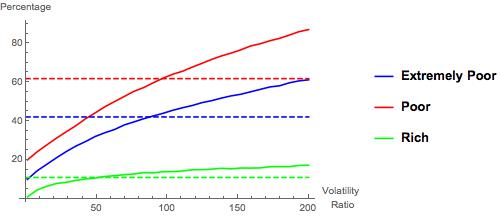
I simulated this model with a range of Volatility Factors ranging from 1 to 200. [1]  I then plotted out percentages analogous to those reported by Rank and Hirschl for each Volatility Factor, as well as the percentage of people who spent at least one year out of the 35 years in the top 1% (i.e., as the richest person out of the 100).  The results are shown in Figure 1, below.[2]  In the figure, the red solid line graphs the simulated percentage of individuals who experienced at least one year of poverty (out of 35 years total), the blue solid line does the same for extreme poverty, and the green solid line does this for visiting the top 1%.  The dotted lines indicate the empirical estimates from Rank and Hirschl—the poverty line is at 61.8%, the extreme poverty line at 42.1% and the “rich” line at 11%.[3]

Figure 1. Simulation Results

Intuition indicates that each of these percentages should be increasing in the Volatility Factor (referred to equivalently as the Volatility Ratio in the figure)—this is because volatility is independent across time and people in this model: more volatility, the less one’s Base Income matters in determining one’s relative standing.

What is interesting about Figure 1 is that the simulated Poor and Extremely Poor occurrence percentages intersect Rank and Hirschl’s estimated percentages at almost exactly the same place—a volatility factor around 90 leads to simulated “visits to poverty and extreme poverty” that mimic those found by Rank and Hirschl.  Also interesting is that this volatility factor leads to slightly higher frequency of visiting the top 1% than Rank and Hirschl found in their study.

Summing that up in a concise but slightly sloppy way: comparing my simple and silly model with real-world data suggests that (relative) income volatility is higher among poorer people than it is among richer people.  … Why does it suggest this, you ask?

Well, in my simple and silly model, and even at a volatility factor as high as 90, the bottom 10% of individuals in terms of Base Income can never enter the top 1%.  At volatility factors greater than 80, however, the top 1% of individuals in Base Income can enter the bottom 20% at some point in their life (though it is really, really rare).  Individuals who are not entering relative poverty at all are disproportionately those with higher Base Incomes (and conversely for those who are not entering the top 1% at all).  Thus, to get the “churn” high enough to pull those individuals “down” into relative poverty, one has to drive the overall volatility of incomes to a level at which “too many” of the individuals with lower Base Incomes are appearing in the rich at some point in their life.  Thus, a simplistic take from the simulations is that (relative) volatility of incomes is around 85-90 for average and poor households, and a little lower for the really rich households. (I will simply note at this point that the federal tax structure differentially privileges income streams typically drawn from pre-existing wealth. See here for a quick read on this.)

Stepping back, I think the most interesting aspect of the silly model/simulation exercise—indeed, the reason I wrote this code—is that it demonstrates the difficulty of inferring anything about income inequality or truly interesting issues from the (very good) data that Rank and Hirschl are using.  The reason for this is that the data is simply an outcome.  I discuss below some of the even more interesting aspects of their analysis, which goes beyond the click-bait “you’ll probably be poor sometime in your life” catchline, but it is worth pointing out that this level of their analysis is arguably interesting only because it has to do with incomes, and that might be what makes it so dangerous.  It is unclear (and Rank and Hirschl are admirably noncommittal when it comes to this) what one should–or can—infer from this level of analysis about the nature of the economy, opportunity, inequalities, or so forth.  Simply put, it would seem lots of models would be consistent with these estimates—I came up with a very silly and highly abstract one in about 20 minutes.

Is Randomness Fair? While the model I explored above is not a very compelling one from a verisimilitude perspective, it is a useful benchmark for considering what Rank and Hirschl’s findings say about income inequality in the US.  Setting aside the question of whether (or, rather, for what purposes) “relative poverty” is a useful benchmark, the fact that many people will at some point be relatively poor during their lifetime at first seems disturbing.  But, for someone interested in fairness, it shouldn’t necessarily be.  This is because relative poverty is ineradicable: at any point in time, exactly 20% of people will be “poor” under Rank and Hirschl’s benchmark.[4]  In other words, somebody has to be the poorest person, two people have to compose the set of the poorest two people, and so forth.

Given that somebody has to be relatively poor at any given point in time, it immediately follows that it might be fair for everybody to have to be relatively poor at some point in their life: in simple terms, maybe everybody ought to share the burden of doing poorly for a year. Note that, in my silly model, the distribution of incomes is not completely fair.  Even though shocks to incomes—the Income Fluctuations—are independently and randomly (i.e., fairly) distributed across individuals, the baseline incomes establish a preexisting hierarchy that may or may not be fair.[5] For simplicity, I will simply refer to my model as being “random and pretty fair.”

Of course, under a strong and neutral sense of fairness, this sharing would be truly random and unrelated to (at least immutable, value neutral) characteristics of individuals, such as gender and race.  Note that, in my “random and pretty fair” model, the heterogeneity of Base Incomes implies that the sharing would be truly random or fair only in the limit as the Volatility Factor diverges to \infty.

Rank and Hirschl’s analysis probes whether the “sharing” observed in the real world is actually fair in this strong sense and, unsurprisingly, finds that it is not independent:

Those who are younger, nonwhite, female, not married, with 12 years or less of education, and who have a work disability, are significantly more likely to
encounter a year of poverty or extreme poverty. 
(pp.7-8)

This, in my mind, is the more telling takeaway from Rank and Hirschl’s piece—many of the standard determinants of absolute poverty remain significant predictors of relative poverty.  The reason I think this is the more telling takeaway follows on the analysis of my silly model: a high frequency of experiencing relative poverty is not inconsistent with a “pretty fair” model of incomes, but the frequency of experiencing poverty being predicted by factors such as gender and race does raise at least the question of fairness.

With that, and for my best friend, co-conspirator, and partner in crime, I leave you with this.


______________

[1]Note that, when the Volatility Factor is less than or equal to 1, individuals’ ranks are fixed across time: the top earner is always the same, as are the bottom 20%, the bottom 10%, and so forth.  It’s a very boring world.

[2]Also, as always when I do this sort of thing, I am very happy to share the Mathematica code for the simulations if you want to play with them—simply email me. Maybe we can write a real paper together.

[3] The top 1% percentage is taken from this PLoS ONE article by Rank and Hirschl.

[4] I leave aside the knife-edge case of multiple households having the exact same income.

[5] Whether such preexisting distinctions are fair or not is a much deeper issue than I wish to address in this post.  That said, my simple argument here would imply that such distinctions, because they persist, are at least “dynamically unfair.”

How Two People’s Rights Can Do Both People Wrong: Vaccines & (Anti-)Social Choice Theory

Vaccination, both in terms of its social good and the role of government in securing that social good while respecting individual liberty, has been a hot topic lately.  In fact, it’s gone viral. (HAHAHAHA.  Sorry.)  In this short post, I link the debate about vaccination, liberty, and social welfare, with the work of Amartya Sen, a preeminent social choice theorist who won the 1998 Nobel Memorial Prize in Economic Sciences.

The Vaccination Paradox. Suppose that—due to there only being one dose of the measles vaccine available—two families, A and B, each with a single child, a and b, are confronted with choosing which child (if any) to vaccinate against measles.  The choices are “a: vaccinate child a,” “b: vaccinate child b,” “n: vaccinate neither child.”

Family would prefer that child b get vaccinated because child a has a compromised immune system, but would prefer that child a get vaccinated rather than neither child gets vaccinated.  In other words, Family A‘s preference over the three outcomes is:

b > a > n.

Due to personal beliefs, Family B is opposed to vaccination for anyone, but due to child a‘s situation, prefers that child b get vaccinated rather than child a.  Thus, Family B’s preference over the three outcomes is:

n > b > a.

Now, suppose that a government agency is tasked with choosing whether to vaccinate a child and, if so, which one.  Furthermore, suppose that the government agency is required to respect the families’ wishes with respect to their own children.  That is, if either family prefers having nobody vaccinated to having their own child vaccinated, then their child is not vaccinated (i.e., the government agency is required to grant an “opt-out” exemption to each family).

What would the result be?  The opt-out exemption requirement implies that Family A is decisive with respect to a versus n, so that n will not occur: child a will be vaccinated if child b is not.  Similarly, Family B is decisive with respect to b versus n, so that b will not occur: child b will not be vaccinated. Accordingly, because the government agency can not choose n, and it can not choose b, it must choose a.  Because the government agency is required to respect individual rights to opt-out, child a will receive the vaccine.

Okay.  But, wait… the government agency has (implicitly) ranked the three possible vaccination choices as

a >> n >> b,

so that in spite of both families agreeing that they prefer that child b be vaccinated rather than child a:

b > a,

The government agency—because it is respecting individual rights—must vaccinate child a instead of child b.

This is an example of the Liberal Paradox (or Sen’s Paradox), which states that no policymaking system can simultaneously

  1. be committed to individual rights and
  2. guarantee Pareto efficiency.

This paradox is at the heart of a surprising number of political/social conundrums. One basic reason it emerges is that individual rights are in a sense absolute and not conditioned on the preferences of others.  That is, if Families A and B could somehow write a binding contract and Family B knew/believed Family A‘s preferences, then Family B would agree to sign away their right to decline the vaccination for child b.

I’ll leave this here, but my limited take-away point is this: individual rights are important, but even in situation in which their definition seems straightforward, there’s no free lunch here: individual rights invariably come into conflict with social welfare.  That’s not saying that individual rights should be sacrificed, of course.  But it is saying that preserving individual rights does not always maximize social welfare.

Default In Our Stars: Kant-ankerous Varoufakis

The Greek Tragedy is a “thing.” And lately it has reemerged.  The question at the heart of this post is how one should bargain when between a rock and hard place.[0]  This point was raised and discussed very well by Henry Farrell in this piece, which was responding to this op-ed in the NY Times by Yanis Varoufakis, the finance minister of Greece and, in earlier times at least, a game theorist. Varoufakis claims in his op-ed to essentially disown game theory in pursuit of bigger, and of course more noble, goals.

I am not actually interested in what Varoufakis’s true goals are here.  Instead, I am going to attack the face validity of the claim that he is not “busily devising bluffs, stratagems and outside options” — because I am going to argue that he was (at least arguably[1]) strategically using that very op-ed as a strategem to make it seem less likely that he is bluffing because the op-ed alters his outside options.

Varoufakis claims in his op-ed that “[t]he trouble with game theory, as I used to tell my students, is that it takes for granted the players’ motives.”

wait…give me a second…
…oh my goodness…
…I just vomited a little in my mouth.

Look, sure… the first 6 weeks of introductory game theory does this, just like physics first starts out neglecting air resistance.  But, really, does game theory “take for granted” the players’ motives?

Answer: OH HELL NO, GAME THEORY DOES NOT TAKE PLAYERS’ MOTIVES FOR GRANTED.

The Ironic Emergence of Concerns About Reputation.  The classic case of game theory not taking for granted players’ motives is something known as “the chain store paradox,” which poses the question of when and whether someone would be willing to incur losses to themselves so as to establish a reputation for toughness.  In the interest of being succinct, that is exactly what Varoufakis is (putatively) attempting to establish in the op-ed.  The fact that game theory is entirely and completely consonant with such behavior was established no later than 1982, when both David Kreps & Robert Wilson and Paul Milgrom and John Roberts independently established that game theory can and does predict that individuals will have an incentive to fake having “tough” or “principled” beliefs so that otherwise “irrational decisions” make sense to or be believed by an opponent.  As the articles by Kreps, Milgrom, Roberts, & Wilson[2] show, it is often the case that a “pure bottom line” player will have an incentive — in repeated negotiations/interactions — to act as if the player has a purpose other than “the bottom line”, regardless of whether this other thing (in Varoufakis’s case, it’s something called “doing the right thing”) is something that is deemed “irrational.”  The reason for this, in intuitive terms, is reputation.  In a sense, Kreps, et al. saved game theory 33 years before Varoufakis attempted to throw it under the bus by showing that, against some naive expectations, it is consistent with common sense.  The Bully on the playground need not actually like hitting people, he might just be someone who really likes not being hit and accordingly “pays it forward” by beating a few people up so as to make others think that he or she likes fighting, thereby making others in the future less likely to challenge him or her.

Thomas Schelling is a genius, and properly credited by Farrell for offering erudite understanding of the dynamic that Farrell discusses.  However, Farrell focuses exclusively on “appearing irrational” in his discussion.  Moving beyond simple “Varoufakis versus the EU” narratives, Schelling, and others (including Bob Putnam and Andy Kydd), have commented on the importance of hiring mediators that are themselves biased/irrational.  The basic idea is the same as that behind why you hire a hit man that you don’t know and can’t be recalled—hiring a crazy “agent” is a commitment device that makes your negotiating partner change his or her valuation of holding out against your demands.[3]

Following this logic, presumably Varoufakis was installed as finance minister precisely because he is a very good game theorist.  And, to boot, he was installed by a government that itself is worried not only about interactions with the EU, but also with the citizens of Greece in upcoming elections.  The question, then, is whom do you hire to go bargain your way out of the absolute poop-storm of debt and austerity that surrounds you?

On one hand, you could install a technocrat that wants to make markets easy and handle things in a mechanistic and (economically/technically) efficient way.  But, to be short about it, economic/technical efficiency is irrelevant to most voters.  Such a technocrat would have a hard time sealing the technocratic deal struck with lenders by selling it to the voters in the form of the ruling coalition.  Accordingly, such a technocrat would have little leverage at the bargaining table with the lenders in the first place.[4]

On the other hand, you could hire a true believing, firebrand populist who will quickly and unabashedly pursue a “forgive, haircut, or default” strategy with the EU.  That person would cause other problems: short term populist gains, but long term fiscal problems that would probably undermine the ruling coalition.  And (unless that person is strategic, see below) the firebrand will also exert little bargaining power because his goals are too extreme and he or she would prefer to walk away.

Finally, you could install someone who is widely believed to be an excellent bargainer.  You know, like an internationally recognized game theorist.  Then suppose that this individual announces that he or she does not believe in being strategic, that he or she is just committed to getting the “right” outcome for the country.  (From the op-ed: Varoufakis promises to “reveal the red lines beyond which logic and duty prevent us from going,” alleges that the “circumstances” dictate that he “must do what is right not as a strategy but simply because it is … right,” and even invokes Immanuel Kant!) Finally, suppose that the voters to some degree “believe” the game theorist insofar as they become more willing to support a somewhat technocratic deal, falling somewhere short of absolute forgiveness.

The arguments of Kreps, et al. imply that a smart game theorist should say the things that Varoufakis said in his op-ed.  If voters respond as supposed above (i.e., believe the statements even a little bit), this increases the credibility with which he can negotiate with the lenders.  Note that the voters’ beliefs that the game theorist actually has stopped believing in being strategic should be stronger if the game theorist takes a very public stand (say, you know, in an op-ed in a globally read newspaper) to that effect,[4] and especially if, as I have pointed out, he aims his arrow at what at least once was his bread and butter.[5]

Conclusion: Varoufakis Doth Protest Too Much.  I actually applaud Varoufakis for the strategy I see him playing (not that he should care, of course).  Nonetheless, I think that he went farther than he needed to go by parroting a frequently tossed-about and grossly inaccurate criticism of game theory.  Of course this is ironic.  I can only hope that at some point in the future, Varoufakis might fess up to the gambit.  Regardless of whether he does or doesn’t “believe in” game theory, I am under no impression that he does not believe in being strategic.  Especially not after reading his op-ed.

_______

[0] This post is about game theory, and good game theorists would advise one to think about how not to wind up being between a rock and a hard place in the first, ahem, place.

[1] I am getting tired of the academic tradition of admitting that perhaps I might not be right.  Of course, I might not be right.  But, that said, this is one of those “every 18 months or so” arguments where I can say “well, if I’m not right, then I am right, because that’s the crazy kind of bull-hooey that emerges in strategic situations.”  And, yes, “bull-hooey” is jarring technical jargon, which is why I put it in a footnote.

[2] These four giants of game theory are, because of their multiple contributions to this incredibly seminal 1982 issue of the Journal of Economic Theory, sometimes referred to as the Gang of Four, a reference that will hopefully still please at least a few people in the set of “game theory and awesome rock fans.”  But seriously, each of these four have contributed huge ideas separately and in combination to game theory for 3+ decades, and for Varoufakis to pretend otherwise is absolutely offensive.  I only say that because he has coauthored a textbook on game theory.  He should know better (for example, see Secction 3.3.4 of the linked textbook).  I also say this because I have the privilege of writing a blog that is at best occasionally clicked on by (some of) my family members.  But, again, I LEARNED THIS STUFF AS AN UNDERGRADUATE.

[3] A great piece about how this works between chambers of Congress was written by Sean Gailmard and Tom Hammond.

[4] This is arguably an example of what some social scientists call “audience costs.”

[5] This is akin to the notion of “burning one’s boats,” in which one eliminates or reduces the attractiveness of backing down at some future point so as to make one’s demands more credible in the present.

If Keyser Söze Ruled America, Would We Know?

In this post on Mischiefs of Faction, Seth Masket discusses the recent debate about whether (super-)rich are overly influential in American politics.  I’ve already said a bit about the recent Gilens and Page piece that provides evidence that rich interests might have more pull than those of the average American.  In a nutshell, I don’t believe that the (nonetheless impressive) evidence presented by Gilens and Page demonstrates that the rich are actually driving, as opposed to responding to, politics.[1]

Seth’s post echoes my skepticism in some respects.  First, the rich and “super rich” donors are less polarized than are “small” donors.  Second, and perhaps even more importantly, admittedly casual inspection of REALLY large donors suggests that they are backing losing causes.  As Seth writes,

…the very wealthy aren’t necessarily getting what they’re paying for. Note that Sheldon Adelson appears in the above graph. He’s pretty conservative, according to these figures, and he memorably spent about $20 million in 2012 to buy Newt Gingrich the Republican presidential nomination, which kind of didn’t happen […] he definitely didn’t get what he paid for. (Okay, yeah, he sent a signal that he’s a rich guy who will spend money on politics, but people knew that already.)

While most donations aren’t quite at this level, they nonetheless follow a similar path, with a lot of them not really buying anything at all. To some extent, the money gives them access to politicians, which isn’t nothing.“[2]

The Adelson point raises another problem we need to confront when looking for the influence of money in American politics.  Since the 1970s, most federal campaign contribution data has been public.  Furthermore, even the ways in which one can spend money that are less transparent (e.g., independent expenditures) can be credibly revealed to the public if the donor(s) want to do so.

Thus, a rich donor with strong, public opinions could achieve influence on candidates—even or especially those he or she does not contribute to—by donating a bunch of money to long-shot, extreme/fringe candidates.  This is a costly signal of how much the donor cares about the issue(s) he or she is raising, and might lead to other candidates “etch-a-sketching” their positions closer to the goals of the donor.  Indeed, these candidates need not expect to ever receive a dime from the donor in question: they might just want to “turn off the spigot” and move on with the other dimensions of the campaign.

Furthermore, such candidates might actually prefer to not receive donations/explicit support from these donors.  After all, a candidate might not want to be either associated with the donor from a personal or policy stance (do you think anyone is courting Donald Sterling for endorsements right now?) or, even more ironically, the candidate might worry about being seen as “in the donor’s pocket.” Finally, there are a lot of rich donors, and they don’t espouse identical views on every topic.  As Seth notes,

“politicians are wary of boldly adopting a wealthy donor’s views, and … they hear from a lot of wealthy donors across the political spectrum, who probably have conflicting ideas”

Overall, tracing political influence through known-to-be-observable actions such as donations, press releases, and endorsements is perilous.  A truly influential individual sometimes wants to minimize the public’s awareness of his or her influence, particularly when that influence is being exercised through others.  It is useful to always remember Kevin Spacey’s line from The Usual Suspects:

The greatest trick the Devil ever pulled was convincing the world he didn’t exist.”[3][4]

From an empirical standpoint, I think the current debate about influence in American politics is interesting: for example, it is motivating people to think about both what data can be collected and innovative ways to manipulate and visualize it.  But I caution against the temptation to jump from it to wholesale normative judgments about the state of American politics.  Specifically, there’s another Kevin Spacey line in The Usual Suspects that is useful to remember as politicos and pundits debate who truly “controls” American politics:

To a cop, the explanation is never that complicated. It’s always simple. There’s no mystery to the street, no arch criminal behind it all. If you got a dead body and you think his brother did it, you’re gonna find out you’re right.


_____________

[1] This is what is known as an “endogeneity problem.”  While some people roll their eyes at such claims, I provided a theory (and could provide more than couple of additional ones) that support the claim that such a problem might exist.  Hence, I humbly assert that the burden of proving that this is not a problem rests on those who claim that the evidence is indeed “causal” in nature.

[2] As a side note, I’ve also argued that donors should be expected to have more access to politicians than non-donors, and that this need not represent a failing of our (or any) democratic system.

[3] Verifying my memory of this quote, I found out that it is a restatement of a line by Baudelaire: “La plus belle des ruses du diable est de vous persuader qu’il n’existe pas.I have no idea what this has to do with anything, but I feel marginally more erudite after copy-and-pasting French into my post.

[4] I will simply note in passing the link between this and the entirety of the first two seasons of the US version of House of Cards.


Shining A Little More Light On Transparency

Thinking more about transparency (which I just wrote about), it occurred to me that I neglected two pieces (of many) that are relevant for the point about transparency of decision-making in bodies like the Federal Open Market Committee (FOMC) in which expertise plays an important role in justifying the body’s authority.

David Stasavage and Ellen Meade made use of a great (and entirely on point) data set in their analysis of the effect of transparency on FOMC decision-making in their Economic Journal article, “Publicity of Debate and the Incentive to Dissent: Evidence from the US Federal Reserve.” They find strong evidence that, once members knew their statements were being recorded, both the content of their opinions and their individual votes on monetary decisions changed.  

The general implications of this point from a theoretical perspective are nicely laid out in Stasavage’s Journal of Politics article, “Polarization and Publicity: Rethinking the Benefits of Deliberative Democracy.” Transparency can affect individual incentives, particularly among career-motivated decision-makers.  If one presumes that the decision-makers in a deliberative are motivated to “look good” by making good decisions, and one is mostly or wholly concerned with the quality of their performance then, in a specific sense, transparency of individual decision-makers’ opinions and votes can “only hurt” actual performance, because the decision-makers are not worried not only about the performance of their collective decisions (e.g., the actual inflation rate), but also by how their individual opinions/inputs are viewed.

Why Have Transparency At All, Then?

There are two broad categories of theoretical arguments in favor of transparency.  The first of these is screening and the second is record-keeping.

Screening. Recall that the problems with transparency sketched out above and in my previous post follow from the presumption that some or all of the decision-makers are interested in being rewarded and/or retained by voters/Congress/the president or whomever else might employ them in the future.  This “career-concerns model” of course implies that somebody else is going to be considering whether to retain, hire, or promote these decision-makers again in the future.  I’ll leave the details to the side for now and simply note that, if the “next job” for which they will be considered is sufficiently important relative to the current job, the ability to possibly infer something about the relative expertise or abilities of the decision-makers might be sufficiently valuable to warrant introducing some “noise” into the current decision-making.[1]

Record-Keeping. Nobody lives forever.  Many decision-making bodies that have authority because it is believed that expert decision-making can and should be used to set policy exist for many years, with decision-makers rotating in and out.  In such situations, because one is leveraging expertise as a justification, one might think that past experience can inform future decisions.  Steve Callander has recently published several excellent articles (here, here, and here) that offer a good starting point (unexplored as far as I know) for us to consider the types situations in which transparency can be helpful by allowing future decision-makers to not only observe past performance, but also learn how policy decisions actually affect outcomes by observing the details of the decisions that produced those outcomes.

Note that this argument, as opposed to the screening argument above, leaves room for one to think meaningfully about the proper “lag” or delay of transparency.  As the evolution of FOMC policy illustrates, many transparency policies involve a delay between decision and publication.[2] Interesting aspects of the policy process, such as how much information is conveyed by more recent versus older decisions, would presumably play a role in the final derivation of how much transparency is optimal.

Conclusions. If there’s any grand conclusion from this post, it’s that I think there’s a lot of important topics left in the study of transparency, and as social science theorists we should start thinking about getting closer to the “policy technology side” of the decision(s) being made.  Abstract static models provide a lot of very key and portable insights.  But they can take us only so far.

_________

[1] Of course, if transparency in the current decision process leads every decision-maker to “pool” and do the same thing, regardless of their type, then one can’t infer anything about the decision-makers from their decision, thereby obviating this argument for transparency.  This will be the case when the decision-makers are sufficiently motivated to “get hired in the next job” relative to their innate preference to “make the right decision” in the current matter at hand.  In the FOMC, this would be an FOMC member who cares a lot more about becoming (say) Fed Chairman someday than he or she does about getting monetary policy “right” today.

[2] This type of argument, combined with career concerns, would also allow us to think in more detail about to whom the decisions ought to be made transparent and from whom this information should be withheld.


How Transparency Could Harm You, Me, and the FOMC

Sarah Binder, as usual, provides excellent insights into a difficult political problem in this post discussing the potential political and economic pitfalls of imposing greater transparency on the Federal Open Market Committee (FOMC), which essentially directs the Federal Reserve’s active participation in the economy, thereby having the most direct control over short-term interest rates and, accordingly, day-to-day “monetary policy” in the United States.

The FOMC is a really big deal.  As Binder notes, the importance of the committee accordingly makes both economic and political observers keen to understand and forecast what it will do in the future.  By deciding over the past decade or so to publish more and more detailed data about the views of the FOMC members,[1] the Fed has increased the transparency of the information it receives.

This seems like a good idea, right?

Well, social science theories in both economics and political science acknowledge the importance of whether the FOMC’s behavior is predictable or not.  On the economics side, predictability of monetary policy (at least in terms of its outputs such inflation) is generally perceived to be a good thing, because it allows investors to focus more attention on the “fundamentals” of an asset’s value, as opposed to paying a lot of attention to purely nominal phenomena and/or inefficiently delaying/accelerating investment and consumption decisions.  In other words, while a low, fixed inflation rate is good, variation in the inflation rate is inevitable, and if this variation can be reasonably accurately forecast, this is a “second-best” outcome.

On the political science side of things, a traditional argument for transparency (in addition to the one above) is that it fosters legitimacy and/or public confidence in the Fed, and thereby makes the Fed a more credible “political actor.”  A more technical description of this is that transparency alleviates an adverse selection problem between the Fed and the public.  The Fed knows something that the public/Congress/Presidents want to know, and—in some situations—everyone would be better off if the Fed could somehow just reveal this information to the public/Congress/Presidents.

Solving this kind of problem is very tricky in practice, because a real solution requires that the Fed not be responsible for releasing the information.  And there’s some interesting things in the FOMC structure (it’s composed of multiple, and members with various overlapping terms) and the evolution of the transparency.

Being the contrarian that I am, I wanted to note two arguments against too much transparency.  I don’t think these are strong enough to justify total opacity, of course, but I do believe they’re strong enough to serve as cautionary tales regarding total transparency.

Each of these arguments revolves around an additional potential instantiation of adverse selection.  The first regards the motives of the individual members of the FOMC.  When decision-makers are career-oriented (they want to be reappointed/promoted/rewarded for their ability/performance, etc.), too much transparency about the decision-maker’s actual decision (i.e., votes and personal positions on monetary policy in the FOMC meetings) can induce conformism (or “pooling”) by the agents such that their policy decisions become suboptimally unresponsive.  For example, everybody might start acting as an inflation hawk would so as to increase the perception of their hawkishness (a worry indirectly indicated in Yellen’s comments as discussed by Binder).[2]

The second argument involves the incentives of those that make individual decisions that the Fed observes.  In particular, the Fed (and every regulatory agency) collects lots of data about the behaviors of firms and individuals.  In some cases, if (say) major firms (as the Fed is responsible for regulating) have access to the information that the Fed will ultimately use to make policy, the incentives of these firms to make decisions that are individually suboptimal in order to try and manipulate the Fed’s subsequent decision-making will be exacerbated.  That is, transparency of the Fed’s information can increase the incentives of major banks (and, arguably, even other regulators) to choose their own actions in ways that try to obscure their own private information.  When this happens, you have a double-whammy: (1) the individual firms’ decisions are not optimal and (2) the Fed does not glean as much information about the real state of the economy from the decisions of these firms.

Sean Gailmard and I make this point (coincidentally with an empirical application to Financial Industry Regulatory Authority (FINRA)) in our recent working paper, “Giving Advice vs. Making Decisions: Transparency, Information, and Delegation.”

Conclusion. I definitely don’t know what the “right” policy for the Fed is without further thought.  But the supposition that “increased transparency is unambiguously good” is at odds with at least two theoretical arguments. Accordingly, it might not be nefarious motives that lead policymakers to call for discussion of “how much transparency is too much?”

____________________

[1] See this description of the recent evolution of Fed transparency and, for a little historical context, see this report describing the 2007 change.

[2] Note that this argument implies that observing the actions of the decision-maker(s) can be bad, but it does not necessarily imply that observing what happens from those decisions (e.g., the actual inflation rate) can be bad. (Good citations on this point are Prat (2005) (ungated working paper here) and Levy (2007) (ungated working paper here), and my colleague Justin Fox has produced multiple excellent theoretical studies centering on this question (here, here (with Ken Shotts), and here (with Richard Van Weelden)).