
I’ll Show You…By Not Showing Up

All is not well in Thaliand, where the opposition Democrat Party is calling for its supporters (some of whom have been actively protesting for months now) to boycott today’s parliamentary elections.

Boycotting elections is not uncommon: indeed, opposition parties have recently boycotted elections in Bangladesh and the main Islamist opposition party is calling for a boycott of upcoming elections in Algeria. The point of this post is, from a strategic standpoint, why would a party call for its supporters to not only not vote for it, but to not vote at all? [1]

I will discuss two theories that can justify election boycotts.  The first concerns the opposition party’s strength, and the second concerns the ramifications of an election result being overturned.  In general, the two are distinguished by whether the boycotting party expects to “win” the election or not.

In both cases, to make the stories succinct, suppose that some proposed “reform” is the main political issue and, without any loss of generality, let’s suppose that the ruling party is proposing the reform and the boycotting party opposes it. (This labeling doesn’t matter, but keeps the language simple.)  I’ll start with “opposition party strength” explanation.

I’m So Popular…Nobody Showed Up.  For the first explanation, suppose that the opposition party expects that it will lose the election—it suspects its supporters are outnumbered by the other party, and suppose that the ruling party will press ahead with the reform if it believes that (say) 60% of the citizens support the reform.

If the opposition party does not boycott, and the ruling party wins with (say) 62% of the vote, then the ruling party will proceed with the reform.  The opposition party loses both electorally and in policy terms.

If the opposition party does boycott, then, while the ruling party will still win, the election result is less informative about the true latent support for the reform.  In particular, as opposed to the baseline case—where abstention by a voter is more than likely due to indifference about (say) the reform—each “non-vote” might represent opposition to the reform.  Thus, boycotting the election can lead to the ruling party being less certain about the underlying support for the reform and either modifying, or demurring from, the reform. [2]

Notice that this justification is based on signaling, and the logic is clearest when there is essentially no hope for the opposition party to win the election.  If the opposition party might win (i.e., it has nearly the same number of supporters as the ruling party), then it must trade-off the potential increased probability of stymieing the reform (in the case of a loss) against the reduced probability of both winning office and stymieing reform.  The second justification is more applicable when the opposition party suspects that the election won’t matter in any event.

It Didn’t Have to Play Out This Way. Sadly, election results are not sacrosanct.  Suppose that the opposition party suspects that, if it wins the election, the ruling party might disregard the election result and impose the reform anyway.  Such an undemocratic move might lead to various ancillary “bad” things unrest and/or a coup.  To keep it simple just suppose that the opposition party prefers the reform to be implemented after being “ratified” (even in a boycotted election) rather than implemented against a contrary election result.  In this case, because voting is costly, voting for the ruling party is otherwise distasteful, or for the purpose of recording an implicit score of (non-)support for the reform, the opposition might benefit from boycotting precisely when it suspects it might “win” the election. [3]

Elections Aren’t Just About Winning. Each of the arguments sketched out above rely on a key characteristic of elections: they aren’t the end of the game.  Rather, an election results is always to some degree a signal about the electorate’s preferences about the issues being confronted at that time.  Of course, the arguments also highlight how the proper interpretation of the “signal sent” by an election result need not be straightforward: as is usual, the fact that something might serve as a signal can infect the incentives of those sending it (in this case the opposition party) in counterinitutive ways (for example, see this point here).

More generally, the arguments provide two alternate routes to understand the legitimating power of participation.  That is, many people understandably say that free, open, and active elections are a foundation of a healthy and legitimate government.  This argument is often (to me, at least) based on the idea that people don’t want to participate in something that they don’t feel connected to and/or “served well by.”  This isn’t a silly argument—it does have a self-enforcing quality that is reminiscent of equilibrium.  But even if one is happy to accept that logic as “just so,” the next step is to examine incentives that logic provides to political actors in pursuit of policy and office.

With that, I leave you with this.

_______________

[1] Especially in multiparty systems (especially with nontrivial electoral “thresholds” for representation and/or public financing), there are clear reasons for a party to call for it supporters to vote for a different party.  This phenomenon, known colloquially as strategic voting, is about coordination, and I will note it and set it to the side: strategic voting does not justify abstention unless there is some type of quorum/participation requirement.

[2] I’ll keep moving, but a moment’s thought suggests that, in some circumstances, this argument also suggests an incentive for the boycotting party to call for a boycott but send some of its supporters to the polls anyway.  The details are a bit complicated, and such an incentive (or, “comparative static of the ruling party’s beliefs as a function of the actual turnout”) might not work out in equilibrium, because the ruling party’s inferences get complicated and depend upon what it knows/believes about the opposition party’s gambit in this regard.  Nonetheless, it is a neat possibility.  TO ME.

[3] One could embellish this argument quite easily (to account for smaller parties also subscribing to its logic) by having the opposition party increasingly dislike the reform being implemented over larger proportions of votes “against” the reform.
Plumbing Presidential Power: Pens, Phones, & Paperwork

President Obama’s SOTU speech has revived interest in Presidential power.  Erik Voeten (here) and Andrew Rudalevige (here) argue that Presidential unilateral action has declined in recent years, while Eric Posner argues here that “executive power has increased dramatically since World War II.”

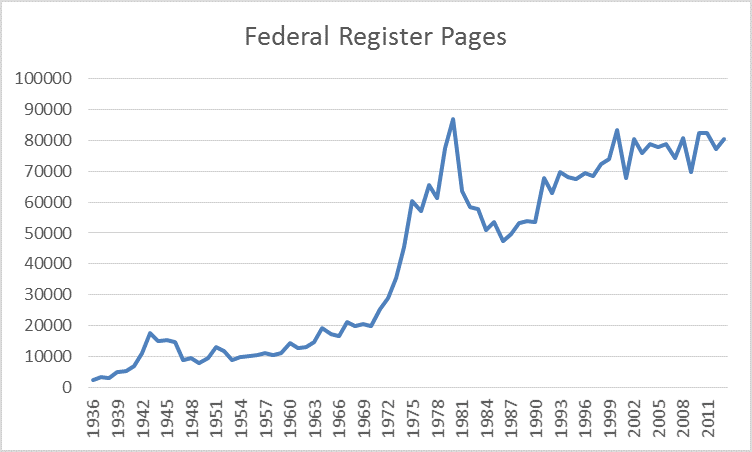
The question of presidential power is a classic one in political science.  The recent debates illustrate three important problems one confronts when trying to measure it, one conceptual, one practical, and one theoretical.  Before considering each of these in turn, it is useful to summarize Posner’s already-succinct point.  In a nutshell, Posner’s argument is that “more pages of regulation produced per year” implies greater executive branch power.

I consider three issues with this in turn.

The Executive Branch Is a “They,” Not a “He.” The Federal Register is essentially the daily record of executive branch actions, somewhat analogous to the Congressional Record.  In it, the various agencies and bureaus within the executive branch publish all sorts of things.  The highest profile (but by no means the only) category of these are what are known formally as rules, or colloquially as “regulations.”

The problem with equating regulations with presidential action is that they are almost never initiated or even approved by the president.  That is, the theoretical gold standard for a rule’s legal standing (i.e., why citizens and firms ought to follow them) is that they are exercising/instantiating statutory authority delegated by Congress to the agency or agencies in question.  The sometimes byzantine fashion in which a policy becomes a regulation is beyond the scope of this post, but it is not uncommon for the process to span multiple administrations.  That is, the action or policy embodied in a rule may very well have been initiated while “the other party” controlled the White House.[1]

Thus, as I will come back to below, regulatory action is (at least arguably) the executive branch doing the work that Congress has requested in terms of “filling in the details” of statutes passed by Congress.

Additionally, at least in de jure terms, the power to promulgate (publish) a regulation is generally held by someone other than the president.  That is, the president does not “sign” regulations.  Rather most statutes with regulatory impact direct a specific official to issue regulations in furtherance of the statute’s goals.  Indeed, one of the most important developments of presidential power since World War II, known colloquially as preclearance, consists of a largely unilaterally-asserted power by the President’s appointed official, the director of the Office of Information and Regulatory Affairs (OIRA).[2] What is somewhat notable about preclearance in this context is that, when this executive power is “exercised,” it usually keeps pages from being added to the Federal Register. But in any case, the existence of preclearance is an acknowledgment of the practical difficulties any president faces when trying to manage the incredible breadth of agencies with at least de jure regulatory autonomy.

Another way of putting this is that executive power and presidential power are related, but not equivalent.

All Pages Aren’t The Same. Of course, some regulations are important and others are unimportant.  But, more to the point, the Federal Register contains more than just rules.  For example, today (1/30/2014)’s Federal Register contains [3]

  • 4 Rules,
  • 6 Proposed Rules,
  • 131 Notices.

Thus, the (vast) majority of the pages of today’s Federal Register are not policy. Rather, they are things like “Notice of Request for Extension of Approval of an Information Collection; Accreditation of Nongovernment Facilities.”  That is, they are notifications of government agencies actions, many of which are trivial.  More importantly, it is distinctly unclear that these filings—many of which are required (somewhat ironically) by statutes such as the Paperwork Reduction Acts of 1980 & 1995—represent nimble and potent executive power.

Is that a Congress Behind the Curtain? I’m definitely not one to argue that executive power has not grown steadily since World War II (in fact, you can read how Sean Gailmard and I narrate and explain part of this rise in our book, Learning While Governing).  But Congress still matters.  And, as I mentioned above, the canonical story of administrative legitimacy (which Maggie Penn and I discuss in our forthcoming book, Social Choice and Legitimacy) begins with the agency issuing the regulation with authority granted by Congress.

As many political scientists have noted in various ways and forms, procedure can be (and, in my experience, often is) politics.  That is, Congress and the president often fight most bitterly over procedure (see executive privilege, fast track authority, filibusters, notice and comment, impoundment, etc.)  A lot of the Federal Register is filled with paperwork that was required of the executive branch by Congress and, furthermore, by Congress under both Democratic (e.g., 1969-1972; 1976-1980) and Republican (e.g., 1995-96) majorities.

As a closing note, if you look at Posner’s graph for a second:

Credit: Eric Posner

I’ll note three features:

1. The really big jump occurs between 1970 and 1975.  The cause of this jump (during Nixon’s Administration):

I’ll just note that Nixon did not get “exactly what he wanted” from the Democratic controlled Congresses in those statutes.

2. President Carter presided over an acceleration, and President Reagan immediately succeeded him with a dramatic pulling back, of the production of Federal Register pages.  I would definitively characterize the first term of the Reagan Administration as more “powerful/effective” than that of Carter’s.[4]

3. The (smaller but still big) jump is around 1990 and corresponds to the regulatory actions required to implement the Clean Air Act Amendments and Americans with Disabilities Act, each passed by Democratic Congresses with a Republican president.

Conclusion…? I guess the basic point of this post is that no single time series is going to capture presidential power.  There are a lot of specific reasons for this, but a major theoretical point is that, if there was, then Congress could leverage that number to “rein in” the president (we see this with the budget/debt ceiling every month or so these days).  Thus, a power-seeking president would attempt to find substitute ways to exert/exercise (truly) unilateral power.

With that, I leave you with this.

____________

[1] A famous (and unusual in other respects) example of this was the ergonomics standard, a history of which is presented here. Note that the linked history was written in 2002, right after the standard was repealed under the Congressional Review Act of 1996 (to my knowledge, the only regulation so far to have been overruled by Congress under the CRA)—things have evolved since then.

[2] OIRA was established by Congress in 1980 and is located within the Office of Management and Budget.  The Administrator of OIRA is subject to confirmation by the Senate.  OIRA’s main statutory mandate is reviewing agency’s requirements for information collection. However, the real “juice” of OIRA review is based on its presidentially crafted mandate to review draft regulations under Executive Order 12866, signed by Clinton and tinkered in minor ways by both GW Bush and Obama.  EO 12866 replaced EO 12291, signed by Reagan, which really established the preclearance regime.

[3] The Register is published daily, Monday-Friday.

[4] Before one says, “well, Reagan was pushing a deregulatory agenda,” I’ll note that (1) deregulation can require as much, if not more, notification and revision (i.e., pages) than regulation and (2) “yeah, that’s kinda my point.”

Poor Work Counting the Working Poor

This Op-Ed in Forbes, “Almost Everything You Have Been Told About The Minimum Wage Is False,” by Jeffrey Dorfman, argues that increasing the federal minimum wage (1) would not affect as many people as you might think and (2) would not help the working poor as much as (say) teenagers.

The first half of Dorfman’s Op-Ed is misleading in important and ironic ways.[1]  I will detail three significant logical failures in it, and then provide a more transparent accounting of how many people’s wages would be directly increased by an increase of the federal minimum wage to $10.10/hr.

Three Failures. First, Dorfman either misunderstands or misrepresents the difference between necessary and sufficient conditions when he writes:

First, people should acknowledge that this rather heated policy discussion is over a very small group of people. According to the Bureau of Labor Statistics there are about 3.6 million workers at or below the minimum wage (you can be below legally under certain conditions). 

Dorfman should acknowledge that raising the federal minimum wage would affect not only those who earn a wage less than or equal to the current minimum wage.  The data that Dorfman is discussing excludes anybody who receives $7.26/hr or more.  Thus, Dorfman should acknowledge that the “small” group of 3.6 million people he is considering compose the relevant basis of discussion if we are considering a one cent increase in the federal minimum wage.[2]

Second, Dorfman starts comparing apples and oranges, writing

Within that tiny group, most of these workers are not poor and are not trying to support a family on only their earnings. In fact, according to a recent study, 63 percent of workers who earn less than $9.50 per hour (well over the minimum wage of $7.25) are the second or third earner in their family and 43 percent of these workers live in households that earn over $50,000 per year.

This is apples to oranges because the data in the (linked) study is from 2003-2007, before the Great Recession, but the BLS data is from 2012. Furthermore, Dorfman doesn’t take the time to actually report what the study does say (on page 593):

Of those who will gain, 63.2% are second or third earners living in households with incomes twice the poverty line, and 42.3% live in households with incomes three times the poverty line, well above $50,233, the income of the median household in 2007.

Let’s think about this for a second: ~20% of those who made less than $9.50/hr in 2007 lived in a household with an annual income (it turns out) of somewhere between $41,300 and $61,950.  I mean, seriously, helping this kind of household—you know, hard-working and distinctly middle class—that would be a ridiculous outcome.

In addition, I’m going to be quick about Dorfman’s faulty (and, I think, disingenuous) logic in his implication that people poorly paid job “… are not trying to support a family on only their earnings” just because others in the household are working, too.

Namely, if you are the second or third earner in a family, that does not imply that you don’t need the money.  In fact, I am going to blatantly assert that it’s probably the case that the number of “voluntarily non-working” 16+ year-olds in an American household is positively correlated with the household’s income.  After all, many people work a job for, you know, the money.  But, of course, some people might take near-minimum-wage jobs just to keep themselves busy.

Next, Dorfman starts making descriptive statements out of the blue:

...Thus, minimum wage earners are not a uniformly poor and struggling group; many are teenagers from middle class families and many more are sharing the burden of providing for their families, not carrying the load all by themselves.

The closest thing Dorfman putatively offers as evidence for the conclusion that these are teenagers (there is no evidence from what kind of families these teenagers come in the BLS data) is the BLS data, which again is constrained only to those earning no more than the minimum wage of $7.25/hr.

Finally, Dorfman says

This group of workers is also shrinking. In 1980, 15 percent of hourly workers earned the minimum wage. Today that share is down to only 4.7 percent. Further, almost two-thirds of today’s minimum wage workers are in the service industry and nearly half work in food service. 

But again, the point is that raising the minimum wage to (say) $10.10/hr, as President Obama has called for, would help more than only those who earn the minimum wage.

I’m not just going to point out Dorfman’s mistakes.  I have done a little digging (it took me about 15 minutes, to be clear, to get real numbers), and I’ll give a better estimate of how big that “very small group of people” really is.[3]

The Occupational Employment Statistics Query System, provided by the U.S. Bureau of Labor Statistics, provides a different picture of how many people would be impacted by a change in the federal minimum wage to $10.10/hr.

The most recent data, from May 2012, is displayed at the end of this post.  The points I’d like to quickly point out are as follows:

  • In Food Preparation and Serving Related Occupations, 50% of 11,546,880 workers receive less than $9.10/hr, and 75% receive less than $11.11/hr.  Thus, somewhere around 62.5% of these workers, or about 5.75 million people would receive a higher wage.
  • In Sales and Related Occupations, 25% of 13,835,090 workers receive less than $9.12/hr, and 50% receive less than $12.08/hr.  So, conservatively, about 3.5 million people would receive a higher wage.
  • In Transportation and Material Moving Occupations, 25% of 8,771,690 workers receive less than $10.06/hr.  Thus, over 2.1 million people would receive a higher wage.
  • In Healthcare Support Occupations, 25% of 3,915,460 workers receive less than $10.03/hr.  That’s nearly a million people who would receive a higher wage.
  • Overall, 10% of all workers (across all industries) receive an hourly wage lower than $8.70/hr, and 25% of all workers receive an hourly wage lower than $10.81/hr.  A rough estimate, then, is that at least one out of every six workers would receive a higher hourly wage if the federal minimum wage were raised to $10.10/hr. To put that in absolute terms:

Over 21,500,000 Americans would receive a higher wage.

…or, about 6 times as many as Dorfman implied.


With that, I leave you with this.

___________________

[1] I will not address the second part of Dorfman’s piece about productivity shifts in the food service industry, and the “ironic” aspect of the mistakes in the piece is the conclusion of the first paragraph, where Dorfman informs the reader that “much of what you hear about the minimum wage is completely untrue.”

[2] I am setting aside the question of how many people who currently earn less than minimum wage would be affected by an increase in the level of the wage.  This is a complicated matter for a variety of reasons.

[3] I, like Dorfman, will leave aside the question of overall impact of a minimum wage hike on employment.  I am not advocating for or against a minimum wage hike—rather, I am advocating against those who argue that very few workers make very low wages.

___________________


BLS Data:


Occupation (SOC code) Employment(1) Hourly mean wage Hourly 10th percentile wage Hourly 25th percentile wage Hourly median wage Hourly 75th percentile wage Hourly 90th percentile wage Annual 10th percentile wage(2) Annual 25th percentile wage(2) Annual median wage(2)
All Occupations(000000) 130287700 22.01 8.70 10.81 16.71 27.02 41.74 18090 22480 34750
Management Occupations(110000) 6390430 52.20 22.12 31.56 45.15 65.20 (5)- 46000 65650 93910
Business and Financial Operations Occupations(130000) 6419370 33.44 16.88 22.28 30.05 40.61 53.50 35110 46340 62500
Computer and Mathematical Occupations(150000) 3578220 38.55 19.39 26.55 36.67 48.40 60.55 40330 55220 76270
Architecture and Engineering Occupations(170000) 2356530 37.98 19.45 26.16 35.35 46.81 59.52 40450 54420 73540
Life, Physical, and Social Science Occupations(190000) 1104100 32.87 15.06 20.35 28.89 41.18 55.38 31320 42330 60100
Community and Social Service Occupations(210000) 1882080 21.27 11.21 14.57 19.42 26.52 34.36 23310 30310 40400
Legal Occupations(230000) 1023020 47.39 16.80 23.15 36.19 62.57 (5)- 34940 48150 75270
Education, Training, and Library Occupations(250000) 8374910 24.62 9.94 14.66 22.13 30.85 41.54 20670 30490 46020
Arts, Design, Entertainment, Sports, and Media Occupations(270000) 1750130 26.20 9.42 13.76 21.12 32.16 46.12 19600 28630 43930
Healthcare Practitioners and Technical Occupations(290000) 7649930 35.35 14.84 20.56 28.94 40.69 61.54 30870 42760 60200
Healthcare Support Occupations(310000) 3915460 13.36 8.62 10.03 12.28 15.64 19.51 17920 20850 25550
Protective Service Occupations(330000) 3207790 20.70 9.09 11.71 17.60 26.89 37.35 18910 24370 36620
Food Preparation and Serving Related Occupations(350000) 11546880 10.28 7.84 8.38 9.10 11.11 14.60 16310 17430 18930
Building and Grounds Cleaning and Maintenance Occupations(370000) 4246260 12.34 8.12 8.95 10.91 14.44 18.93 16890 18630 22690
Personal Care and Service Occupations(390000) 3810750 11.80 7.96 8.66 10.02 13.10 18.21 16560 18010 20840
Sales and Related Occupations(410000) 13835090 18.26 8.25 9.12 12.08 20.88 35.60 17170 18970 25120
Office and Administrative Support Occupations(430000) 21355350 16.54 9.17 11.51 15.15 20.18 26.13 19070 23940 31510
Farming, Fishing, and Forestry Occupations(450000) 427670 11.65 8.23 8.65 9.31 12.97 18.64 17130 18000 19370
Construction and Extraction Occupations(470000) 4978290 21.61 11.15 14.37 19.29 27.19 35.61 23190 29900 40120
Installation, Maintenance, and Repair Occupations(490000) 5069590 21.09 10.92 14.56 19.72 26.63 33.69 22720 30290 41020
Production Occupations(510000) 8594170 16.59 9.02 11.05 14.87 20.26 27.11 18760 22990 30920
Transportation and Material Moving Occupations(530000) 8771690 16.15 8.56 10.06 13.92 19.41 26.83 17800 20930 28960
Footnotes:
(1) Estimates for detailed occupations do not sum to the totals because the totals include occupations not shown separately. Estimates do not include self-employed workers.
(2) Annual wages have been calculated by multiplying the hourly mean wage by 2,080 hours; where an hourly mean wage is not published, the annual wage has been directly calculated from the reported survey data.
(5) This wage is equal to or greater than $90.00 per hour or $187,199 per year.
SOC code: Standard Occupational Classification code — see http://www.bls.gov/soc/home.htm

Data extracted on January 30, 2014


What Didn’t He Say? …And How Didn’t He Say it?

Tonight, President Obama will deliver the State of the Union speech, or SOTU.  The SOTU is an odd creature.  It is an annual opportunity for the President to directly address Congress on whatever he wishes—a time to “show his hand” for the upcoming year.  From a “math of politics” perspective, there are at least three interesting aspects of the SOTU: (1) time is limited, (2) it’s not just what you talk about, but how you talk about it, and (3) everybody knows that everybody else is listening, too.[1]

1. What’s (not) in Your Hand? First, the fact that time is limited and the SOTU occurs only once a year provides the President a chance to credibly signal priorities.  Given time constraints, including a topic in the SOTU is a signal of its importance in the obvious fashion.  But what is more interesting is the case of topics that one might expect the President to include but are instead left unmentioned.  Especially if the topic is relatively polarized, omitting it from the speech might be an implicit concession to moderate Democrats and/or Republicans in Congress.  If I had to pick a topic that is in the news and yet might not be mentioned, it would be immigration.  I’m not going to bet the house on this, but I wouldn’t be surprised if there isn’t much attention paid to it precisely because some in the GOP are indicating that they might be organizing for a push in favor of immigration reform.[2]  A topic I predict will be included: the debt-ceiling. (See my previous post about Mitch McConnell’s stance on this to understand why.)

Given the realities of bargaining before an audience (as I have discussed beforemultiple… times) the fact that a topic was not brought up in the SOTU can signal to Congress a flexibility on the part of the President about what he might be willing to accept with respect to that topic—because he has not (re)staked out a public position on the issue.  Indeed, this is independent of how the President spins a position on the topic.  That is, ironically, if the President explicitly signals flexibility on a topic in the SOTU, then this might make it harder for him to actually compromise, because the details of the compromise might be interpreted and/or spun as the President/Dems “folding” and/or the GOP might be accused of “not getting as much as they could.”  We’re arguably seeing a version of this play out right now with the debt ceiling.

2. What Kind of Glove?  Now, taking the topics brought up in the SOTU as given, how does the President propose to address each topic—does he “seek” Congressional leadership on the matter, or does he announce a unilateral initiative?  This is particularly interesting in tonight’s speech, given the recent suggestions by the White House that President Obama is “ready to take unilateral action to close the gap between rich and poor Americans” and the pre-speech announcement of an Executive Order that will raise the minimum wage for Federal contract workers.

The press release linked above is particularly interesting in this regard, as the following quote illustrates (emphasis added):

The President is using his executive authority to lead by example, and will continue to work with Congress to finish the job for all Americans by passing the Harkin-Miller bill.

Given this “pre-game messaging strategy,” Obama might be seen as more conciliatory and “bipartisan” if he requests Congressional leadership and/or initiative on other topics.  Furthermore, such an approach on a different topic would set up a justification for subsequent unilateral action by Obama if (when?) Congress fails to act on the matter in question.  The message sent by the White House’s comments in general and the minimum wage Executive Order in particular can be interpreted as President Obama saying, “hey, I’ll give it a go on my own if I have to.”  Of course, there’s necessarily a lot of bluster in such statements by any President, but it’s not completely cheap talk.

3. Why Don’t We Shake Hands On It? Third, the SOTU is the basis of what game theorists call “common knowledge.”[3]  In other words, while the President can say whatever he wants, whenever he wants, and get media coverage of it, the SOTU is a time when all of Congress is sitting in front of him when he says it.  That is, he knows that Congress has heard him take the precious time available in the SOTU to say what he said (and not say what he didn’t say) and, even more importantly, he knows that Congress knows that he knows they were there.  Or, put another way, the voters know that Congress heard the SOTU.

This mutual knowledge aspect of the SOTU is important in the following way: if Congress does not act upon a request in the SOTU, it is difficult to believe that the inaction was due to Congress not knowing that the President thought the topic was important.  As alluded to above, this is particularly relevant if the President eventually takes unilateral action on the topic. If he signaled a topic was important through the allocation of SOTU time and Congress doesn’t bring a bill on it to his desk, then it is clearly easier for the President to justify unilateral action to the voters.

In summary, while any speech is necessarily “just” talk, the State of the Union is more than just a speech: it is a constrained amount of time when everybody knows that everybody is watching. This kind of talk ain’t cheap.

With that, I’m going to go get my popcorn and leave you with this.

___________

[1] Of course, it’s not true that everybody is listening.  I mean, this is about SOTU, not SYTYCD.

[2] I’ll leave aside the interesting question of whether such attempts, given the timing, might be strategic attempts to preempt Obama staking out a big position on immigration.  That would require another post entirely.

[3] Technically speaking, common knowledge is a much deeper phenomenon than what I am talking about here.  However, this is merely a blog post. I am using this footnote to try to make it common knowledge that I am aware I am being loose with the notion of common knowledge.  Know what I mean?


Going Down in Flames…To Rise Like A Phoenix (in the Primary)

So, the Federal Government is once again approaching the debt ceiling.  Senate Minority Leader Mitch McConnell has said that he thinks that

“…for the president to ask for a clean debt ceiling, when we have a debt the size of our economy is irresponsible. So, we ought to discuss adding something to his request to raise the debt ceiling that does something about the debt or produces at least something positive for our country…”

What McConnell and his colleagues will discuss adding is a bit unclear at this point (though approval of the Keystone pipeline might be part of it), but Democrats are repeating President Obama’s earlier stance that there will be no negotiations based on the debt limit.

This seems like a stand-off in the making…or does it?

Setting aside the popular conception (with which I concur) that Congressional Republicans “lost” the previous fight on the debt ceiling, McConnell followed the above quote with the following statement:

“We’re never gonna default. The Speaker and I made that clear,”

Um, maybe this isn’t a stand-off in the making.  Maybe a “stand up, just to sit down?”  That’s not catchy, but it brings us to my point in this post.

I could argue that McConnell is pursuing a strategy of either looking “crazy” or trying to imply that he is “hemmed in” by his colleagues, as I have argued before regarding Boehner and his factious caucus.   But, I don’t think this is that.  Rather, McConnell’s unusual comments might be best understood as an attempt to send a costly signal to his constituents, as he is facing and already fighting a right-wing primary challenge by Matt Bevin.  I’ll quickly detail this argument.

Let’s suppose that McConnell is facing a primary challenge because some believe his conservative bona fides are lacking.  McConnell can scream as loud as he wants that he is as conservative, but Glenn Beck doesn’t think he’s good enough.

How can McConnell convince voters that he is a true conservative? Well, he can’t just say it—the voters he wants to convince with such a statement will understand that this is cheap talk.  He has to make the statement that he is “one of them” costly—it has to “pin him down” in some way.  This is tough to do with policy, given that he is the minority leader and his party does not control the White House.

So, my argument goes, he can publicly stonewall what is (hopefully) in the end a fait accompli—the debt ceiling increase—and take his lumps along the way.  This type of position will work only if it hurts McConnell in some verifiable way.  My too-clever-by-half argument is that he is setting exactly such a situation up for the voters who care to see that, at the least, he is willing to bleed for them.

His two statements above make it clear that (1) he is simply being difficult, and (2) he is willing to acknowledge that he will lose unless Obama is willing for some reason to compromise.  (Not saying Obama won’t—he might—but McConnell probably doesn’t know that Obama will.)

Arguably, by saying that he is going to try to drive a hard bargain on the debt ceiling while at the same time admitting he’ll ultimately support a clean debt ceiling increase,  McConnell has adopted a position of “I’m so conservative, I’m willing to fight A KNOWINGLY UNWINNABLE FIGHT FOR CONSERVATIVE `PRINCIPLES.'”[1]

To revisit the argument again before concluding, my point here is that McConnell was probably not speaking off-the-cuff: he is no idiot, and I believe he realizes that his position is internally inconsistent.  Most voters won’t care, but those who pay attention might, and the distinction between his statements and simply saying “awww, heck no—we aren’t going to give a clean debt ceiling increase” is that he purposely made clear that not only was he against default—he and Speaker Boehner have “made it clear” that “we’re never gonna default.”  That is, he explicitly pointed out that the GOP is very unlikely to get anything from this—and yet he’s willing to lose trying.

Because that’s just how flamboyantly conservative he is.

With that, I leave you with this.

___________________

[1] I apologize if my distaste for this narrative offends you, dear reader, but I will not accept that even flirting with violating the full faith and credit of the Federal Government is consistent with any reasonable rendition of conservative principles.  Trust, reliability, sanctity of contract—hell, even the facile analogy between running the government and the responsible financial management of a family or small business—-all run squarely against using the debt ceiling as a bargaining chip. Full stop.  That said, as a political scientist, I do not think McConnell is playing dirty—procedural stopgaps are rightly the fitting and necessary last bastion of the minority party.  (See what I did there?  I can link filibusters and debt ceilings, because that’s the way I’m wired: namely, short-circuited.)

So, What Now?

I just came off sabbatical.  It’s nice to be teaching again.  It’s also the cause for a moment of reflection.

This post isn’t about the strategic calculus of real-world politics. Rather, it’s (sort of) about the strategic career calculus of political science.

There are several milestones in the typical academic career. A key question at each is, “what next?”  This question gets harder and harder to answer precisely because, in general, the set of acceptable answers enlarges each time. In my current case, the question boils down to, what do I want to produce?

I just turned 40, which provokes the panoply of trite musings about what one has left, and will leave, behind.[1] Should I write another book?  Should I continue the fun but/and frustrating struggle to publish journal articles?  Should I pursue administrative tasks? Should I get a real hobby?

These are tough questions, and I don’t know what the ultimate answer will “be,” but I think they represent an important reality of being a professor.  In the end, if you’re lucky, you truly become your own boss (within certain bounds).  That’s a good but/and scary thing.

Writing and publishing is, at least to me, a lot like the “typical” picture of drug addiction: the first couple of successes are so awesome. I mean, the first time you’re published, the first time you’re cited, the first time one of your articles gets a second cite, the first time more than one of your articles is cited in the same paper… these moments seriously rock.  (If these things don’t rock your boat, then I predict you wouldn’t pursue publishing in the first place.)[2]

But “the buzz” dulls—not in a “woe is me” way, mind you—and the quest for the next step gradually emerges.

Perhaps coincidentally, I spent the past 36 hours or so pursuing an active “twitter life.”  That is, I thought it would be fun to see how much I could chum the twitters by being really “active.”  After finally remembering to delink my twitter and facebook accounts (sorry it took me so long, FB friends), I have now realized (unsurprisingly) that “the buzz” there is the same.  Tweet favorited? Hells yeah.  Get a reply from someone you know?  That’s right…the conversation IS STARTING.  Get a reply from someone you don’t know?  Yeah, that’s what social networking is all about. Get an RT from someone with a bunch of followers? BOOYAH.  Watch the followers gather, people!

But, in the end, you even more quickly run into the same question: what next?

If you’ve been reading, you’ll realize that this isn’t a diss on twitter.  It’s life.

The scary part of all of this is a simple reality: if you like attention,[3] the game never ends, regardless of its format.[4]  But, before one says “well, seeking attention is unseemly,” I’ll note that the same is true from those who seek prestige/authority/influence as well.  The realities differ in details, but the maxim “what have you (for me) done lately?” still holds in most cases.  Memories fade fast, competitors and distractions emerge even more quickly….you’re only as good as your last outing.

Why say this? Well, its my blog, and it’s what I’m thinking about.  But, more universally, it’s at the heart of the (generally unsolicited) advice I offer to graduate students:

Before anything else, figure out what you care about. Divine what you won’t mind being bullied about. And definitely rule out the things you can’t stand thinking about.  Best case scenario, you’re going to be doing this, essentially alone and sailing into a mixture of indiscriminate indifference and poorly-disguised disdain, for years to come.

I’ve found that it’s worth it.  But the world isn’t black-and-white: there’s always a “what’s next?” right around the corner.  Maybe my point is that, these moments of reflection—seemingly inevitably tinged with a genteel bouillabaisse of self-doubt and fatalism—are what’s next. They are the detritus of self-renewal, the requisite weigh stations of producing.

With that, I leave you with this.

______________

[1] I was told by a close friend that this is a very “male” worry, but whether that is true in general is irrelevant, as that description is vacuously true in this case.

[2] Everything I describe here can be mapped into performing/creating in general. It’s all about taking the risk and seeing, nay feeling, it “pay off.” By pay off, I mean simply “get noticed.”

[3] And, I do.

[4] Okay, I’ll take notice of what I’ll call the J.D. Salinger category, which is the rarest of beast: the creator who arguably gets more attention by doing nothing.

The Noted Is Always Notable

…but the notable is frequently unnoted.

This post, along with the always thought-provoking repartee with my friend Chris Bonneau, inspires me to write a  post about selection effects and their ability to magically turn a mountain into a molehill.  The short version of the story is that a brouhaha was breaking out at the University of Colorado-Boulder regarding Patricia Adler, a Professor of Sociology whose course in “Deviance in US Society” (which looks fascinating) attracted unwelcome attention.  I will dispense with the details of the case, but note that Adler was ultimately not formally punished. As a faculty member myself, I rightly and consciously adopt a default position of “the critics generally know less about how to do it than the faculty member and, accordingly, often have even worse motives when they attempt to intervene.”

But, to be clear, this post is not about Adler’s case, per se. Rather, and I think more fairly, this post is about the argument advanced by  in the post linked at the beginning.  In a nutshell, Schuman—or her copyeditors—argues in the subtitle:

How would you like it if a bunch of online randos could get you fired? That’s life for professors.

Well, I wouldn’t like it. Indeed, you could omit the “online” qualification.  Or, for that matter, substitute “anyone” for “a bunch of online randos.”  But, more to the point—and I feel bad picking on Schuman, because it’s a common mistake in this kind of crisis post mortem and I believe the intentions are (very) good—Schuman’s argument is prone to a classic selection effect.

Specifically, the article presents no evidence that “online randos” (i.e., some sort of viral flame against Adler) had provoked the CU-Boulder administration’s initial actions.  In some searching, it seems that what did provoke it is still unclear.  The remarkable thing about viral anti-intellectual vitriol is it tends to be VERY CLEAR.  (Doubt it?  Just click here.) So, let’s suppose that some soon-forgotten wave of outrage from the “internet review board” did not actually bring upon the Adler brouhaha.

No, the viral storm started after Adler (understandably) went public about the burgeoning brouhaha.  And, to repeat myself, Adler was ultimately inconvenienced, but not otherwise punished. Yes, I am sure that the ensuing viral maelstrom attracted vitriolic detractors.  But, to be honest, if you’re in the middle of a brouhaha and you surf the blogosphere, it’s not really reasonable to expect not to find a deluge of derogatory detritus.

Caveat surfor, as the Roman kids say.

In fact, in spite of the anti-Adler/anti-Sociology/armchair-intellectual/professional-anti-intellectual invective that followed the initial splash of Adler’s tribulations, again…she was ultimately not formally punished.  So, this isn’t about the internet (even potentially) getting a professor fired.  Rather, it’s more likely reflective of the reality that a tenured professor at a nationally prominent university being investigated/harassed by her administration is/was per se notable.  (Let’s hope it stays that way.)

Before concluding, let me provide a simple, three-pronged analogy to this:

  1. Internet criticism of President Bush caused his inept performance during and following Hurricane Katrina,
  2. Internet criticism of President Obama caused his inept performance with respect to Benghazi and/or the Affordable Care Act rollout, and
  3. Internet criticism of Governor Christie caused his inept handling of traffic leading to George Washington Bridge.

Of course, none of those causal stories seems plausible.  As much as I am suspicious of those who spend precious time pestering faculty, I really doubt that the ex post ranting of “online randos” was somehow the ex ante cause/inducement of her troubles and travail.

With that, I leave you with this.


You’re Welcome for the Thankless Thanks

Tonight’s Golden Globes reminded me of a point I haven’t seen made (though I am sure somebody has made it).  Namely, why do actors and actresses thank a whole bunch of other people when they are on TV in front of millions of viewers who hate watching actors and actresses thank a whole bunch of other people?  After all, it is arguable that awards shows are clearly and only about the viewers.  Right?

Well, a quick point is in order.  A “thank you” is like a gift—it is more meaningful when it is costly and demonstrates that the thanker “thought of” the person being thanked. The seconds one gets to speak on live TV are precious and fleeting.  More importantly, an actor or actress sacrifices a lot (e.g., of at least hypothetical accolades) by not giving some meaningful speech and instead thanking one’s agent, producers, etc. This is even more true given the fact that nobody likes listening to such acknowledgments.

The fact that the time is limited and the awardee presumably had to prepare the list of people to thank without knowing for certain that he or she would actually win merely amplifies the cost—and accordingly, the meaningfulness—of the “gift” of the thanks.

But, here’s the kicker: the fact that we, the audience members, hate listening to “a list of thank you’s to otherwise anonymous industry people” bolsters the value and, accordingly, the incentive for actors and actresses to do this.  So, in a nutshell, it’s kind of Alanis-esque: the fact that viewers of award shows hate listening to lists of thank you’s ironically causes /induces actors and actresses to get up on live TV and run through lists of thank you’s.

And, with that, I leave you with this.

Ironic, quick second takes on sequential rationality

I just finished writing this meandering post about sequential rationality. Subsequently, I thought of these better examples that come from different angles.

First, a classic example (mostly) of failures of sequential rationality: food challenges. In most cases, most people who think they can eat that amount of food can eat that amount of food. They just end up, part of the way through the challenge, not wanting to do so.

A so-so story about motivation that, upon reflection, suggests an interesting take on harnessing “nonsense” intrinsic motivations to overcome sequential rationality/commitment problems: Jerry Seinfeld’s “don’t break the chain” tip for writing. (But, how do I motivate myself to bother writing the “X” on the calendar? I’ll just remember, right?  HAHAHA.)  In other words, it’s usually more fun to not work than work (because, hey, somebody‘s got to bang on that drum ALL DAY), but it also sucks to think about breaking a streak.  Well, at least a streak that is endorsed by Jerry Seinfeld.

Oh, I Thought You Said You Wanted To Sell A Bus…

It’s a new year, the ground is covered with more-than-ankle-deep snow, and I told a friend tonight that it seems like, over the past couple of weeks, the notion of a “day of the week” has lost all meaning.

This is how winter break winds to a quiet close.

It is an opportunity to take stock, and think about what we do as faculty and researchers.  In a sense, it is the quintessential time for “well, time to get BACK AT IT.”  After all, the spring semester lurks right around a single left-click on the google calendar, and both students and journals are inexorably rising from a temporary slumber, bringing the holiday respite to a close.

The details of my own thinking are ephemeral even to me (though you never know when hindsight might prod one to think such classifications naive or at least short-sighted).  But the classic math of politics point that keeps coming back to me during this thinking is

Don’t start what you won’t want to finish.

Notice it’s not can’t finish…this is about incentives/motivations/desires, not ability. In the end, time is finite and, ironically, fleeting.  A project you’re not “into” has a very small chance of being finished.  In game theory, this idea is captured by what is referred to as sequential rationality. In a nutshell, a sequence of actions or decisions is sequentially rational if, at every opportunity one has to revisit and revise the sequence, continuing the sequence as originally prescribed is still in the decider’s interest.  In other words, it is a sequence of decisions that the decision-maker never has significant regret about continuing.

As one example, I (re)designed two syllabi this week.  I am teaching Intro to American Government, a course that I have always wanted to try, and graduate game theory, a course that I have taught for years, but never perfectly.  In both courses, there are topics I like more than others.  In both courses, there are topics I really don’t find relevant…at least for the way I think about “the course.”  However, many of these topics are de rigueur.

So, should I cover these topics?  I can stomach the claim that I should cover them well. But, to be blunt, both sequential rationality and experience—the two of which pair quite nicely, if you think about it for a minute—suggest that that fortuitous combination is not likely.  Rather, my real choice is between covering them as well as I will or simply omitting them.  (I’ll set aside the possibility of minimizing them for the purpose of maximizing clarity.)

On the one hand, it is likely (at least in my mind) that the time spent covering these topics in a subpar fashion could be better spent on other topics I feel more strongly about.  So, covering these topics comes at a cost.  On the other hand, not covering the topics, in addition to potentially leaving gaps in the student’s knowledge,[1] sends a signal about my own tastes/abilities/dedication.  Setting aside the “gaps in knowledge” worry, as none these topics couldn’t be covered by students on their own at least as well as I would cover them, given my lack of interest in them, the comparison is even more stark.

Specifically, if one presumes that my interest in/dedication to the topic—i.e., the sequential rationality of me “committing” to a syllabus where I will talk for 3 hours about the topic[2]—is positively associated with quality of the teaching, then an earnest student would, prior to the course beginning, wish that I would allocate my teaching of the various topics roughly in proportion to my interest in them.  But, I have an interest in being seen as “teaching well.”  Or, less admirably, I have a latent but abiding interest in avoiding scrutiny.  If I teach what I think most appropriate according to the logic of sequential rationality, and for some reason a student complains about the course, I would potentially have to explain why my course omitted some de rigueur topics.  My argument could, of course, be that I don’t find those topics as interesting, relevant, and/or important as others.  But, to be both clear and hyperbolic, this would be arguing against the discipline.

Now, luckily for me, it doesn’t really matter right now.  But, this is a classic and subtle point about accountability, discretion, and commitment.  My hypothetical earnest student is arguably also a plausible benchmark for the hypothetical earnest parent and/or university administrator.  But, once the “fire alarm oversight” of a disgruntled student (or, to be fair, many students) is “pulled,” the sequential rationality of even the hypothetical earnest parent and/or university administrator to stand up for “well, the syllabus was ex ante efficient given Professor Patty’s own sequential rationality constraints” is suspect.

In other words: the road to commitment problems is paved with unrealistic intentions.

With that, I leave you with this.

_____________________

[1] To be clear, in some cases, I might be preserving the students’ knowledge by not covering a topic.

[2] Arguably commensurate and definitely countervailing to the dropping of worries about the gaps in students’ knowledge, I am also setting aside the potentially deleterious effects of proffering a syllabus that is ultimately not followed. That’s the more traditional portrait of a failure of sequential rationality: the plan is ultimately “not followed.”  A piece of advice for those who have yet to teach your own course: varying from the syllabus is the surest way to lower your course’s evaluation without significantly risking your own dismissal. Trust me on this. I have plenty of evidence, all of which I regrettably “manufactured.”